
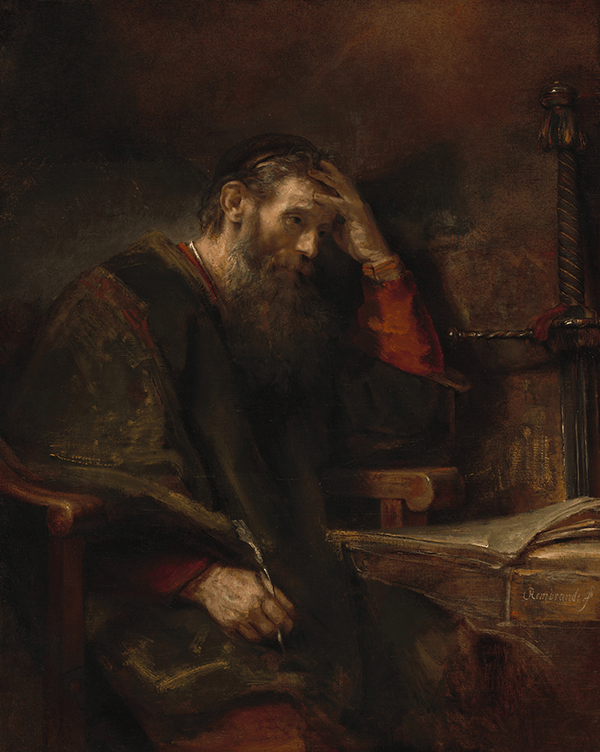
From The Apostle Paul (circa 1657), oil on canvas by Rembrandt van Rijn and workshop in the National Gallery of Art (Wikimedia Commons). As the main protagonist of the unfinished play The Apostle (1911), Paul is the forerunner and epitome of intellectual heretics that George Moore scorned and ridiculed in his evangelism for a more modern Ireland. Understanding the “heresy” of Saint Paul may be vital to understanding the legacy of George Moore, not as anticlerical or iconoclastic, but as compassionate and humanistic. The Apostle by George Moore is now available on GMi.
Medical Leave
Over the past 18 months I’ve complained about impaired vision, not regularly because symptoms came and went like the weather — and like weather, they were variable. Until recently the condition of my eyes was merely annoying but tolerable.
It’s become intolerable.
My eyes have been examined by several ophthalmologists — cornea specialists, retina specialists, neurologists — with not much to show for it other than “see you in six months.”
After each consult I hopefully and patiently returned to the spotlights and magnifying glasses on my desk, and carried on the work.
Recently there was breakthrough. I was almost inadvertently diagnosed with “extremely” dry eyes. My lids and lashes were littered like a volcanic crater with hard debris.
“Symptoms of dry eye include dryness in the eye, irritation, redness, discharge, blurred vision, and easily fatigued eyes. Symptoms range from mild and occasional to severe and continuous.”
This and the rest of the Wikipedia article about dry eye disease fit me to a tee. But what caused it?
“Excess screen time on computers, smartphones, tablets, or other digital devices can cause dry eye. The American Academy of Ophthalmology states ‘humans normally blink about 15 times in one minute. However, studies show that we only blink about 5 to 7 times in a minute while using computers and other digital screen devices. Blinking is the eye’s way of getting the moisture it needs on its surface.’”
Screen time looks to me — even with blurry vision — like a smoking gun, and there’s yet another: refractive surgery (e.g. lens replacement that I underwent about 18 months ago). Injuries during surgery are a common cause of dry eye, and since one of my corneas was injured (twice) I have good reasons to suspect.
Whatever the cause of dry eye, the tipping point was apparently reached in recent months with handwriting on paper rather than text on screens. As I scrutinized hundreds of nearly illegible index cards to extract useful data my eyes felt like they were running a marathon in a desert.
I’m pretty sure that this daily assault seriously aggravated my dry but poorly understood baby blues.
The upshot is a medical leave of absence from GMi.
I will, of course, sneak into my office every day to work a little without straining my eyes. But until my symptoms improve with treatment, I won’t be able to tear through George Moore’s literary legacy — like I’ve torn through my tear layers — with my usual aplomb.
Kick It Up a Notch
One casualty of dry eye is the Collections Stewardship grant I was preparing. I will not continue for obvious reasons: I can’t read the NEH solicitation or my own draft proposal!
I am too stressed to think deeply about the path from curation to simulation. If I don’t simply take my NEH proposal off the table, I will stress even more about the deadline in December and my increasing uncertainty about making it.
Instead of stressing and striving, I’ll save From Curation to Simulation for a future solicitation, perhaps in 2027 if the blond bombshell doesn’t demolish the NEH by then along with the Kennedy Center for the Performing Arts.
A good idea can wait; it has no expiry date.
Meanwhile, I qualified Kickstarter crowdfunding for the GMi Discovery System. What better way to kickstart a literary legacy than a campaign on Kickstarter?
In order to launch a campaign to raise about $10,000, I first need to find seed money of about $5,000 to pay for coding a prototype.
The prototype would not be a one-off. It would embody core technology of the Discovery System and demonstrate functionality for Kickstarter reviewers and prospective donors.
This demo is the cost of entry for crowdfunding software projects. The need and the idea are not enough. Got to walk the talk.
Raising $5,000 may not be easier than raising the total of $15,000. I’ll find out. Coincidentally I recently initiated a reset of Resurgam fundraising, switching the focus from institutional to individual prospects. I’m looking for wells that are neither dry nor crowded.
Am I heading for a harmonic convergence over the Discovery System? Will the worthy project pair with generous individual funders?
Whether or not it does, my research and development will continue as soon as my vision clears, albeit at a slower pace. I can’t continue ocular abuse with impunity.
Yet one of the beauties of GMi is that much of it is self-funded and doesn’t depend on the generosity of strangers who have better things to do with their money.
So, an NEH proposal for Curation to Simulation? Yes, brilliant, bring it on. I’ll get to it ASAP. A Kickstarter campaign for the GMi Discovery System? Indubitably, pack the wagon and hitch the horses. I’ve already got the map and compass.
Still, those prospective activities, and others like them, are not what get me out of bed in the morning. What gets me out of bed are two gorgeous Bengal cats and the to-do list I made the day before.
I feed the kitties and get on with it.
Defensio Intellegentiae Artificiosae
Among other things, I use generative artificial intelligence for historical research, handwriting analysis and transcription, text editing, image search and generation, workflow planning, sourcing and implementing technology, open-ended ideation, and self-assessment.
When clocked out, I also use it for gardening, health care, and shopping.
I’m not a power-user, but I am a paid subscriber and true believer. I agree with those who claim that AI is the greatest thing since sliced bread, and also with those who worry that AI is an existential threat.
This is not evidence of cognitive dissonance! The extremes are not mutually exclusive or self-canceling. Both are true, in my view, and it may be that each belief validates the other.
Lately I read and hear a lot of doubts and complaints about AI chatbots, pretty much summing up to “untrustworthy.” Yet in my experience with ChatGPT and Gemini, the complaints are unjustified.
These chatbots are remarkably conscientious, candid, and deferential — more than most humans (including me).
What they are not is always right. They’re reasoning is excellent but they often come to unsuitable conclusions.
Is that a problem? Only if the human using them is irresponsible.
That’s because every interaction with a chatbot is a conversation. Even when the chatbot answers questions confidently, the answer must be pondered, evaluated, challenged if necessary, compared with alternatives if possible — not blindly accepted.
The same as in conversation with a human.
A human who doesn’t participate and contribute to conversations with a chatbot is not fulfilling a basic responsibility. Why? Because the technology is very good at thinking for itself, but it isn’t made to think for us.
If we let a chatbot think for us, instead of with us, we may soon believe that AI is untrustworthy because it didn’t turn out to be right. Fair conclusion? No, probably not.
In my experience, a chatbot always does its best but attains the lofty goal of correctness only when I argue with it.
I don’t resent that; I admire it.
Age of Heretics
“A detestable family mine is, from a religious point of view, myself the only heretic in it, but such a natural one that I compensate, in a measure, for the spiritual apathy of the rest. — George Moore, preface to The Apostle (1911).
Thus did our admirable heretic wave goodbye (for the second time) to his Irish homeland after a ten-year experiment in personal nation-building.
With a seeming facile touch he tagged himself a heretic, but as usual his meaning was subtle, paradoxical, ironic, and folded like a generative protein.
Not long before that, in 1905, his stance as a heretic was observed but grossly misunderstood by G.K. Chesterton, and would be again by countless critics and pedagogues who made — and still make — a mockery of this sincerely ruminative author.
Chesterton aside. what did George really mean by calling himself a heretic?
I normally don’t dabble in literary criticism, preferring to stand back while readers make up their own minds for better or worse. But since this question has often been badly answered, and since it spans George’s corpus, I’ll at least sift it.
Luther vs. Paul: Two Modes of Heresy
For George Moore there were two kinds of intellectual heretic, and neither was irreligious:
- Lutheran (associated with the historical Martin Luther)
- Pauline (associated with the historical Paul the Apostle)
“Lutheran” heretics are agitators and reformers who appeal to a prior, purer truth (e.g. original scripture, founding revelation). They oppose what they see as temporal deviations. They long to realign a religious institution with its own founding principles and purpose.
“Pauline” heretics have an unshakable and uncritical belief in extant canonical truth. To them an institution like the Catholic Church is not merely an administrative body — it’s a vital manifestation of God in the world and one that engages belief on behalf of God.
From end to end of his fifty-year literary career, George Moore modeled Lutheran and Pauline protagonists in his books: Martin Luther (1879), Evelyn Innes (1898), Sister Theresa (1901), The Untilled Field (1903, the year he converted from Roman Catholicism to Protestantism), The Lake (1905), The Apostle (1911), The Brook Kerith (1916), Héloïse and Abélard (1921), and The Passing of the Essenes (1930).
(Those are examples that come immediately to mind; there may be others.)
George himself was a diehard Lutheran heretic. Neither agnostic nor atheist, he was a true believer who opposed a corruptible if not corrupt Roman Catholic Church, especially in Ireland.
He argued that the Church had replaced the message of Christ with deviant dogma and institutional malfeasance. As a heretic he insisted that we’ve got to get ourselves back to the garden (as the song goes).
According to George, the apotheosis of Lutheran heresy was Jesus himself. In The Apostle, he had Paul murder Jesus for to protect the Church; in The Brook Kerith, both men survive their meeting but their existential struggle continued, and you might say, we live with it even now.
The Apostle is published now on GMi in three formats for different use cases. It’s an incomplete play that turned into a novel in 1916 and back again into a play in 1930. Some may view it as an archaic literary work, but its relevance is probably greater than they think.
In The Age of Heretics (1996), Art Kleiner defined an organizational heretic as someone driven by dual loyalty — a deep commitment to the original spirit or core purpose of an institution, combined with a willingness to challenge the prevailing institutional hierarchy that has betrayed that purpose.
His book is a phenomenal lens through which to examine and interpret business and political organzations in our own time.
The magical thing about The Age of Heretics is that it makes its case by summoning the archetypes of heresy from ancient history to understand and celebrate today’s change agents.
If you read Kleiner’s book, you will not come across George Moore’s name, but you will come across some of George’s lifelong ideas, his methods, the consequences of his principled behavior, and an inarguable sense of how he got heresy right in his own time and ours.
Esther Waters Redux
In September, along with The Apostle, GMi published George Moore’s adaptation of Esther Waters as a play. His novel appeared in 1894; the play was performed in 1911 and published in 1913.
The play highlights aspects of the original narrative and also changes important details, including an ending that somewhat alters its meaning.
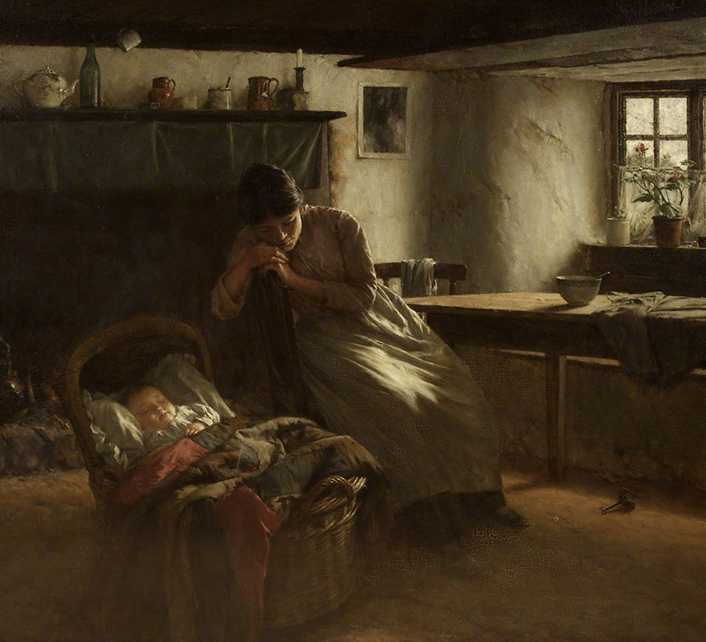
This unsentimental view of a working class mother and her baby was painted soon after the play was published.
It’s so apt a rendering of subject matter that I want to claim that Moore and Langley knew and appreciated each other, but that may not be true. At least they were similarly inspired.
Next Up
I’m not planning to curate letters in October, while my vision gradually improves (hopefully). But the much less arduous task of curating first edition texts will coninue. I plan to work on the play Elizabeth Cooper and the novel Muslin.
I may be facinating to compare A Drama in Muslin (1886) and the rewritten novel under a new title. Between the first and the second versions, the author participated in the Irish Literary Revival.
I may also begin populating the Collections pillar of GMi with institutions and individuals. I suspect my tired eyes will tolerate that since it probably doesn’t require the use of a magnifying glass. We shall see!
Bob Becker (25 September 2026)
Make a joyful noise:

,_c._1657.jpg)
_-_Day_Dreams_-_K357_-_Bristol_City_Museum_%5E_Art_Gallery.jpg?utm_source=chatgpt.com)