
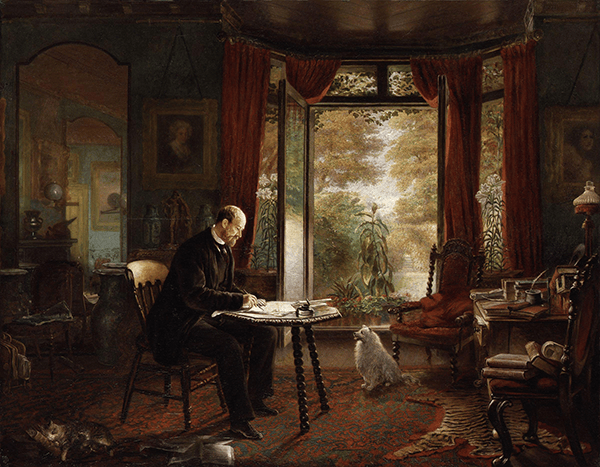
From Charles Reade (circa 1870), oil on canvas by Charles Mercier in the National Portrait Gallery, London (Wikimedia Commons). This picture of an actual man of letters seems to illustrate George Moore’s play Elizabeth Cooper (1913) written more than 40 years later. I have no evidence that George knew the painting existed; if he didn’t, the coincidence is remarkable.
DOB (Coming Soon)
Serendipitously over the past few weeks, I stumbled into a hack that makes GMi even more adaptive to different use cases.
I call it the Document Options Bar (DOB). It’s been ideated, carefully planned and budgeted with the help of Google Gemini; now it’s being implemented by a senior WordPress engineer through Codeable.
DOB is a tiny control panel appended to every Google Doc that is embedded in a GMi web page.
Without DOB, visitors to the website have been able scroll and read black-on-white Docs while viewing the white-on-black WordPress pages they’re on. That was functionally adequate but inflexible.
DOB introduces more user-centered ways to engage with curated source materials. With DOB visitors will be able to:
- Download an embedded Google Doc in their choice of PDF or DOCX format, to use any way they want after they leave GMi.
- Print the Doc in case paper happens to be more convenient than screens for reading, sharing, and study.
- Open the Doc in the cloud where they can adjust their view of it, search the text, and insert comments in the margin for me and the community.
When DOB launches, it will magically appear with every Google Doc already embedded in GMi web pages. It will also appear with every new Doc that is embedded after launch.
Today there are more than 2,000 Docs on the site and the number keeps growing; it will eventually top out at around 10,000.
As I continue to haul the website to that 10K summit, some of the previously published Docs are likely to change from time to time. For example:
- Curated text may need corrections for better fidelity to source material
- Locations of Docs in the website or database may need reorganization
Such changes have been foreseen and will not disrupt navigation! DOB will automatically pace the system updates and serve up a current version of any Google Doc that is requested by a visitor.
And what do thousands of Google Docs on GMi contain? The curated corpus of George Moore in four distinct pillars:
- Aesthetics
- Worlds
- Letters
- Bibliography
Not as stale scans of artifacts, but as freshly transcribed, edited, annotated, illustarated, and digitally published texts.
The texts are “interactive” because they are eminently accessible, readable, editable, formatable, printable, shareable, responsive to scholarly inquiry, and primed for faceted search by the forthcoming GMi Discovery System.
My vision of “kickstarting a literary legacy in the digital age” has always been about revitalizing literature and art of the past for everybody everywhere and always. DOB is a small, high-value building block for getting that done. And it’s coming very soon!
Vision Quest (Continued)
A month after taking medical leave from GMi to address ocular problems, I’m still having trouble reading what I see.
My prescribed self-administered treatment has involved drops, washcloths, compresses, cleansing wipes, and goop that nearly blinds me for 3-4 hours at a time.
Not fun.
According to a recent ophthalmologic exam, my dry eye symptoms are less. My eyes are no longer raw, sore, or irritated, though they are still dealing with blepharitis. Hardly any crust collects in the canthus, along the lids, or among the lashes.
However my vision is quite blurry and relatively dim, and there’s a tendency to slip into convergence insufficiency when I’m staring at text, especially when I’m tired. Retinal irregularities are the suspected cause.
How am I doing overall? As Groucho Marx memorably put it, “I can read but I can’t see it.”
A new Rx and forthcoming retinal exam should help clear things up. Fingers crossed, prognosis is good, I’ll go on.
Fun with Book Covers
During medical leave in October, I didn’t curate letters of George Moore. That activity scores ten on a scale of ocular challenge because of inscrutable handwriting, complex formatting, and the number of moving parts.
Nearly a thousand fully transcribed, edited, fomatted, and annotated letters are already curated on GMi. (That partly explains my vision problems.) About 5,000 are frozen on the workbench in various states of development.
The frozen letters are like recently exhumed archeological fragments still encrusted with soil, lacking formal cohesion. I haven’t been able to tolerate the strain of grappling with them.
That said, in addition to planning and outsourcing DOB in October, I engaged in more comfortable curation in the Worlds pillar of GMi.
I roped three more more dramatic works into the digital archive:
The first two are versions of the same play but different entries in the Bibliography. The third is a revised and finished version of a treatment named The Apostle (1911) that GMi published in September.
One of the most enjoyable aspects of revitalizing George Moore’s legacy is making ebook covers. Each new title gets it’s own page in the Worlds pillar, where it is arranged for human and machine readers. It also gets an ebook in the GMi Shop with a link to Apple Books for the free download. My covers are for the Apple Books store.
Compared with reprints of other classics, George’s covers have been mediocre. I might even call them dull, witless, uninformed: designed by people who evidently didn’t read the books or care what’s in them.
Is that why his reprints so rarely turn up on the shelves of bookstores?
After all, cover art is what makes a book salable to booksellers and buyers who know little else about it. A well-designed cover is a window into a world. A well-designed cover makes a world welcoming, intriguing and trustworthy.
It’s a visual overture.
Last month I chose Rembrandt’s secular portrait of Paul for the cover of The Apostle. Unlike sacred art, Rembrandt’s painting captured the salty and ruminative humanity of his subject just as The Apostle did in words.
I could argue that if you liked what Rembrandt saw in Paul, you’d probably like the Paul in George’s play.
This month, for The Passing of the Essenes, I made a cover with Stephen Gooden’s copperplate engraving of Jesus Meets Paul, from the illustrated edition of George Moore’s novel The Brook Kerith.
“Essenes” replaced “Apostle” as the keyword in the later title, so I wanted a cover that represented a group.
However a monochrome fine line engraving lacks the punch needed for a cover, so I asked Gemini to colorize it.
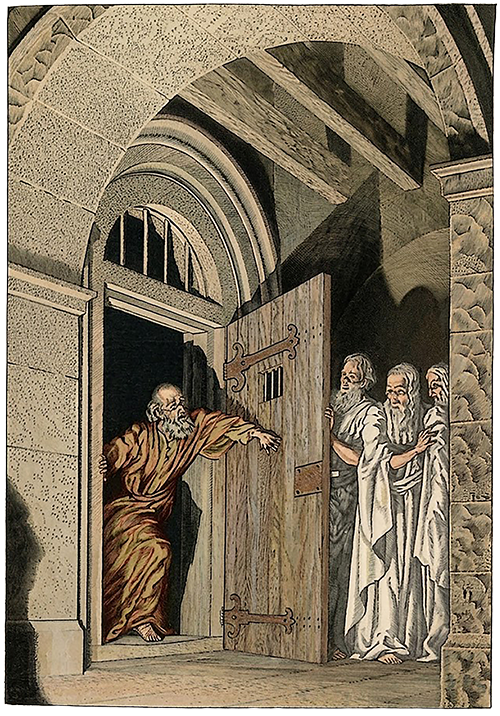
From Jesus Meets Paul (circa 1928), copper-plate line engraving by Stephen Gooden published in George Moore’s novel The Brook Kerith (1929). The original artwork is in the Victoria and Albert Museum.
The picture in color seems purpose built. Without knowing anything about the play, the viewer can sense from the cover that it’s about a frought and momentous meeting of cultural icons.
I chose a portrait of author Charles Reade by Charles Mercier for the cover of Elizabeth Cooper because it really looks like the play’s protagonist Lewis Davenant, seated in his combination study and drawing-room, overlooking the garden, where much of the action is set.
Mercier’s painting is shown at the top of this post.
The alignment of the painting and text is uncanny, even more because the date of the painting is roughly the date of action in the play. I could argue (without evidence) that the fictional Davenant is somewhat based on the historic Charles Reade!
For The Coming of Gabrielle, I chose the painting Trust Me by John Everett Millais for three reasons.
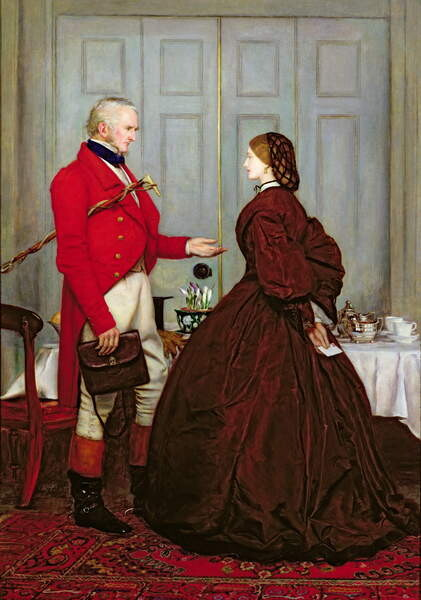
From Trust Me (1862), oil on canvas by John Everett Millais in a private collection (Wikipedia).
First, the character Lewis Davenant was said to own a portrait of himself by Millais. The gentleman in Trust Me looks something like Davenant in the play.
Second, because the enigmatic title of the painting is apt for the play, with the lady in both works holding a controversial letter. She could very well be Gabrielle, the Countess von Hoenstadt, engaged in mind games.
Third, the date of Millais’ painting is roughly the date of action in the play:
“This comedy does not seem to me suited exactly to the present time; it would be better to throw it back a few years into the sixties or eighties — in other words, into the crinoline or bustle period.” — George Moore, The Coming of Gabrielle
My explanation of art chosen for these book covers does not assume that readers must like it. The point of the art is not to be likable, but faithful to the books it covers.
That said, I do like the pictures. They’re not witless.
The Talented Mr. Moore
The second and second-to-last books by George Moore are plays. There are ten published plays in his bibliography (nine have already been curated for GMi):
- Martin Luther (1879)
- The Strike at Arlingford (1893)
- The Bending of the Bough (1900)
- Diarmuid and Grania (1901)
- The Apostle (1911)
- Esther Waters (1913)
- Elizabeth Cooper (1913)
- The Coming of Gabrielle (1920)
- The Making of an Immortal (1927)
- The Passing of the Essenes (1930)
He also wrote theater criticism of consequence and lasting value. Most of it has been curated on GMi.
He cofounded the Independent Theatre of London and the Irish Literary Theatre of Dublin, two experimental and influential incubators.
His second novel A Mummer’s Wife was a deep dive into music hall culture in provincial England. His ninth novel Evelyn Innes pivoted on the musical theater of Richard Wagner.
He was friends with Irish playwrights Oscar Wilde, W. B. Yeats, J. M. Synge, and George Bernard Shaw — and with numerous critics, actors and actor-managers of the theatrical West End and avant garde.
Based on the scope of his activities, I feel sure that George Moore wanted to be a playwright and perhaps saw himself as one. He wanted to catalyze if not foment the evolution of modern dramatic arts, and perhaps he did.
Yet all of his activity doesn’t sum up to a personal dramaturgy. His plays passed critical muster but were not commercially successful. His essays were disruptive and controversial but not generative.
It could be argued that George Moore was the Tom Ripley of modernist theater: an aspirant cloaked in pretense.
Patricia Highsmith’s Ripley came to mind as I curated Elizabeth Cooper and The Coming of Gabrielle. Other than trying his hand at a vocation that wasn’t really his, the point of these plays is a Ripley-like riff on class and identity.
“DAVENANT. You were deceived. But what an enchanting deception! You should thank me, Countess, for having spared you what you wrote for and sent you what you desired.” — Elizabeth Cooper, Act 3
Was Lewis Davenant — a celebrated playright — the masked surrogate of the middle-aged George Moore? The first name Lewis gives that idea traction because George’s self-projection in other books was named Lewis.
Davenant later says:
“My dear Countess, I should not like you to forget the man — not altogether. I cannot reconcile myself to becoming an intellectual abstraction, represented by seventeen volumes.” — The Coming of Gabrielle, Act 3
If that isn’t the real George Moore of Ebury Street, I don’t know what is. He seems to be dropping his mask.
The character Sebastian Dayne may likewise be a surrogate of the youthful George Moore. Edward Dayne narrated the first edition of Confessions of a Young Man, one of several works by George that play with invented identity.
But the real George Moore was not a celebrated playwright. He wrote ten plays: well-constructed and paced, driven by dramatic ideas, but still lacking an essential quality of theater which I choose to call entertaining.
His plays were edifying but not fun to watch, and he knew this. He admitted that his last play, The Passing of the Essenes was “infinitely tedious” on stage. I can’t imagine a more interesting idea than Paul meeting Jesus, but somehow it didn’t fly.
It was not Jesus Christ Superstar.
The plays of Wilde and Shaw soar because they’re fun. The dramas of Highsmiths’ Ripley take off because they’re devilish and suspenseful.
I find myself wishing that George had read his plays to the Marx Brothers and had an S. J. Perelman moment. “It stinks” might have turned him into the fine playwright he pretended to be, instead of the wannabe he truly was.
Next Up
The month of November may include the launch of DOB. The timing of that is out of my hands but it shouldn’t take longer if my Codeable guy doesn’t encounter obstacles.
In addition to launching DOB, next month I will curate that tenth play in the George Moore theater collection, The Making of an Immortal (1927).
I’ll also curate Muslin, the 1915 rewrite of his third novel A Drama in Muslin (1886). I’m curious to see how this bittersweet story about Irish girls changed after its author repatriated to his homeland as a nationalist (of sorts).
I’m not ready to resume work on the letters. However, assuming my vision continues to improve, I may also start building the Collections pillar of GMi. Much of the preparation for that has been done; the grind of data collection is up next. I think I can, I think I can…
—Bob Becker (24 October 2026)
You are cordially invited to join the GMi mailing list (for free):

