
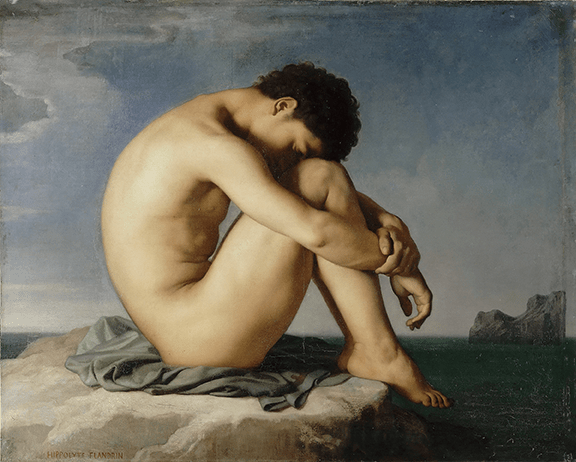
Jeune homme nu assis sur le bord de la mer (1836), by Hippolyte Flandrin in the Louvre (Wikimedia Commons). I have no proof and little doubt that George Moore bore this celebrated painting in mind when he wrote the last chapter of The Lake (1905):
“There is a lake in every man’s heart … And every man must ungird his loins for the crossing.” At the end of the novel, the protagonist Oliver Gogarty interrupts his long swim across the water to rest and also delay his arrival on the far shore until he is less likely to be observed. He sits on an outcropping of a small barren island, overcome with grief over what he has left behind, with fear over what awaits him, and with joy over the prospect — however slim — of freedom. He’s like Adam leaving paradise voluntarily — not because of a woman’s mistake, not on God’s orders, but purely as an act of self-actualization. T
Collections Reboot
When I formed George Moore Interactive nearly three years ago, the planned architecture of seven pillars included one named Collections. My vague idea at the time was to list notable public and private owners of rare manuscript and printed materials.
Odd, you might think, that a digital curator and publisher like me would care about ink and paper, but I did (and still do, as you’ll see in a moment).
It seemed to me, even before GMi got on its feet, that tangible assets like books, newspapers, and letters would never be eclipsed, made obsolete or redundant, by digital scans.
As a reader, scholar, and avid collector, I felt (and still feel) that primary source materials are irreplaceable artifacts of our cultural heritage. Their full meaning can’t be pixelated. They’re the backstop of literary legacies in the digital age.
But this notion was vague. I didn’t know what to do with it, so Collections fell off the main menu of GMi and into a background of TBD. Now Collections is back and ready for showtime.
I have restored Collections to the main menu. You may click it to read what it’s about. Moreover your clicks will open a neat prototype: the first entry of hundreds to follow in due course.
The prototype demonstrates how every collection may eventually appear on GMi. They will first be sorted into two categories: Institutional and Personal. The prototype University of Reading is institutional but its structure is common to both categories:
- Title or Name
- Image (footprint)
- Location (mailing address)
- Relevant Holdings (to studies of George Moore)
- Further Information (tips for inquiries and contacts)
Collections won’t only list owners of George Moore’s written materials. It will also list owners of legacy-adjacent materials: physical things that shed external light on his life and work.
An organizing principle of Collections is “uniqueness.” Obviously GMi won’t list the whereabouts of every copy of every book, but it can list the owners of things that are different from every other thing.
The prototype is an example of a legacy-adjacent institutional collection.
What about a different example, say of a unique printed book by George Moore? The copy of Martin Luther (1879) that he inscribed to Oscar Wilde? There’s only one. I saw it when it came up for auction (I didn’t bid high enough). I have no idea what became of it, but if one day I can identify the owner, he, she, or they will be listed in GMi Collections.
I will begin populating Collections in a few weeks when I launch my census of the owners of MS letters.
Census Taking
“A letter is a bewildering thing; even the most ordinary letters often fill one with doubt.”
Was George Moore time-hopping me a message when he wrote that in Chapter 7 of The Lake?
“Roger that, George, I heard you loud and clear.”
My previously announced census of letters made slow and steady progress in August. After auditing several books for printed excerpts and clues to the whereabouts of MSS, and after writing menus of dated letters that I documented years ago on quaint 3×5 inch index cards, I have mainly censused letters in the “undated” section of my card catalog. There are ~600 of these conundrums on index cards. In August I reviewed the first third.
“Review” in this context means filtered my tiny handwritten notes on the cards for clues to each letter’s date. Clues may be supplied by return addresses, and by the juxtaposition of day of the month with name of the day. More often clues are supplied by brief references to what George was working on at the time, whom he was meeting, what had just happened in his social circle.
To do this work, I replaced the spotlight attached my bookstand to make the cards just a tad more readable, and I continued to train a lighted magnifying glass on the letterforms.
I’m rather like a Georgian archeologist scrutinizing the newfound Rosetta Stone, except the baffling chirography is my own bloody chicken scratch!
My inspection of cards has been slowed by frequent chats with AI. I ask the chatbot about historical events and proper nouns that were mentioned in the letters and potentially suggestive of dates. The chatbot is very fast and skilled at connecting obscure dots for me.
This careful labor with undated letters could be called clerical, but that would not be fair. It feels scientific, analogous to brushing the dirt off an excavated Greek vase and parsing figures on the slip.
Rosetta Stone, Greek vase, index cards: “lions and tigers and bears, oh my!” But contrary to expectations, it’s going pretty well. More and more facts are coming to light. I just need my dwindling reserve of patience and weary eyes to last until I finish.
I’m not sure when I’ll finish the census of undated letters, but it will probably be in mid autumn. As soon at I reach that milestone, I’ll change horses and conduct my census of MS owners.
That will also be my queue for populating Collections.
Becker Multimedia
“The Age of Reading Is Over” is the cover story by twenty-something Rose Horowitch in The Atlantic (August 2026).
She argues that we (all of us) are members of a postliterate (or post-literate) society. Meaning that reading is no longer the sole or even primary way we acquire, experience, use, or share information. The bulwark of reading — the print medium — has been swallowed by multimedia.
It’s worth pointing out that multimedia is not merely multimodal. It probably was in the early 1960s when Marshall McLuhan popularized postliteracy as a cultural meme, but things developed after that.
In a postliterate society like ours, multimedia means more than a mélange of content types: image, text, time-based. It is also the capacity of disembodied, impersonal information to act upon, and react to, systems and their users (we the people).
That’s my definition of multimedia based on my experience.
I recognize in generative artificial intelligence the acme of postliteracy, the highest level of interactive multimedia that seems likely to occur. I’m alive to see this happening! It excites me!
Confession: I left a faculty position in higher education in 1985 for a DIY career in the infant field of educational technology. I did that primarily in response to the siren call of postliteracy.
By the mid 1980s, the decline of the humanities and the collapse of academia were already written on the wall, or so it seemed to me. (College students who don’t read books were common long before Rose was born.)
I may have been wrong about the timing of decadence, but clearly I wasn’t clueless, because since then the writing has leapt off the wall and covered nearly every surface that captures our attention.
I spent my first few years in the business world exploring pathways and byways of digital postliteracy. Then in 1994 I formed Becker Multimedia. It was a startup dedicated to the proposition that people enjoy and learn from experience far more than things they read, watch, or listen to.
My ambition to design experiential learning systems led to the high echelons of simulation and video games: two modes of interactive programming that pushed postliteracy to its limits.
I also dabbled with AI in a lab at the Georgia Institute of Technology. Back then expert systems were a rising star, but not yet adaptable for educational technology. I tried anyway and failed.
That’s all behind me now. Machine learning, large language models, and chatbots allow us to dream the impossible dream. Reading and writing in the traditional ways have become optional for most of us most of the time.
They’re now a choice, no longer a necessity.
I’m explaining this because I feel responsible to explain why somebody (me), who didn’t fear postliteracy but welcomed, applauded, participated in, and profited from it for years before it was cool — why I am developing ways to “kickstart literary legacies in the digital age” (i.e. postliterate society).
Aren’t literary legacies permanently locked in the print medium, specifically ink on paper? Isn’t reading books and articles of yesteryear an immovable cornerstone of the humanities?
Well yes, literary legacies have been locked in vaults and placed on restricted shelves for centuries, and perhaps the reason they need to be freed (along with the humanities and pedagogy) is because, like it or not — according to Marshall, me, Rose, and many others — we live in a postliterate society.
But a caveat, please, before you jump to conclusions. I view “the age of reading is over” like a year is over at the end of December. Let’s not forget that another year begins the next day.
GMi, like Becker Multimedia, is dedicated to the proposition that people are enriched primarily by experience rather than content they read or listen to.
GMi aims to make literary legacies experiential by restoring authorial voices to legacies, so a legacy can act upon, and react to, systems and their users; so a legacy can speak for itself rather than through interpreters.
Will GMi help hasten the end of reading printed materials? Marshall probably wouldn’t have thought so, and neither do I.
Done right, projects like GMi may pull the humanities off the cliff where they’re teetering and return them to where they belong: the mainstream of contemporary culture.
I see something like this happening in crowded art museums. Paintings, drawings, sculptures, and objets d’art stand on pedestals and hang on walls. They edify and change the lives of visitors who “experience” them.
That is what GMi is doing for the writings of George Moore. Visitors to the site of course can read what George wrote, for free, at will; soon they will be able to search his legacy with a powerful Discovery System; and before long they will also be able to have conversations with him about his work, his life, his world, even about themselves.
I reckon that may make more readers out of nonreaders than any lecture or textbook ever has, or ever will, in a postliterate society.
If GMi succeeds, it may not merely preserve George Moore’s writing for a postliterate society. How futile would that be? Instead it may help restore a venerable way of enjoying literature: not by passive consumption of print, but active conversation with authors across time.
That would be a contribution to culture that Marshall himself, I suspect, would find intriguing. And it might make Rose and other millenials hopeful.
Postliteracy always was and still is an opportunity for people, not to avoid reading but to have a deeper rapport with authors they choose to read.
It’s an opportunity to augment books and make them more personally relevant, not an excuse to bypass them.
The Madness of the Woods
“A phantom life seemed to emerge and beckon him, and he asked if the madness of the woods had overtaken him.”
So wrote George Moore about his quixotic protagonist Oliver Gogarty in Chapter 4 of The Lake (1905).
The novel apparently sprang from the same indigenous source of fiction as The Untilled Field two years earlier. Both books served a virtuous aim: to seed modern Irish literature with imagination and passion.
Moreover like ripples of a stone flung into the water, the soulful meditation woven through The Lake was reprised and personalized the following year in “Resurgam,” the capstone of Memoirs of My Dead Life (1906).
But that meditation was actually a longer time coming. It emerged in Evelyn Innes, a duology that described the struggles of a gifted but conflicted diva to reconcile her conscience with her conduct: to live in accordance with her values and beliefs.
In Evelyn Innes (1898) and Sister Teresa (1901), the female protagonist withdrew from adventure and gratification for an austere religious vocation. She became a Catholic nun in the suburbs of London, giving up 95% of who she is and what she has in order to nurture the remaining 5% that matters more than all the world to her.
Evelyn is a mirror image of Oliver in The Lake. He is the male protagonist who exits a strict religious vocation as a Catholic parish priest in the West of Ireland for the prospect of freedom and worldliness overseas.
Odysseus-like, Oliver discards his habit and swims au naturel to the distant shore of an anonymous fresh start.
But unlike Odysseus, his new beginning is not a mythic homecoming and restoration of estate. It’s a rejection of tradition, sacrifice, home, and country for the sake of adventure and gratification.
It’s as though Evelyn and Oliver passed each other on the same road, going in opposite directions.
We can and should view Oliver and Evelyn as two sides of the same literary coin. Moreover they are emblems of their author’s quest for untrammeled self-expression and actualization.
“Everyone must try to cling to his own soul, to cherish what is inly. And that is the only law, the only binding law I can believe in. If we are here for anything, it is surely for that.”
Thus George Moore wrote for Oliver in Chapter 15 of The Lake. There’s an argument to be made that he was also talking about himself.
He went on in Chapter 17:
“There is no moral law except one’s own conscience, and that the moral obligation of every man is to separate the personal conscience from the impersonal conscience. By the impersonal conscience he meant the opinions of others, traditional beliefs, and the rest…”
With The Lake, its predecessors and successors in mind, the epitaph written for George Moore, inscribed on his stone on Castle Island in Lough Carra (where the novel seems to be set), more empathetically resonates:
He forsook his family and friends
For his art
But because he was faithful to his art
His family and friends
Reclaimed his ashes for Ireland.
I would like to add to that epitaph that George Moore strove to reclaim Ireland for art, to free the nation from sectarian and religious shackles, but I am not Irish and I don’t have the right to make such claims.
That said, from a distance of 3,500 miles and only a meagre understanding of Irish history and culture, that’s how it looks to me, and who knows, there may be something to it.
The Lake is now published on GMi in three formats for different use cases. It may rank as the apotheosis of George Moore’s Irish writing — and most Irish writing — in the first decade of the twentieth century.
His overt purpose was to fire and temper an Irish Literary Revival or Renaissance. The meditative novel didn’t accomplish that, but at least it resolved what I’ve elsewhere called his midlife crisis.
And it confirmed him as a master craftsman, songster, and seer.
Elusive Grants
In August I began the arduous process of applying for a federal grant, a process more fraught than ever under the peculiar regime in Washington.
I have read that bureaucrats are pouring sand into the engines of federal funding, but a program officer tells me that things are still humming along. We shall see.
I’m trying for a Level 1 grant in the Collections Stewardship program of the National Endowment for the Humanities. The name of my project is From Curation to Simulation.
The scope of work is to develop techniques and protocols for making GMi conversational: essentially for implementing George Moore’s literary legacy as a high-fidelity simulation in the form of a chatbot.
Hopefully my grant will be written in language clearer than the preceding paragraph, but you probably get the idea.
The grant would enable step one in a process that brings George Moore to virtual life, and shows how other legacies can likewise be animated in the digital, postliterate age.
I’m sad to report that the Delmas Foundation declined to fund the GMi Discovery System. That technology is foundational to simulataion, so it will move into the NEH grant where I can explain it as a solution rather than an application. Makes more obvious sense that way.
Given my recent disappointing but not surprising efforts with the Delmas and Silvers foundations, and the prerequiste labor invested in grantseeking through Forefront, my chatbot and I have also decided to pivot.
I am going to bypass institutional funders that mostly fund academic institutions and look instead for wealthy individual donors. My belief, still to be tested, is that approaching such people may be more fun, less laborious, and more fruitful.
As always though, the value of grantwriting is not determined by a win. Each grant forces me to think more carefully, deeply, and critically about what I am building and where I am going.
If an NEH grant fails to materialize, but writing the grant produces a better roadmap, that alone makes it worth the effort. One of these days GMi will reach that far shore of the lake.
Next Up
While my census of George Moore’s letters continues in September, I will devote a portion of each day to grantwriting.
What’s that you say? Sisyphus?
I also plan to add two plays to the Worlds pillar of GMi:
- The Apostle (1911) foreshadowed George’s twelfth novel, The Brook Kerith (1916).
- Esther Waters (1913) looked back at his eighth novel (1894). In that year he attended the premiere of The Land of Heart’s Desire, whose author William Butler Yeats soon became his collaborator in Irish theater.
It’s easy to forget how productive the novelist was as a playwright because his plays weren’t commercially successful. Did they succeed as literature? Stay tuned to find out.
Bob Becker, 24 August 2026
Enter your email to win (my sincere appreciation)

_-_Jeune_homme_nu_assis.._1855_-_Louvre.jpg)