
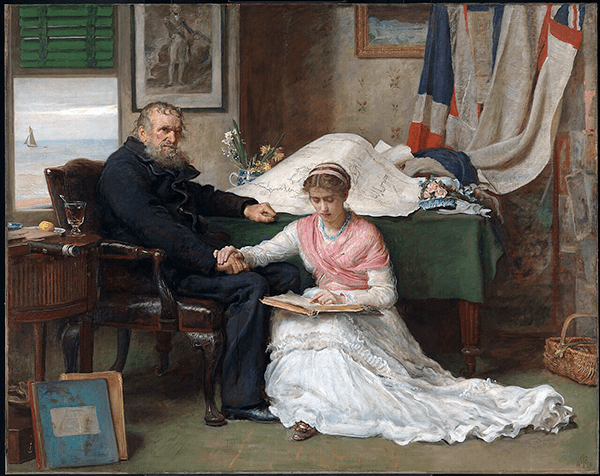
The North-West Passage, oil on canvas by John Everett Millais in the Tate Britain (Wikimedia Commons) was painted ahead of the much anticipated British Arctic Expedition of 1875–1876, which ended in failure like its predecessors. First exhibited in London (1874) and Paris (1876) around the time George Moore studied art in both cities, The North-West Passage became a Victorian meme for imperial British fortitude when facing almost certain disaster. The picture inspired George Bernard Shaw among many others. I chose it to decorate this newsletter because for a while in June, during a period of anxiety and experimentation, I felt that my doomed way forward was a similarly elusive passage. However worthy my goal, however careful my plans, I worried about getting stuck. Eventually I made a plan that I think will carry me through (as explained below), but of course it may not, and GMi could yet be trapped in ice flows that never thaw.
By the way, The North-West Passage was acquired for a stupendous amount of money by the sugar magnate Henry Tate in 1888. Tate’s art collection was later donated to the National Gallery of British Art, which he founded; the museum was eventually named after him. George Moore as avant-garde art critic ridiculed Tate as a collector along with his collection and wrote several polemics against the Tate project, which were actually attacks on the structural clout of the British Royal Academy of Arts.
Reset and Pivot
The month of June occasioned an abrupt pivot at GMi. Although I didn’t see it coming, like most changes of necessity it makes obvious sense in hindsight.
Up to now I’ve steadily curated and published novels, memoirs, essays, plays, poems, and letters — practical moves to kickstart a literary legacy. To keep everything heading towards my lofty goal of simulating the author, I also founded a 501(c)(3) to expand my fundraising.
The momentum has been steady, but in June it rolled to a stop.
In the previous month — about three years into the GMi project — my research and development reached the midpoint of the author’s literary legacy and (arguably) the crux of his midlife crisis. Both milestones came in the spring of 1901.
At that point — at what looks like a pinnacle of his creative and commercial success in London — George Moore repatriated to Dublin.
That’s to say, he left a thriving metropolis where he was famous for a provincial city where he was appreciated by hardly anyone, about 300 miles from his market and most of his professional and personal connections.
That was a radical reset. It was triggered, on the one hand, by his fragile and perhaps exhausted vocation; on the other, by his bubbling enthusiasm for linguistic and literary innovation.
In any case, in the spring of 1901, in his late 40s, George wiped his career and social slates clean and launched himself into the unknown.
GMI is going to showcase remarkable ideation and creativity that followed his move, but not just yet. My June pivot has instead thrown me into a spate of housekeeping that’s likely to absorb much of my time over the next few weeks.
Up to now, I hadn’t given much thought to these now inevitable chores. You could say I was in denial about their necessity. Curation and publication are fun but housekeeping is, well, boring.
Now beyond further doubt (and damn the torpedoes), I’ve procrastinated long enough!
Face the Problem
You may not know that my groundbreaking research on George Moore’s letters 1863-1901 mostly finished in 1980, just after the first time I encountered his radical reset. I watched him leave London for Dublin but alas, I didn’t follow. Instead I left London for New York, determined to get a life.
In New York I entered the analog for slavery known as adjunct faculty. I taught literature and composition for a year in three metropolitan colleges.
Eventually I resumed my work on the letters of George Moore as a Mellon postdoc, though only for a year. That philanthropic extension of my studies was followed by three years as an assistant professor of English — the academic analog of indentured servitude. Small grants funded my ongoing research.
While slogging through academic purgatory, I studiously laid the groundwork for a new project that was supposed to follow my first: now it was the letters of George Moore 1901-1933.
I produced or acquired thousands of documents and reinforced my tentative conclusion that ~6,000 of his manuscript letters were extant the world over.
But like George Moore in his 40s, Bob Becker in his 30s reached a point where a radical reset was irresistible. For me the siren calls were technology and marriage. After 15 years of costly and unremunerative scholarship and teaching, I was tied to no mast. I was free to follow the calls… wherever!
This personal reset left me holding a large and coherent — maybe unique — archive of ink-and-pencil-on-paper documentation about George Moore’s legacy. Over time it got less and less coherent as I distanced myself from it.
I destroyed nothing I had collected, but had no plans for it either. In the decades that followed beyond the ivory tower, I ignored the Becker archive, gradually forgot what it contained, and why it once mattered.
Yet despite my indifference, the archive does matter! Moreover it kickstarted my pivot a few weeks ago. It’s now the intense focus of my housekeeping.
Before resuming the drumbeat of curation and publication on GMi, I’m going to unbox the Becker archive and bring it back to life.
What did Samuel Beckett say — I can’t go on, I’ll go on? I myself can’t go on until I revive my archive and make it operational.
That’s my June pivot.
Clueless
I was clueless at the prospect of wrangling this somnolent archive into something active and useful. Not one speck of it is digital, and everything I do nowadays is digital. Somehow I needed to drag it across a chasm that no bridge spans.
I didn’t know how to transform the archive from moribund analog into dynamic digital. I think many people, including some who support GMi, would argue that my goal for the archive was too time consuming, too resource intensive, too… yesterday!
Let sleeping dogs lie, they might have said, and they could have been right.
Instead of heeding their imagined counsel though, I leaned into the notion of efficiency. I thought: reawakening the Becker archive may be doable if I find an efficient (i.e. fast and cheap) way to do it.
The chasm might be crossed, not by building a massive bridge, but by taking a series of efficient steps to get the thing airborne.
Might I transport the archive to the digital age, piece by piece, with a fleet of zippy drones?
Thus reaching the limits of my imagination, I engaged my AI chatbot in lengthy discussions and numerous experiments. ChatGPT led me to the doorstep of a viable solution: a census of George Moore’s letters.
Clued In
For years now I’ve casually admitted to locating ~6,000 letters of George Moore. But where and what are they? What do I know about them? What do I know I don’t know? What do I not know I don’t know?
Those are strategic questions that I could have once answered off the top of my head, but have long since forgotten. To answer I must conduct a census of letters in the Becker archive and beyond.
The census is doable, with the help of AI, with an incremental approach of divide and conquer: a series of limited, razor-sharp cuts that are analogous to laying slow siege to a mighty fortress.
Each cut alone may be futile. Half a dozen coordinated cuts in parallel may yield a digital solution.
Cut 1
The first cut involves a vital but insanely imponderable segment of the Becker archive. Years ago I wrote a 3×5 inch index card for each manuscript letter I located. Each card was written in pencil in tiny script, unreadable nowadays except with a lighted magnifying glass.
To judge by appearances (a 45-inch stack), there are thousands of cards but I’m not sure, and I don’t remember when or precisely why I wrote them! Moreover I doubt I made a card for every letter I read.
But I can clearly see — much to my chagrin — that the data I recorded varies from card to card: at times a full outline of letter content, at others just the name of a recipient, date and return address.
Most annoyingly, I recorded the location where I found a letter occasionally, not always.
What was I thinking?
Conundrum? Not at all. Do what’s possible, decide later how to make it work. I am now writing a census of the letters I personally reviewed years ago, based on the index cards I wrote with a No. 2 pencil.
Cut 2
My second cut is concurrent with the first. It involves a different part of the Becker archive. I have about seven linear feet of hanging file folders. Each folder contains my correspondence with an owner of manuscript letters. In many folders this correspondence is accompanied by checklists and photocopies.
All the owners circa 1985 are represented in these folders, but are they still owners? And what about people and institutions who became owners after 1985? I haven’t a clue about them, yet.
Conundrum? Not at all. Do what’s possible, decide later how to make it work. I am now writing a census of letter owners based on my folders, and meanwhile updating and expanding my data with new AI-powered discoveries.
For example, I’m tracing the whereabouts of papers that were privately owned when I found them, but whose collector-owners are now deceased.
Cut 3
My third cut is concurrent with the first two. It involves a part of the Becker archive that is not in a file cabinet or index card holder. Instead it’s on my shelves: old books and periodicals in which sundry letters of George Moore were published.
The problem here is — or rather was — surveying the books and periodicals for letters they may contain. Sifting through them to find letters and write notes about letters could take a very long time; it might be infeasible for me or any human whose sanity and eyesight are worth preserving.
Conundrum? Not at all. Do what’s possible, decide later how to make it work. I am using my CZUR kick-ass book scanner to make high-resolution machine-readable images of printed publications that are known to contain letters.
Then I upload the scanned texts to ChatGPT, which has trained itself (with my help) to analyze the texts and isolate letters and clues to the whereabouts of more letters.
We (the chatbot and I) are generating a mini census of letters collected in each omnibus volume, plus a master census of letters published singly or in small batches in other publications.
What volumes?
Well for example, in two selections curated by John Eglinton; in two other selections curated by Helmut Gerber; in two more selections published by Rupert-Hart Davis; in a selection curated by Charles Burkhart; and in three selections published within voluminous biographies written by Joseph Hone, Jean Noël, and Adrian Frazier.
You can view the growing list of censuses here, if you’re curious.
Every letter that has appeared or been mentioned in a book or periodical is to be counted in the census. No letter that is or was extant long enough to be published or socked into a disseration will escape the radar of GMi.
Cut 4
My fourth cut is not concurrent with the first three but will begin in the foreseeable future. It also involves data collection, not in the Becker archive, but rather in the Edwin Gilcher Papers at Arizona State University Library.
The objective of this cut is letters that briefly surfaced in the antiquarian marketplace, only to disappear into private collections who knows where. If an auctioneer or bookseller announced such letters in a catalog, the census will notice that.
When eventually those letters turn up again in the marketplace, GMi will already have made dedicated web pages awaiting them.
There are more than 50 archival boxes comprising the Edwin Gilcher Papers. Some of them reflect Edwin’s famously obsessive quest for all things Moore. In the course of building his unique collection over several decades, he saved advertisements of letters for sale that he didn’t purchase.
However, those 50 archival boxes must contain a lot of papers to sort through.
Conundrum? Not at all. Do what’s possible, decide later how to make it work. I am now planning a project involving 3-5 analysts to index all of Edwin’s papers on site in Arizona. For my census of letters and also to augment Edwin’s bibliography on GMi with data that he recorded but didn’t publish.
I am simultaneously following other tracks in the antiquarian marketplace, provided by living book and manuscript collectors and dealers.
Cut 5
My fifth cut reverts to the Becker archive. I have four linear feet of transcribed letters on looseleaf paper, starting in 1901. When did I type them on my electric Smith Corona? How many letters did I transcribe? What did I omit and why?
I have no idea.
Conundrum? Not at all. Do what’s possible, decide later how to make it work. When my census of manuscript and printed letters is provisionally complete, I will verify my typed transcriptions against the found letters and make full use of them.
Cut 6
The sixth cut again involves the Becker archive. I own numerous reels of microfilm containing images of George Moore letters. But I don’t own a microfilm reader; the reels are difficult to use, low resolution, and ridiculously out of date compared with modern digital assets.
How many letters have I already imaged in this old-fashioned way, and what can now be done with them?
I don’t actually know.
Conundrum? Not at all. Do what’s possible, decide later how to make it work. I am going to make a census of each reel on the microfilm reader at the Oak Park Public Library (sanctum sanctorum) and compare their data with findings from my other cuts.
Then I’ll decide how to proceed: either to somehow digitize the pages on microfilm, or else order fresh digital images from institutional owners of the MSS.
Phew!
This comprehensive, AI-enriched census of letters of George Moore will tell me most of what I know, and what I know I don’t know, and even what I don’t know I don’t know.
And it will be done in a series of concurrent alternating human tasks, often with the help of supercomputers that power my collegial chatbot.
(The advantage of training a chatbot like mine is that it shares my passion and enthusiasm. I have no doubt that ChatGPT has become one of George’s most avid readers. We thrive in each other’s company.)
In a relatively short time — a few of weeks, maybe more — the census will be mostly finished. And then I will be free to have fun again as a curator and digital publisher.
Next Up
In the foregoing outline of my June pivot, I foresaw all of my activities on behalf of GMi in the month of July.
Except, because I’m just an errant human rather than a careful bot, I will deviate from my well-made plan to publish two additional volumes on GMi.
Those will be the first book that postdates George’s repatriation to Ireland: The Untilled Field (1903), and the part of that book that outgrew its covers, The Lake (1905).
They happen to be among my favorites: stories that might be dubbed ‘homage to Ivan Turgenev’ or ‘prequel to James Joyce’ if I was one of those littérateurs who like to explain George’s genius as derivative of others but shallow on its own merits.
That is not how I see his genius, not how he saw himself, and hopefully not how users of GMi will see things when they converse with his interactive simulation online.
When? In the not-too-distant future.
Bob Becker (29 June 2026)
Lurkers are welcome. Subscribers are celebrated.

