
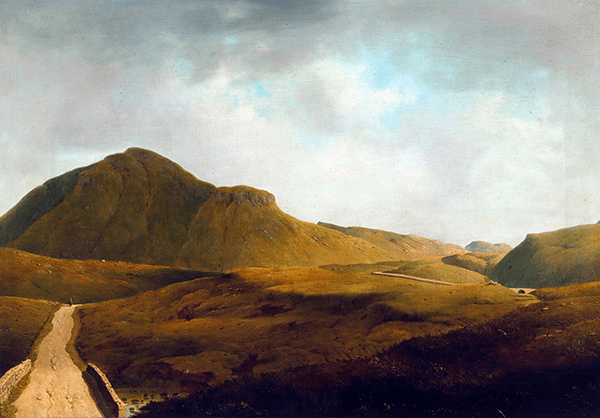
A Mountain Road in Mayo (n.d.), oil on canvas by James Arthur O’Connor, private collection (Artvee). Painted a few years before depopulation in the Great Famine, not far from where George Moore was born and raised when the Famine ended, this picture is to me a wistful and melancholy glimpse of what I choose to call Irish national character, though that may be a chimera fostered by stories in The Untilled Field (1903). A tiny solitary figure in the painting walks a lonely country road to who knows where. A big house? A bothán dóibe? A mass? A presbytery? A market town for Fair Day? A céilí? A cruinniú poiblí? A train for Dublin? A ship for London or New York? All of those possible destinations are present in The Untilled Field, as are conditions from which people strove to escape: strictures, drudgery, poverty, celibacy, alienation, futility. How did such a beautiful country — in the picture and the book — become the background for such sadness, even hopelessness? George blamed the Roman Catholic Church, but it’s complicated.
- Census of Letters
- Bon Noël
- Untilled Fields
- Music of “The Wild Goose”
- Generous Philosophy
- Frontier Scanning
- Up Next
Census of Letters
Last month I started a six-cut census of the letters of George Moore. The census was outlined in Clued In.
My goal is to account for every handwritten, typed and printed letter noted in the historical record, whether or not it exists today. That includes letters inherited by a recipient’s friends or family, sold by a dealer, archived by a librarian, cited by a scholar, or published by an editor.
I should mention that George Moore neither retained copies of letters he wrote nor saved letters he received. No such papers were settled in his estate. Neither did he save books he collected over the years. I haven’t come across any with his bookplate or inscribed to him.
What became of George’s library and papers? I don’t know, but if you do, please post a comment.
Parts of my six-cut census continued throughout July; the rest are waiting; the end is not yet in sight, but I feel pretty good about progress so far.
Cut 1 is my basis for drafting GMi menus of letters 1901-1933: one menu per year, like what I’ve already done for letters up to 1901.
I seriously worry that Cut 1 is damaging my eyes. It has me scrutinizing 3 x 5 inch index cards of tiny handwriting, in lead pencil, that I can barely read even with a lighted magnifying glass (otherwise not at all).
Hour after hour peering through the glass, it feels like I’m incinerating my retinas and jangling my optic nerves. Somehow in spite of this, my census in Cut 1 has reached 1926.
Menus of letters are emerging, not in the Letters pillar of GMi, but in unpublished Google Docs. The Google Cloud is a much better environment for content management than WordPress web pages.
I have meanwhile done nothing with Cut 2 (a census of owners), though I tried to work it concurrently. There’s only so much excavation I can juggle before balls start dropping.
I look forward impatiently, with ailing eyes, to Cut 2 as it will join what I know with what I have. I expect that will create a eureka moment, but alas it is still waiting in the wings.
By contrast my progress in Cut 3 is substantial, thanks to the help of ChatGPT. Most, though not all, of George Moore’s letters that were transcribed or translated or merely cited in books and magazines have been censused.
The data from Cut 3 will become operational after I finish Cut 1 in the next few weeks. They will be merged into my draft menus.
Cuts 5 and 6 will gain traction only after the data from Cut 3 have been integrated with Cut 1. In a way this is ironic because Cuts 5 and 6 account for the full content of imaged and transcribed letters in my files.
But it’s pointless to work with that heavy content before I have mostly finished the menus and I’m ready to resume digitial transcription, annotation, and publication.
Lastly Cut 4 is not a black swan, but it’s the one cut that I can’t do on my own, so it’s parked in a siding. It will require a team of researchers working onsite at a library in Arizona for a few weeks.
Cut 4 will very likely advance both the Letters and Bibliography pillars of GMi, and it’s tantalizing to think about, but it must wait until I have finished crushing my eyeballs.
Who knows if I’ll get all 6,000 letters of George Moore into GMi? Who knows if there actually are 6,000? I don’t, yet; but census is an efficient way to find out.
At the very least it will tell me what I know (and have), what I know I don’t know (or have), and some of what I don’t know I don’t know (and obviously don’t have).
That’s a worthy goal of practically any cutting-edge research and development.
Bon Noël
Today I’ll mention a delightful offshoot of the census: a rare instance of showcasing literary criticism on GMi (other than George’s own).
I recently made what may be the first digital scan of Jean Noël’s George Moore: L’Homme et l’OEuvre (1966) and uploaded all 700 pages of machine-readable French text to ChatGPT.
My purpose was census-building, but while surveying the text for letters and clues to letters, the chatbot also summarized Noël’s ideas and arguments with delightful enthusiasm.
“This is really good stuff,” it said in so many words, and I added the occasional “Wow” and “That reminds me” and “My thoughts exactly.”
Our digital back-and-forth led to a pact to make a guide to Noël’s book for English-language readers. Given the book’s age, length, and lack of English translation, it’s safe to assume that relatively few readers have read it or ever will.
But it has a lot to offer! And now there is a guide to Noël on GMi in the form of a downloadable PDF. Humans can read it, and can upload it to the AI application of their choice for enhanced perspective.
As a quiet admirer of Noël, I wanted to nudge him into the digital limelight so he can show more people why George Moore matters. I don’t need convincing but some people might.
If the guide moves the needle, GMi can easily publish other guides to the critical heritage.
Untilled Fields
And soon after passing this road I noticed that although the land was certainly better than the land about Culloch [Coolock], there seemed to be very few people on it; and what was more significant than the untilled fields were the ruins, for they were not the cold ruins of twenty, or thirty, or forty years ago when the people were evicted and their tillage turned into pasture, but the ruins of cabins that had been lately abandoned. Some of the roof trees were still unbroken, and I said that the inhabitants must have left voluntarily.
That passage from “Julia Cahill’s Curse,” first published in the English Illustrated Magazine (April 1902) provided the title of The Untilled Field (April 1903), the author’s second collection of short stories about his troubled homeland.
“Twenty, or thirty, or forty years ago” was the historical period of reportage in his “Lettres sur I’lrlande” serialized in Le Figaro Supplément littéraire du dimanche in 1886 and published the following year in book form as Terre d’Ireland and Parnell and His Island.
The true-to-life scenes in the Lettres were probably recollections of brief visits home in the late 1870s and early 1880s, when George mostly enjoyed a privileged, bohemian lifestyle in Paris and London while making his way as a painter and writer.
Years later in the early 1900s, no longer a nominal “young man,” no longer a cosmopolitan expatriate observing Ireland from a comfortable distance, the author of The Untilled Field resided a short walk from the Shelbourne Hotel in Dublin where his novel A Drama in Muslin (1886) told a different but resonant story of endemic futility.
Curating The Untilled Field for GMi in July forced two thoughts to the top of my mind. One concerned humility, the other excellence.
Regarding humility, I want to make clear that I’m not Irish, nor of Irish descent. I have not lived much in Ireland, or even visited often. The first time I stayed there, for a few weeks in the mid 1970s, the experience convinced me that Irish people (North and South) were inscrutable .
I don’t feel that way now, but I’m putting it out there because The Untilled Field is a book by an Irishman, about Ireland, and specifically for Irish readers.
Like Turgenev’s Russian Sketches from a Hunter’s Album, published in the year George Moore was born, The Untilled Field is a kind of national treasure; an artistic mirror in which a civilization can view and judge itself, and perhaps resolve to be better.
As such, I am not an intended or even qualified reader of The Untilled Field. Its matter is foreign to me, not in my DNA.
That said, I may be a credible judge of literary excellence; not a pooh-bah of course, but probably a sensible, not clearly biased, reasonably well-informed reader. In my capacity as a non Irish reader rather than scholar of Hibernia, The Untilled Field strikes me as an unalloyed masterpiece.
Its 13 stories, ranging in length from 2,000 to 25,000 words, are a prism through which the light of fin-de-siècle Ireland passes and fragments into tones and shades of shimmering beauty and pathos.
Apart from the book’s subject matter (which seems somehow parochial and universal at the same time), the literary style is nearly flawless in every way I can think of.
There may be one flaw, in my opinion, in this brilliant gemstone, and that is the anger it reflects towards Catholic clergy. Not sectarian violence, but personal resentment of judgmental meddlers in ordinary people’s lives.
Not that the anger was unwarranted, but rather that a constant invocation of a priest’s responsibility and blame becomes expected after a while.
Rather than letting readers judge for themselves, George hammers the point so there isn’t much room for debate. He doesn’t ask “what do you think”; he can’t seem to resist “this is what I think.”
So the author of Martin Luther is not entirely absent from The Untilled Field.
On the other hand, more sympathetic and humanist, “Everyone’s conscience is his own law and you must act accordingly.” If not. there will be trouble.
That major theme of Sister Teresa reemerges in “The Wild Goose,” the longest story in The Untilled Field. To me, it deserves comparison with James Joyce’s “The Dead,” the longest story in Dubliners (though much shorter than “The Wild Goose”). Joyce’s began writing Dubliners soon after publication of The Untilled Field.
“The country was joyless; man’s life is joyless in Ireland,” observed George in “The Wild Goose.” Yet he left his career path and moved back to Ireland to help revive Irish arts, language and culture.
Music of “The Wild Goose”
“The Gael will be remembered,” said Carmady, “if he is remembered, by his little folk tunes. The day before I left Ireland I heard one. The hills were shrouded in mist and I could not find the flute-player; but the tune he played, melancholy enough in itself, sounded in the mist like the death wail of a race. Never did music affect me more profoundly — a little eight-bar tune.”
Carmady whistled the melody and Rodney said:
“Melancholy as bog-water and, like the Gael, melancholy and ineffective.”
The tune that characters in “The Way Back” discuss at the end of The Untilled Field was actually printed in the penultimate story, “The Wild Goose.”
I know nothing about the music, but I doubt that George Moore wrote it. Who did, and what does it sound like?
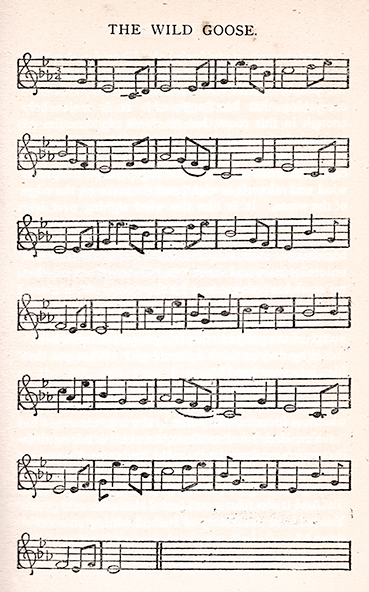
My AI chatbot and I spent a long, intense afternoon trying to figure it out. We were unable to find the same, or a similar song that preceded The Untilled Field. (One may exist, but we can’t vouch for that.)
We spent even more time and energy trying to render the musical notation into MusicXML, so that we can play it digitally and interpret it with different instruments. That was a frustrating experience because it yielded no results.
The problem is that the printed score in the book is full of ambiguity caused by way the ink settled into the paper.
I gave the chatbot an extremely high resolution scan of the notation, but that only made me aware of how faulty the print is as source material.
What is needed, in the age of machine readability, is a human musician, with knowledge of Irish traditional music, who can thoughtfully transcribe the music of “The Wild Goose” into MusicXML code.
Once that happens, we’ll be able to hear what “sounded in the mist like the death wail of a race.”
If you know musicians with the requisite skills and background, please ask them to help or post a comment!
Generous Philosophy
George Moore Interactive is a WordPress website, and for that reason the WordPress brand is important to me.
In an age when oligarchic geeks are following reptilian instincts, I would like to feel that GMi associates with really good people (not just wizards).
And I received that impression when I watched Code for the People, a video from WordPress that tells its origin story and core values.
WordPress is an enterprise that wants to propagate projects like GMi. It enables GMi to do its best “for the people” who care about literary legacies in the digital age.
If ever you wonder, why is Bob Becker doing his thing on GMi for no fame or fortune, you can watch Code for the People and maybe be clued in.
The most important things, including art, are important for their own sake.
Frontier Scanning
This newsletter occasionally beams with admiration of scanning technologies that make GMi hum. I am speaking now of CZUR and Abbyy software. They are pulling the printed legacy of George Moore into the digital age.
But what about the handwritten legacy?
Until now, I thought the chasm between analog handwriting and digital text could be bridged only by humans typing on a keyboard.
That is a mighty big chasm when you realize that thousands of holographic letters by George Moore are waiting to get across.
So imagine how excited I was to discover, through experiments for another project, that my AI chatbot can read and transcribe my chicken scratch!
The project involves digitization of a handwritten diary and 35mm slides from a 1974 bicycle tour. I am using my Plustek OpticFilm 8200i along with my CZUR ET24 Pro to digitize the assets.
I unexpectedly discovered that ChatGPT can read and transcribe the scanned diary!
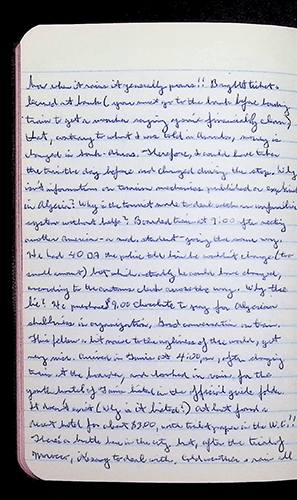
Because I know that ChatGPT can read and transcribe the kind of writing that is ruining my eyesight, I also know that it can read and transcribe the relatively large and clear handwriting of George Moore.
Ergo, George’s handwritten letters have a toll-free bridge for crossing the chasm!
What seemed like an onerous task of transcription has suddenly become feasible.
This is a vivid demonstration of my mantra: Do what’s possible, decide later how to make it work. My experiments will continue.
Up Next
The census of George Moore’s letters will continue in August. I will not finish any of the cuts, but will try to sustain momentum. My goal is distant but the way there is clearly mapped.
Apart from census, I will publish The Lake (1905) on GMi. I wanted to do that in July along with The Untilled Field but ran out of time.
I don’t remember if The Lake also qualifies as a masterpiece, but I suspect it does. Stay tuned and decide for yourself.
Bob Becker (27 July 2026)
This is how one stays tuned:
