
Music of The Wild Goose
On the eve of exile, the character Ned Carmady hears a tune that George Moore called The Wild Goose. The tune resonates with Ned’s feelings about Ireland, perhaps more than any words he has written or spoken in the story.
The musical notation is printed, without lyrics or comment, on page 389 of the first edition:
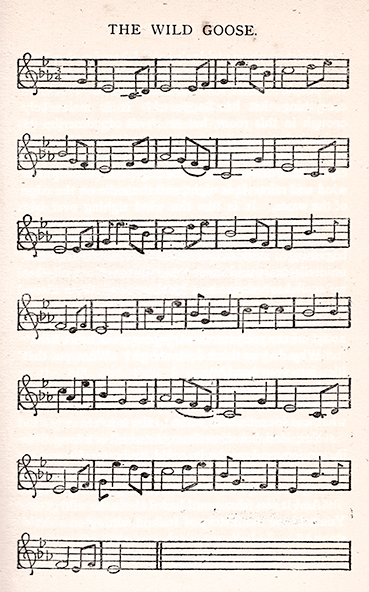
In “The Way Back,” the next and last story of The Untilled Field, Carmady mentions the tune in conversation with John Harding (alter ego of George Moore in several novels) and John Rodney (sculptor at the center of “In the Clay,” the first story in The Untilled Field):
“The Gael will be remembered,” said Carmady, “if he is remembered, by his little folk tunes. The day before I left Ireland I heard one. The hills were shrouded in mist and I could not find the flute-player; but the tune he played, melancholy enough in itself, sounded in the mist like the death wail of a race. Never did music affect me more profoundly — a little eight-bar tune.”
Carmady whistled the melody and Rodney said:
“Melancholy as bog-water and, like the Gael, melancholy and ineffective.”
Origin of the Music
Mary S. Pierse of the George Moore Association identified this music as the traditional Irish air Éamonn an Chnoic (Ned of the Hill).
Moore’s musical notation may be compared with the version written by Canon James Goodman in his mid-nineteenth-century manuscript collection of Irish traditional music, published as Tunes of the Munster Pipers: Irish Traditional Music from the James Goodman Manuscripts, ed. Hugh Shields, vol. 1 (Dublin: Irish Traditional Music Archive, 1998), tune no. 34.
A modern score and digital facsimile of Goodman’s manuscript are available from the Irish Traditional Music Archive (ITMA).
Piper Séamus Ennis’ classic solo performance of Éamonn an Chnoic was recorded in 1978. Older and newer recordings with various instruments, with and without voice, are easily found through online search.
“The Wild Goose” faithfully represents the melody of Éamonn an Chnoic. Two years after the first edition of The Untilled Field, Walter Power recorded the complete Irish-language song a capella. The lyrics, though not present in George Moore’s story, resonate with his theme.
I will have to go across the sea,
to a place where I have no relations.

Leave a Reply