
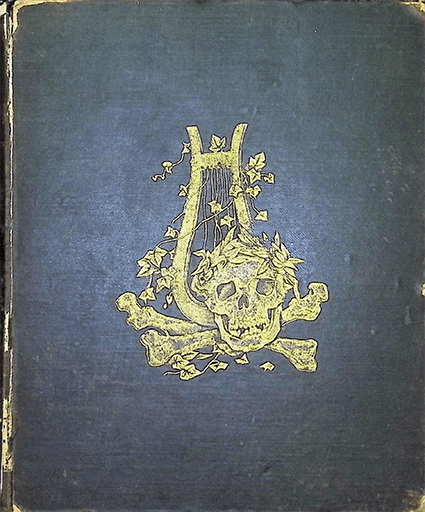
Flowers of Passion (1878) was George Moore’s first book. It was published in London when he was 26 years old living mostly in Paris on passive income. A decade later he recalled this period of his life in two fiesty memoirs: Parnell and His Island (1887) and Confessions of a Young Man (1888).
Identifying as a Parnassian poet, his first three books were formal poetry and verse drama. The titillating themes are shocking, but their serious aesthetic premise and precise techniques would remain true of the mature novelist.
Flowers of Passion predated George Moore’s first novel by five years. In A Modern Lover (1883), the protagonist Lewis Seymour may be a kind of self-projection: an imagined version of himself who lacked both the conscience to give up art and the intellect to experiment with literature, as George was doing in his poetry.
Poems
Serenade [The infidel has no heaven]
Song [Love gazed on sweet beauty]
Serenade [I have wandered to my love]
Rondel [Lady! unwreath thy hair]
Sonnet. Summer on the Coast of Normandy
Song [My soul is like a house of doves]
Flowers of Passion (AI)
Flowers of Passion (AI) is a PDF of the first edition that may be uploaded to AI applications such as Notebook LM for guided analysis and interpretation.

Leave a comment