
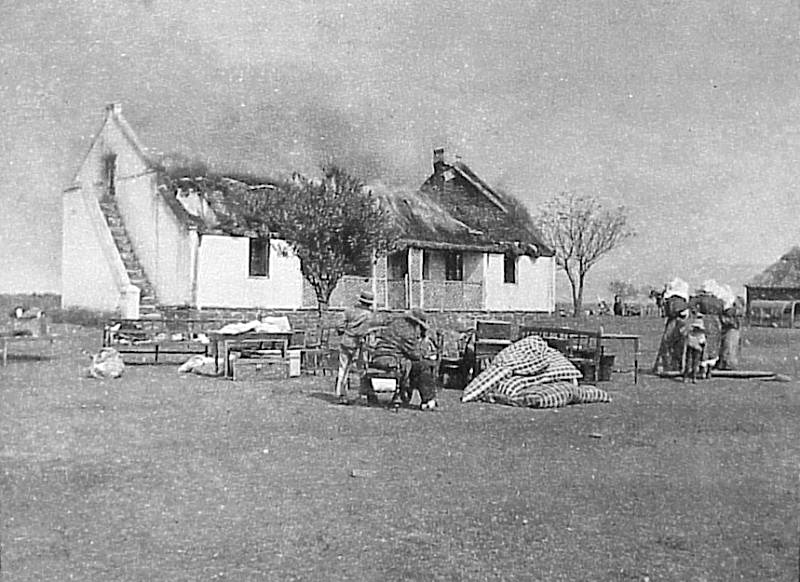
Major Maurice Moore of the Connaught Rangers was the anonymous author of controversial eyewitness accounts of atrocities committed by British forces (under his command and others’) during the Second Boer War in South Africa. This archival photograph (Wikimedia Commons) illustrates the “scorched earth” policy that Maurice reported, by which thousands of Dutch colonial farms were pillaged, burned and dynamited as punishment for … for all sorts of reasons and for no reason at all. Some traumatized homesteaders were turned out on the veldt to fend for themselves; others were held in concentration camps and/or deported to remote parts of the Empire where they knew nobody and had nothing. Maurice was a whistleblower a few years before that term was coined! His accounts inflamed many people (including his brother George Moore and the advocacy journalist William Thomas Stead) with righteous indignation. Even today the reports are upsetting but undeniably earnest and authentic testaments of imperial barbarity.
Grant Applications
My grant-seeking for research and development has gained two toeholds.
As previously mentioned, I applied for funding from an aligned foundation to cover travel expenses: Chicago to London for two weeks in the British Library, where I can round up the last ~90 of George Moore’s uncollected articles that are not already published on GMi.
If the grant comes through in August, it will propel me across the Atlantic in October to finish one of my curatorial pillars: 100% of George’s ~600 known articles of art and literary criticism! All could be live online by March 2027. If they are, the articles will be freely accessible, maybe searchable too.
Because I also applied for funding (from another foundation) to support implementation of the GMi Discovery System. I introduced this project in last month’s newsletter. You can read about it here in case you missed it.
If that grant comes through, it will make thousands of GMi web pages and embedded docs (including the aforementioned articles) searchable by various selectable criteria. It will also make the entire digital archive supportive of machine learning and high-fidelity simulation of George himself.
This is a tantalizing proposition that curators may want to replicate for other legacies, and I have promised help them by freely sharing Discovery System code and implementation guidance.
There are other prospective foundations in my sights, whose missions are aligned with GMi. I ran out of time to approach them in April, but they’re on my call list.
One more thing I’ll proudly mention: I learned in April that the Discovery System is a good fit for the Collections Stewardship program of the National Endowment for the Humanities. An NEH Program Officer encouraged me to apply for a grant until I mentioned that I need only $15,000 to complete the project. The minimum amount of an award is $50,000.
So for now, I won’t apply because my ask is too small. I was nonetheless delighted to learn that my vision and mission for the digital humanities are aligned with NEH strategic priorities!
With plans to make GMi a paradigm of literary legacies in the digital age, I’ll certainly revert to the NEH in the future with a larger ask.
You Can Donate, Too
My update about foundations and endowments should not dampen your wish to make an individual contribution. Remember: the Resurgam website is chock full of ways to donate online and every little bit helps. If you’re wealthy enough to offer a larger donation (bless you), the amount you give may reduce your federal and state tax bill next year.
This is a frictionless way to promote cultural enrichment in our hyper-stressful times. Donating may make you feel good about yourself and the world! Enough said.
War Crimes
I always regarded Maurice Moore as an officer and a gentleman. I didn’t realize he was also a skillful writer, albeit not imaginative like his brother.
Maurice passed his childhood at Moore Hall in the pastural West of Ireland. He was schooled at St. Mary’s College, Oscott, near Birmingham, England, overlapping there with his late-blooming brother George (Maurice was two years younger).
After Oscott and preparations with a military tutor, he enrolled at the Royal Military Academy Sandhurst in Berkshire, England, and upon graduation served with the Connaught Rangers in India (1880s) and Ireland (1890s), but not in conflict zones.
Bloody and desperate conflict came his way in 1899 when “The Devil’s Own” were deployed to a front of the Second Boer War in South Africa. The following year, the steady but anguished Maurice secretly penned three accounts of unethical British war-fighting.
The accounts were in the style of letters sent to his brother George in London. George was horrified by war crimes committed not randomly, but in accordance with policies issued by the British High Command.
He confidentially shared the first two letters with the anti-war journalist William Thomas Stead, at the time editor of Review of Reviews. Stead published the first letter in a broadsheet named Hell Let Loose and the second in a pamphlet named How Not to Make Peace.
George tried to get the pro-war Daily Chronicle of London to publish the third letter. When they declined he gave it to the Freeman’s Journal of Dublin. The Times of London soon reprinted a fragment, sanding its sharp edges with conservative editorial commentary.
Maurice’s letters and Stead’s legal polemics are now live on GMi. They are no longer lost to time.
Maurice wrote his letters at great risk to his personal safety — indeed to his life. He wrote them without any expectation of personal gain — indeed, he had every reason to believe they might destroy his career. He was neither asked nor paid to write the letters, but did so in order to right a terrible wrong and reconcile his way of life with his conscience.
If that reminds you of a character named Evelyn Innes, bravo, you’ve earned a gold star from the GMi Academy of the Self-Taught!
Like Evelyn, Maurice prospered in his career by doing what was expected rather than being true to himself. He was promoted from Captain to Major shortly before secretly blowing the whistle on his peers and commanders.
Unlike most of the 200,000+ British soldiers serving with him in South Africa, he put everything on the line for his values and principles.
I’m not a student of military science, and I didn’t rescue Maurice’s testimony from oblivion in order to set a record straight.
I did it because his letters are eloquent, impassioned, meaningful; moreover, they help me understand George Moore’s myriad motives for returning to his homeland in March 1901. Like Evelyn Innes and Maurice Moore, by 1901 George was exhausted by painful cognitive dissonance.
Evelyn Innes Redux
In his preface to Evelyn Innes third edition and Sister Teresa first edition (both published 8 July 1901), George Moore announced that his duology was complete but not a duology. It was really a single novel named Evelyn Innes and ought to be issued in one volume.
For business rather than artistic reasons the duology format persisted, but now in 2026, the author’s wish has been fulfilled. The ebook Evelyn Innes (1901) is in the GMi Shop with Evelyn’s unified saga between its virtual covers. It reproduces the entire text of the novel from the historic moment of completion.
To make the novel easier to explore, GMi also publishes the longer first edition of Evelyn Innes (1898) online and as an ebook, plus the first edition of Sister Teresa online and as an ebook, plus PDFs of each text for AI-assisted analysis and interpretation.
Evelyn Innes (1901) is long! More than 216,000 words across 87 chapters and two prefaces (both included as a courtesy to scholars), the unified saga may be George’s largest, longest, and most difficult project.
Is it worth reading today?
Perhaps it is, so I’ve offered optional ways. Digital curation supports self-directed quick dips as well as deep dives. It supports AI-assisted query, summary and comparison. Different readers are empowered to take what they want from the novel in ways that suit them personally.
Will digital curation make the saga accessible and meaningful to more people? I’d like to think so.
The warp and woof of Evelyn Innes are the universals of music, and also religion; sex, and also spirit; wealth, and also work, conscience, and also ambition, freedom, and also inhibition; prerogative, and also sublimation.
On a higher level that reflects George’s mid-life crisis at the turn of the century, Evelyn Innes is counter-intuitively a meditation on “sacrificing all that she liked for all that she disliked” (Chapter 46).
But is that relevant now, or sealed in the cultural amber of classroom and study carrel? To decide, you may compare Evelyn with the opera star Lise Davidsen who is “one of the greatest opera singers of our time — a soprano with a voice so rare, critics reach back a century for comparison.”
At the apex of Lise’s early career, she chose to stop the music and start a family. She risked forfeiting her voice for new life. She set aside the wealth and glamour of the opera house for a role she considered more meaningful and urgent.
That is just what Evelyn did when she gave up the theater for a religious vocation. The choice between material success and moral imperative that George Moore wrestled with at the turn of the century is the same dilemma that many gifted people face today.
We strivers and seekers may be only vaguely aware of it, but as an artist George was tuned in. He believed that Evelyn Innes was about the most wrenching and disruptive challenges that many people face in their lives.
As such, he and his novel are sensitive guides to our fraught journeys.
Letters Milestone
More than forty years after collecting The Letters of George Moore 1863-1901, I have finished publishing them on GMi. I must have taken the long way around!
The correspondence concludes (for now) in March 1901 when George bid adieu to London for a new home and fresh start in Dublin, in the unlikely role of Irish nationalist.
Before turning this geographical and biographical corner, I corralled six letters not written by George but helpful to understanding his legacy.
- I’ve already mentioned three letters about war crimes from his brother Maurice in South Africa. They’re with George’s Letters of 1900.
- I also corralled three letters written in the late 1860s by Father James Spenser Northcote, President of St. Mary’s College, Oscott. They’re with George’s Letters 1860s.
I must insert a mea culpa about Northcote’s letters.
For reasons unknown (carelessness?) I didn’t jot down their location when I transcribed them. I think the manuscripts are in the National Library of Ireland, but they’re not in the catalog.
Until they’re found, I am publishing my transcriptions without provenance. This is a ridiculous but can’t be helped. Stay tuned for the big reveal when a sleuth finds them.
Aside from those six letters, I also published lists of Ephemeral Letters and Unlocated Letters of the period 1863-1901. The lists are sure to expand as the Letters pillar continues to grow next month.
Finally, I added a curious narrative about the Lost Letters to Lady Cunard. Unfortunately it does not offer a large reward for any investigator who finds them. Logic and intuition tell me that the lost letters are extant. I shared what I know about them.
Up Next
Next I plan to curate George’s letters April-December 1901.
At the same time, I’ll create The Collected Poems of George Moore. It will include the contents of two books plus uncollected poems that I found in periodicals.
The general assumption is that George’s verses are ridiculous, but I suspect they aren’t entirely. A different adjective is wanted.
I’m also ready to curate Diarmuid and Grania (1901) and The Strike at Arlingford (1893). George Moore worked long and hard on these plays, with notable collaborators, and both premiered in major experimental theaters before falling off our cultural radar.
I may not get to them in May, but I’ll try.
At the Grolier Club
I was fortunate enough to be in New York on opening day of Risings: The Irish Literary Revival and the Making of a Nation. Rare books, manuscripts, and pictures illustrate the exciting birth of a nation!
The curators don’t seem familiar with George Moore. The only book by him in the display cases is Parnell and His Island (1887), which has nothing to do with so-called Risings.
But look carefully and you’ll find his signature on a cornerstone document of the Irish Literary Theatre. It represents the major role he actually played in the Irish Literary Revival, one that the curators left to your imagination.
Bob Becker (30 April 2026)
(You can do this:)

