
- Impressionist Moment
- More Memoirs
- Who is Octave Barrès?
- And what about Sargent?
- “I shall rise again”
- The Sensible Text
- Wait a minute!
- French Letters
Impressionist Moment
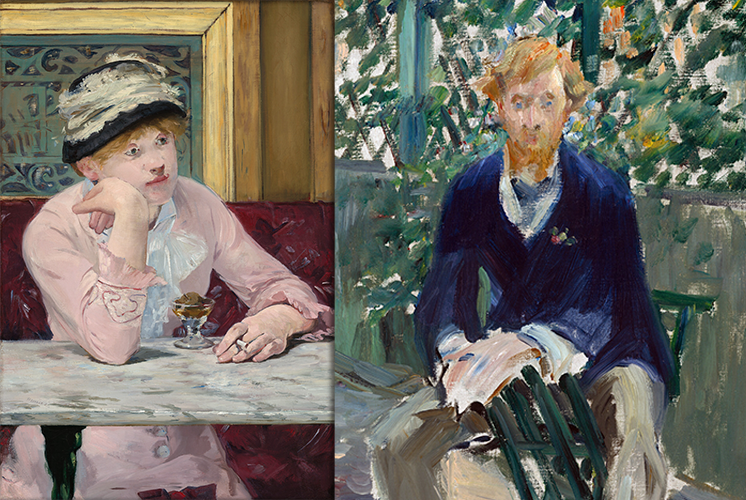
These days visitors to the National Gallery, who appreciate George Moore, can get even more for the price of admission (free).
Until 19 January 2025 just a few steps from where George and Ellen hang, they can also view Paris 1874: The Impressionist Moment.
This is a grand exhibition from the Musée d’Orsay that epitomizes the art and culture of Paris during George’s formative years there.
It covers both the Salon of 1874 and a momentous show of the Société Anonyme des Artistes Peintres, Sculpteurs, Graveurs, et Lithographes, at the former studio-gallery of Nadar in the Boulevard des Capucines.
I recently went to the National Gallery to see George in the artist’s garden for the first time. Oh my, oh my… it’s electric! Then I was awestruck by Paris 1874.
The exhibition documents the seminal event of impressionism and is just as spectacular as the Manet/Degas exhibition at the Metropolitan Museum of Art in New York — and that’s saying a lot! (George and Ellen were also seen there.)
The paintings are individually and collectively… incredible!
If you can’t get to Washington in time for Paris 1874, consider reading the catalog. It’s large and heavy. I place it on a pillow on my lap to get comfortable while reading.
It contains not a single mention of George Moore, though he lived in Paris in 1874 while learning how to paint. Still, the catalog relates a great deal about the world he observed, and pondered, and interacted with, and later celebrated in the books and articles that are coming back to life on GMi.

You can order the exhibition catalog from the National Gallery of Art.
It’s lavishly illustrated of course, though nothing compares with luminous paintings on the wall.
The scholarly essays deepened my understanding of the artists’ lives and work. They offered a different way of thinking about impressionism. Truer to life; and truer to George!
More Memories
Last month I promised to publish A Communication to My Friends (1933) in Apple Books. I’ve done that, and also published Memoirs of My Dead Life (1906). Both ebooks are free to download in the GMi Shop; they’re also published in the Worlds pillar of GMi.
The closer I read George’s numerous memoirs, the harder it is to classify them. Are they autobiography, or autobiografiction, or autofiction, or even fiction?
One would think fiction of some sort because they’re written in the fluid style of a novel. Yet time and time again, the ingenuous author pauses to assure his readers that he is relating facts, not making things up; moreover that the literary value of his text depends on its fidelity to actual, lived experience.
Shall we take him at his word?
One of the benefits of a project like GMi is to subject George’s canon to textual analysis by computer; to use artificial intelligence to summon and evaluate all the evidence embodied in his art.
So eventually, the truth will out!
Meanwhile, I do take George at his word. What he says happened, in point of fact did happen according to his memory and belief.
Still, does he accurately remember everything? That’s a different question.
For example, he recalled living in the Rue de la Tour des Dames, Paris, in the afterglow of the “Impressionist Moment.” Did he really? I suspect not, though at the same time, weirdly, I’m sure he was telling the truth.
Go figure.
Next up in the Worlds of George Moore: volume II of Hail and Farewell! — Salve (1912).
Who is Octave Barrès?
In “The End of Marie Pellegrin” (chapter 4 of Memoirs of My Dead Life), George recalled sitting to an artist in Paris named Octave Barrès.
Biographer Joseph Hone mistook Octave Barrès for a writer and man of letters named Maurice Barrès. But I doubt that Maurice ever wielded brushes and a palette, and besides his full name was Auguste-Maurice, not Octave. Seems like a different person!
So who was Octave Barrès and where is his portrait of George Moore? I can’t allow that George invented Octave in order to tell a story. George insisted that he didn’t do that kind of thing.
I searched for Octave Barrès on the Internet and in my professional network, but found not a trace.
Can you help?
And what about Sargent?
If you mumbled “eh, maybe” under your breath so I wouldn’t hear, let me assure you that your efforts would not go unappreciated. When you pull back the curtain on Octave, George Moore Interactive will loudly applaud you.
And while you’re solving mysteries of art history and iconography, please consider telling me where to find the known portrait of George Moore by John Singer Sargent. What little I know about it is published here.
Unlike autofiction, this picture is real and probably owned by a private collector somewhere in the United States. I should have asked about it when I visited the National Portrait Gallery in Washington, but I forgot.
No, I didn’t forget; I was distracted by another portrait that took my breath away:

Portrait of Gertrude Stein by Pablo Picasso, finished in the year that George Moore finished Memoirs of My Dead Life (1906).
This picture is currently on loan from the Metropolitan Museum of Art in New York to the National Portrait Gallery in Washington for the exhibition Brilliant Exiles: American Women in Paris, 1900–1939.
“I shall rise again”
If you download and read Memoirs of My Dead Life, be aware that George saved the best for last.
The last chapter is named “Resurgam” (look it up). It’s an exquisite blend of the lyrical and the profound, but that’s not why I’m bringing it up here.
The author fantasized about his final return to Ireland, 27 years before it occurred. In his fantasy he abhorred the prospect of being buried with his parents in the family crypt at Moore Hall.
He instead imagined being cremated on a huge funeral pyre on an island in Lough Carra, and then having an urn of his ashes suspended in the lake for all time to come.
Resurgam is a memoir projected into the future, and really moving, but of course that’s not what happened after George died in 1933.
What happened is this. He was cremated in Golders Green near London. His ashes were placed in an urn, though probably not the urn he envisioned. The urn was rowed out to little Castle Island in Lough Carra and buried under a pile of rocks near the shore.
That is what happened, and that’s why people like you and me cannot pay our respects to George Moore unless we go to a great deal of trouble — even more trouble than getting to Moore Hall in the first place.
I have said before, now I say it again: it doesn’t have to be this way. Nobody — least of all one of Ireland’s greatest writers — benefits from a grave in the middle of nowhere!
Hear my prayer. Bring him home.
The Sensible Text
I wrote last month about a way to incorporate the letters of George Moore into GMi using new scanning technology. And behold, it is happening and it’s fun.
The letters of George Moore from 1863 through 1884 are now online. Many more are in the pipeline.
Like most kinds of brainy fun, this effort depends on heuristics, or figuring things out: on deciding what is the right and best way to do something.
That’s because editing letters in the past, for a dissertation or print publication, was a hardened professional discipline. So hard, in fact, that nobody could simply read letters after they were published.
Letters were examined like depositions rather than read.
On behalf of ordinary readers, I have declared there must be a better way, though I don’t know precisely what it is. I’m still working on that.
My goal is pure and simple: to publish letters that are readable online. We can leave all the searching and analytics to machines that do it better anyway.
To reach my goal I am making editorial decisions that are unconventional, at least in academic publishing (which GMi is not). These are my (still evolving) practices:
Regarding structure…
- Publish each letter in its own WordPress page
- Title each page with date and recipient of the letter
- Place a button under the title for navigating away from the page
- Give a concise explanation of the letter’s obscure content
- Display my transcription of the letter in an embedded Google Doc
Within the embedded Google Doc…
- Repeat the title of the letter, left justified
- Under title, say in what medium the letter exists, left justified
- Next to medium, identify the owner of the letter
- Next to owner, state the number of words in the Google Doc
- Under word count, write the sender’s address on one line, right justified
- Replace line breaks in the original address with commas
- Under address, write the date of the letter on one line, right justified
- Add day of the week to the calendar date
- Under date, write the salutation on one line, left justified
- Under salutation, write the body of the letter, left justified
- Under body, write the close and signature, right justified
Within the body of each letter, normalize…
- Paragraph breaks
- Capitalization
- Spelling
- Punctuation
- Character spacing
Moreover…
- Replace each line break of the original letter with a space (except verse)
- Insert a blank line between all paragraphs (no hanging indents)
- Append hyperlinks to words that benefit from expansion
- Do not insert footnotes (no annotations)
I use that word “normalize” to connote common usage of British English during George Moore’s life; and also idiosyncratic usage that is typical of his published writing.
My prohibition of footnotes is to prevent editorial clutter from interfering with reader focus and attention. I don’t permit any interruptions when a reader is reading a letter.
Wait a minute!
Scholarly editors may object to both of the foregoing editorial principles, claiming that chaotic typography is potentially meaningful and footnotes likewise increase meaning.
To them I respectfully submit:
(A) The original, physical letter may be examined by anybody who wants to interpret orthography. I identify the owner of each letter, making it much easier to find than it was for me.
(B) In any case, holographic and printed language are different media. If anybody thinks they can reproduce the holograph with type, they are naive a.k.a. wrong (in my opinion).
(C) One of the benefits of interactive publishing, when done properly, is that it promotes reader exploration and discovery. Footnotes stymie same.
Footnotes are means for subject-matter experts to share their knowledge whether or not it is wanted; and the effect is to inhibit readers from making (rather than learning) new knowledge.
If readers want to know more about a person or event or thing that George mentioned in a letter, guess what, they can go search the Internet without leaving their seat.
That behavior — that act of investigation — is just as important as the knowledge they are seeking. Maybe more, depending on your philosophy.
Philosophy aside, it’s worth saying, I think, that the correspondence of great men and women (including George Moore) may be analogous to Frodo under the caressing arms of Shelob.
Why? Because in the highest academic traditions, letters are devoured rather than edited for readers.
By that I mean holographs have gotten sucked into a “word chipper,” where they lose their organic properties and become… well, the kind of text you sadly remember from homework.
Planks and blocks, littered with bracketed insertions, cluttered with superscript numbers, rigged like a mannequin with an editor’s relentless acts of informing the reader.
Such letters pass beyond writing by a human hand. They are unreadable.
Let it also be said that holographic writing is usually (not rarely) full of “organic” mistakes of all kinds: linguistic, grammatical, orthographic, stigmeological.
Some of those errors are intended to make a point. (Think about the last time you waded into Finnegan’s Wake.)
Most errors are careless and have no exclusive meaning. They are slips of the pen or keyboard. They obscure rather than enhance meaning.
My choice is not to represent holographs in type. My alternative is to present letters that are as readable as I can make them, according to the rules I have made for this project (and more than may occur to me).
Years ago I called this The Sensible Text (as in common sense). I viewed the alternative, which I produced for my dissertation, as The Sacred Text — the object of reverence, perhaps idolatry, by people who want to seem more clever than they actually are.
Yes, that was me.
I repeat: nobody reads letters that editors have treated as Sacred Text. To me, that kind of editing is like throwing a pot of paint at the Mona Lisa and claiming it adds color.
Speaking of which, if you get to the National Gallery of Art in Washington, just down the hall from George Moore in the Artist’s Garden, you should look at this miracle from the hands and mind of Leonardo da Vinci:

French Letters
My devotion to The Sensible Text poses a challenge to editing George’s correspondence. Lots of his letters are written in French to French recipients, and they are beyond my ability to normalize.
I will require the help of a native French reader to do with George’s French what I myself do with his English: normalize it.
For now I am publishing the French letters just as they were written. That’s a stopgap, not a solution.
If a native French volunteer wishes to normalize French text for GMi, please step up. I will make it very easy and convenient for you to help, and you may have fun doing it.

5 responses to “The Sensible Text”
have you been to Moorehall ?let me
know if your u visit and will give you the
guided tour
Mary O Reilly
LikeLike
Thank you Mary. I have been to Moore Hall three times and to Castle Island twice, but have never had a guided tour. I am thrilled by your offer and will take you up on it! I plan to visit Ireland in April 2025.
LikeLike
When you say’ Bring him home’ wh
LikeLike
Thank you Mary, your comment is truncated so I can’t read it. If you repost I will reply to a question you may have. “Here my prayer. Bring him home” is a quote from the song “Bring Him Home” in the musical Les Miserables.
LikeLike
[…] Last month I enthused about Paris 1874: The Impressionist Moment at the National Gallery of Art in Washington DC. The exhibition epitomizes art during George Moore’s formative years without mentioning him. (He studied painting in Paris in 1874, but was 22 years old and hadn’t cracked his shell.) […]
LikeLike