
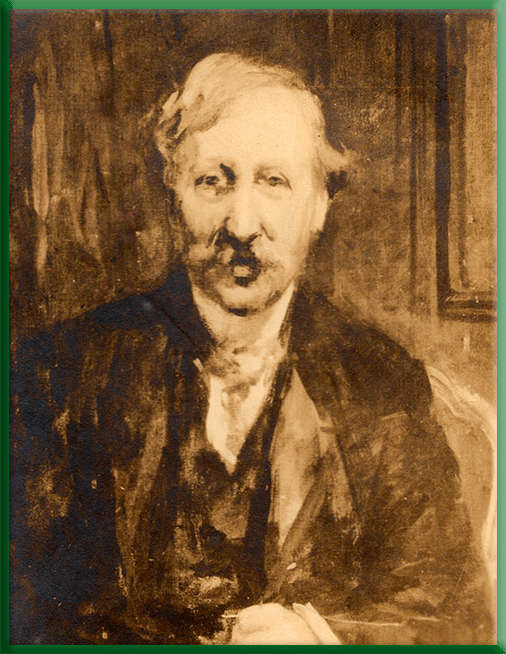
The Irish Storyteller, by Philip Wilson Steer. This undated, hitherto unattributed portrait was likely painted in George Moore’s home in Dublin in the early 1900s, around the time that Moore dedicated Reminiscences of the Impressionist Painters (1906) to Steer. The picture was mentioned to D.S. MacColl by Vernon Wethered (see MacColl’s Life Work and Setting of Philip Wilson Steer (1945), p. 66). Wethered recalled that a Steer portrait was published without attribution as the frontispiece in one of George Moore’s books. Only one such portrait was ever published, in The Untilled Field & The Lake, Carra Edition (1923), in sepia tone. I am especially fond of this picture because it has the convivial personality so often and fondly remembered by GM’s friends. Present whereabouts unknown.
Nine months after conceiving George Moore Interactive, I’m getting ready to pull something out of the oven. Not the vivacious embodiment of a beloved modernist author — the virtual resuscitation that I proclaimed in Kickstarting Literary Legacies. Gestation of that marvel continues apace, towards a firm but still distant due date.
The approaching milestone is mundane, if not boring. It’s a prototype of sorts, with the faint heartbeat of a “minimum viable product”: the online publication of qualified content with rudiments of interactivity.
The point of publishing something that’s neither finished nor ready for showtime is to facilitate improvement. By putting a body of hot and freely accessible work on the Internet, I may increase the chances (say from 0% to maybe 3%) of exciting early adopters to view interesting things, take it for a spin, identify systemic defects and limitations, and challenge me to build it better.
Forthcoming “interesting things” are the extensive foundations of three pillars: Iconography, Aesthetics, and Bibliography. Textual, quantitative and pictorial data that form these pillars will appear online as a prototype, in formats that are readable and, to a limited degree, useful. Early adopters (like you?) who engage with the prototype will be able to find, read, and cross-reference data, and insert comments. As such they will become collaborators, stakeholders, and individual investors of intellectual capital.
That is, if anybody shows up! As groundbreaking as this project is, I am ever mindful of Linda Ronstadt’s mashed potatoes. (Google that if you don’t know what I mean.)
Initial objectives for the prototype include:
- Clear, accurate, human-readable text (the opposite of what is usually found — with difficulty — in digital archives)
- Machine readable (learnable) text (practically never found in digital archives)
- Searchable text (which is part of being machine readable, but geared to human users)
- Updatable, correctable and self-correcting text (enabling crowdsourcing of quality improvement
- Text that can be commented by readers (members of the crowd to whom quality is sourced)
- Text that can be hyperlinked to anything on the public web (including aforementioned barely legible source material)
- Text that can be illustrated with digital images (because so much that sums up to “George Moore” is visual)
- Text that can be performed (read aloud) by a machine voice (for accessibility and also, eventually, for simulation)
- Text that can be automatically personalized for individuals (enabling each to build a unique perspective on the legacy)
- Text that can be exported and printed (enabling migration to external apps and use cases)
- Text that is free of embedded exegesis (helping impede or at least slow “the imposture of the expert”)
- Text that can be translated by machine into other languages (however imprecise, still better than no translation)
Early adopters will evaluate the prototype against those initial objectives. A few advanced publishing objectives are beyond the scope of this prototype, including:
- Dynamic generation of web pages
- Elegant (more than readable) page format and typography
- Integrated graphic, video and audio data
- Responsive page layout (landscape and portrait)
- High-levels of interactivity (e.g. simulation)
The three pillars Iconography, Aesthetics, and Bibliography must wait for later developments before integrating imagery, but for now will at least link to many of the pictorial objects that Moore created or wrote about. For example, where he wrote about specific paintings, the prototype will provide means to view the paintings even though users will have to open a different app to do so.
The prototype Bibliography will include contents of Edwin Gilcher’s two books in one unified volume (actually, the prototype comprises several digital documents that include all of Edwin’s published data). Errors in his work are corrected but not definitively, pending crowdsourced review.
What’s not in the prototype Bibliography are data that Edwin gathered during the years he continued his research after publication; nor does it include bibliographical entries that postdate Edwin’s death more than 20 years ago. That may be the target of a research team that hasn’t yet formed, and perhaps doesn’t need to form if I crowdsource the task (I think I can, as the Red Engine said).
There are three use cases for this prototype. One consists of unsupervised, self-directed consumers of literature and art: the fandom of George Moore — for upwards of 90 years rumored not to exist, but I suspect it’s out there, somewhere. Another use case consists of academically trained scholars — professors and students, librarians and booksellers — whom the prototype may benefit professionally. Another use case consists of AI developers, many of whom are scrambling to monetize information like that being developed by George Moore Interactive. Some may find the approach taken here to be inspired and pragmatic at some level; a few may want to make the approach work for their own projects while helping to make my project better.
Prototyping and crowdsourcing are different from the time-honored diktat of “publish or perish.” So much of what appears under that cruel regime is stillborn or gets overlooked or forgotten (in arts and sciences alike).
In contrast I mean to publish imperishably. What does that mean? It means that the structure of information hardens but content and techniques of communication do not; imperishably means dynamic and evolving, as in forever young. As an information system, imperishably grows by building on itself and through active connections to data beyond itself.
In a manner of speaking, to publish imperishably is to suppress my editorial ego (alas!) and make room in George Moore Interactive for the talents of others who think differently.
A Voice that Breathed o’er Eden?
I’ve mentioned from time to time that an aim of George Moore Interactive — beyond the prototype, beyond the data — is to reanimate the author digitally. A big part of that is making his voice audible, even though there are no sound recordings that provide a model and no living person who ever heard him speak.
Bringing his voice back to life, so it can speak for itself, will be huge creative fun. It will draw from witness testimony like the following.
He talked along in gusts. Then for a long enchanted stretch it was like the waters of ”The Brook Kerith” flowing by. Very often he paused to correct his own words, editing his speech as though it had been a manuscript; blue-penciling an infelicitous word and underlining its substitute with fine emphasis. It was like reading long passages from one of George Moore’s exquisitely worded later works – and something infinitely more, the spirit of George Moore speaking for itself – which my notes cannot begin to express. Then we settled down to cigarettes and a genuine “conversation in Ebury Street” that was less didactic, less formal, but which bristled with George Mooreisms; taking pot-shots at the conventions both past and present, he chuckling at every coddled white dove he brought down.
From Henry Albert Phillips, “Mr. George Moore Vents His Spleen On the Age We Live In,” New York Times Book Review, 12 June 1927, page 2.

One response to “Publish Imperishably”
Super Bob, I’m totally tied up for the past month but hope the skies might clear by end of August. Sorry not to be responding meaningfully recently.
Keep going, GM loves you!
<
div>Mary
Sent from my iPhone
<
div dir=”ltr”>
<
blockquote type=”cite”>
LikeLiked by 1 person