
Hi Reader! When I started George Moore Interactive, Iconography was the only pillar. First and foremost, I wanted to explore the symbiosis between words and pictures in Moore’s world. I intended to show how verbal and visual arts enhance and advance one another, as Moore himself often did.
Years ago with an incipient version of this idea in mind, I gave a public lecture about George Moore and art at the Metropolitan Museum of Art in New York. Likewise I published two articles in the glossy Irish Arts Review. I admit, these were hurried, half-baked efforts, and they remained that way for a very long time, because afterwards I emigrated from academia and found other fish to fry.
Even so, I never lost my desire to do more with words and pictures. And now because technology is so much better, faster and cheaper, I actually can!
My lecture and articles explored two poles of George Moore and art: one being pictures of the author, the other being the author writing about pictures. I slated both under the title “iconography,” but that was a force fit. Strictly speaking, iconography is just a cluster of pictures; the only words that belong there are ones that document the pictures.
That’s what you’ll find in the updated Iconography of George Moore Interactive: currently more than 150 pictures of him; plus dozens more of people, places and things that George Moore experienced and appreciated; plus documentation of all the pictures and where to view them in collections. I’ll talk more about the new Iconography in a future post.
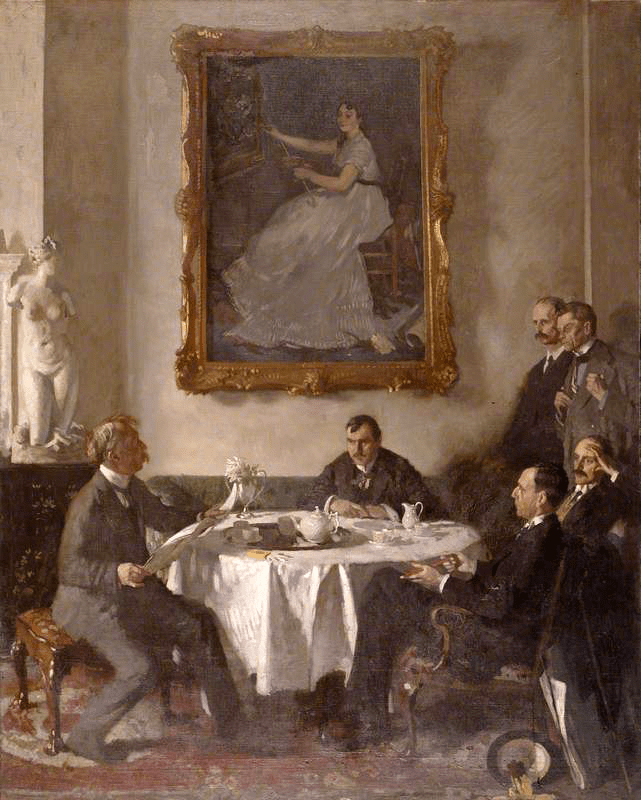
The other pole of my original iconography — the force fitted stuff — is now housed in a second pillar named Aesthetics. This pillar is for George Moore’s writing about art and artists; his visual acuity trained on ancient, neoclassical, impressionist and post impressionist pictures (illustrated by William Orpen in Homage to Manet).
There’s a trove of Moore’s writing in Aesthetics, most of it uncollected and unedited for contemporary readers like you and me (until now). The pillar currently has about 220 essays of art criticism that Moore contributed to magazines and newspapers, from the mid 1880s until the early 1930s. This is Moore the aesthete, the philosopher, the polemicist, the tastemaker, the advocate and iconoclast.
Also in Aesthetics are about 40 quotidian articles that Moore revised for publication in books, as a more permanent and collectable testament of his beliefs. Because George Moore Interactive is unconstrained by the economics of print publication, all of these revised texts are served up with their predecessors, so that the curious among us can see for themselves how the author’s “impressions and opinons” evolved. Why take Douglas Cooper’s word for it?
Though Aesthetics is mainly textual, it is illustrated. Not with pictures of George Moore (those are in Iconography), but with pictures that Moore gazed at, thought and wrote about (e.g. Manet’s portrait of Eva Gonzalès). As an art critic, he frequently attended exhibitions in academies and galleries and evaluated what was for sale (including lots of pictures that he didn’t like and the few that he loved). When empty column inches and press deadlines demanded Moore’s immediate attention, and there was nothing new in Bond Street worth talking about, he would visit museums and review what he found there; occasionally he advised curators about what to acquire, what to shun and what to deaccession; he once even interviewed for a job as director of a museum of art (but wasn’t hired).
Aesthetics retrieves, edits, annotates and programs hundreds of essays that George Moore wrote about art and artists, and also shows the pictures he wrote about. Each of us gets to ponder and decide what to make of it.
This is a dynamic, self-directed approach to art history and it’s how many of us like to approach words and pictures when we’re allowed to roam the stalls and galleries without a tour guide or lecturer telling us what to think.
Be Notified of the Next Post
You’ll receive a confirmation email after entering your address and tapping Subscribe. Your subscription to this blog becomes active after you confirm. Cancel any time.
You Are Invited
The Oak Park (Illinois) Public Library will host a virtual + in-person discussion of George Moore Interactive on Saturday, February 25, 2023 at 12:30 PM US Central Time (6:30 PM GMT). Click here to open the Library’s free online registration page. I’d love to see you there.

One response to “Words and Pictures”
Bob, thanks for letting me knowColin
LikeLike