
←Menu of Pictures of George Moore
- Always Yours
- The Unknown God
- Your Gain Is My Loss
- The Red Dressing Gown
- A Wonderful Pose
- Study for The Lovers of Orelay
- The Lovers of Orelay
- Exhibition of Works by Professor Henry Tonks
- To Encourage Bad English
- George Moore Reading, No. 1
- George Moore Reading, No. 2
- The Conversation Then Turned
Always Yours
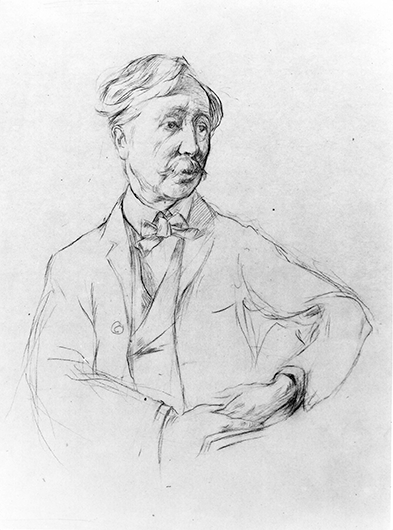
George Moore half-length seated, head turned to his left, left arm resting on the chair back or a cushion, clasped hands on an armrest.
This unsigned portrait was first attributed to William Rothenstein in the Book Buyer (November 1901), presumably based on advertising received from the publisher. It was later attributed to Henry Tonks by Helmut Gerber in George Moore in Transition (Detroit: 1968, page 213), based on an undated letter from Moore to his publisher.
The owner received the artwork from book publisher Constant Huntington in 1960, shortly before she died, without an attribution to any artist. In reply to my inquiry, the owner wrote:
…although the portrait is unsigned and entered the collection unattributed, we are reasonably confident about the attribution to Tonks. We are aware of the reproduction of the drawing accompanying an article in the Book Buyer (New York, Vol 23), November 1901, in which it was attributed to Rothenstein. However the basis for this attribution is unclear and stylistically it appears unlike Rothenstein’s work. As you will know, the drawing was reproduced as the frontispiece to Sister Teresa in that year and a letter from Moore to the publisher Fisher Unwin, of June or July 1901 (published in Gerber’s 1968 George Moore in Transition), discusses Moore’s preference for the drawing by Tonks (over that by Blanche) which he offers to provide. Additional evidence for attribution to Tonks is also found in Gerber’s book as he reproduces the drawing, acknowledging permission to reprint ‘by courtesy of Mrs Claude Rogers for the Tonks Estate’. Claude Rogers was a pupil of Tonks and it seems unlikely that he or his wife would have been mistaken about the authorship of the drawing.
Based on cursory review of portrait drawings by various artists of this period, the style of this drawing seems less like Tonks than like William Rothenstein, William Orpen and J.S. Sargent. Those artists are known to have drawn portraits of Moore around this time. There is no other known picture of Moore by Tonks around this time.
Moreover Joseph Hone, in The Life of Henry Tonks (1939) page 67, tells a story which seems to reinforce my doubt about the picture:
A further anecdote, turning on the secrecy in which Tonks painted, may serve to introduce into this narrative one of its leading figures. One Sunday, O’Brien being alone at No. 18, someone knocked at the door, and there was George Moore who asked for Tonks. “Tonks is out,” O’Brien replied, “but is there any message?” Instead of answering, Moore edged himself into the hall and commented on the way in which the entrance was hung with etchings by Charles Keene. Then he said: “There seems to be a sort of dam,” and went on looking about him. “A dam?” queried O’Brien. “Yes, some sort of obstruction or dam in the flow of portraits of me, and I have thought it would be a good thing for Tonks that he should do a drawing of me, as I have finished writing a book which will have a certain notoriety. Tonks could do a very nice drawing of me as a frontispiece.” O’Brien promised to give the message; whereat Moore, to his horror, started to climb the stairs, saying that he wished to see what his friend had been painting. “It is absolutely forbidden,” O’Brien cried out; but Moore not only gazed at the picture on the easel, but turned around the other canvases that were there. When the matter was reported to him, Tonks boiled over, but consented to do the portrait. He felt sure that it would be “not half beautiful enough according to Moore’s conception of himself,” and indeed Moore grew to hate the drawing which he had hung up and framed in his room. He abused it so much that one day Tonks stole it away.
The picture was published without attribution in George Moore, Sister Teresa (3 July 1901), as a frontispiece with a facsimile signature Always yours George Moore. The same image was reproduced in the Book Buyer (1 November 1901, page 262); and again in as the frontispiece in Helmut Gerber’s George Moore in Transition (Detroit: 1968) with this acknowledgement: Original drawing by Henry Tonks, reprinted from the first edition of Sister Teresa by courtesy of Mr. Claude Rogers for the Tonks Estate.
It is the first of two portraits that Moore published as a frontispiece without crediting the artist; the other is by Philip Wilson Steer.
Joseph Hone, the biographer of both Moore and Tonks, doesn’t attribute the frontispiece of Sister Teresa to any artist.
Owned by the National Portrait Gallery, London, England.
The Unknown God
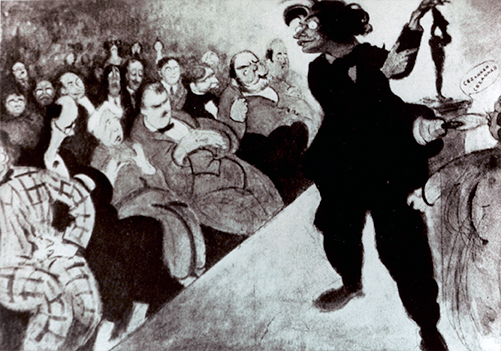
Inscribed Cezannah Cezannah. Roger Fry lecturing on post-impressionism to a group including George Moore, St. John Hutchinson, D.S. MacColl, William Sargent, Walter Sickert, and Philip Wilson Steer. Moore’s facial expression and raised hands indicate surprise and dismay, perhaps because he liked cats and Fry was holding and pointing to a dead cat.
Published in Joseph Hone, The Life of Henry Tonks (1939); and in Martha Kapos, ed. The Impressionists and Their Legacy (1995). The picture is evidently cropped. Present whereabouts unknown.
Your Gain Is My Loss

30 November 1916, aet. 64
Ink on paper
Inscribed 88 Victoria Rd., Aldershot. Nov 30 1916. My dear Mrs. Hunter, As I have no doubt as to the issue of the struggle, I submit with good grace, but with sadness. Your gain is my loss. Instructions to this effect will be sent to 121. I am looking forward to Monday four weeks if you still are of a mind to take me to Hill Hall. Yours ever, Henry Tonks. I hope you have good news of Mr. Hunter. Three full length figures, George Moore in the center, his right hand outstretched to Mary (Mrs. Charles) Hunter, his left hand released by Tonks, to whom he waves. The Hunters lived at Hill Hall, near Epping.
Published in George Moore, Letters to Lady Cunard, ed. Rupert Hart-Davis (1957). Present whereabouts unknown.
The Red Dressing Gown
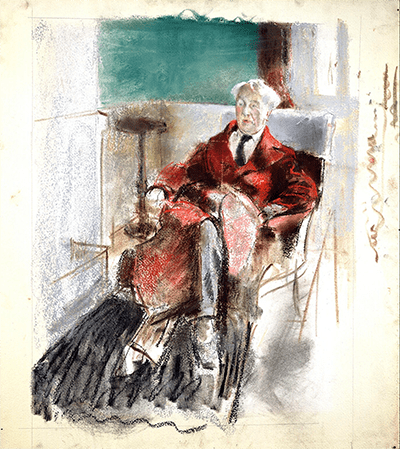
Geroge Moore full-length seated on an upholstered chair, half-turned to his right, arms on the arm rests, wearing a necktie and a red dressing gown.
Owned by the National Portrait Gallery, London, England.
A Wonderful Pose

Circa 1920, aet. 68
Ink and watercolor?
Inscribed This is only a note of a wonderful pose I saw in Ebury St. I very nearly asked him to let me do it properly but it would only have ended in fumes but is it not characteristic? The evening was very hot. H.T. George Moore full-length, seated in an armchair, an open copy of Northanger Abbey near his left foot. Inscribed by Mary Hutchinson to Joseph Hone on verso.
I dated this undated picture around the time of The Red Dressing Gown. though it may be earlier. It appears to mark the moment of inspiration for that painting.
Published as the frontispiece in Edwin Gilcher, Supplement to the Bibliography of George Moore (1986), “courtesy of the Tonks estate.”
Presumably owned by the Edwin Gilcher Papers, Arizona State University Library, Tempe, USA.
Study for The Lovers of Orelay
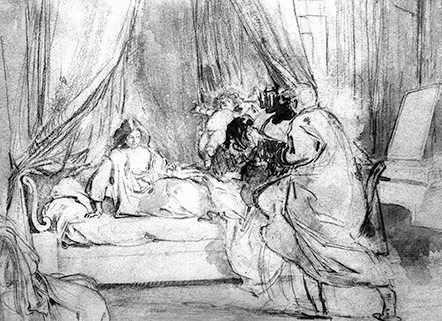
Circa 1920, aet. 68
9 x 12 in; 22.86 x 30.48 cm
Graphite, sepia and grey wash on paper
In a boudoir, George Moore full-length in voluminous nightshirt and slippers, approaches a seductive young woman in a canopied bed. Cupid hovers between them.
I believe this is the artwork owned by Mr. J.C. Medley in the 1970s when I visited and he showed this or a similar picture to me. Present whereabouts unknown. Mr. Medley might have received the picture from his father who was George Moore’s attorney late in life.
Henry Tonks made “a series of little pictures” for Moore’s story “The Lovers of Orelay” in Memoirs of My Dead Life (1906) beginning in 1920. Some were exhibited at the New English Art Club Retrospective Exhibition (London, January 1925) and again at the Tate Gallery (London, 6 October until 15 November 1936). In 1936 one of the pictures was subtitled Night, another Morning. Owners named in the exhibition catalog (see below) include Lady Kendall-Butler, Miss Ethel Sands, and Mr. St. John Hutchinson.
According to Joseph Hone in The Life of Henry Tonks, 1939, the pictures were offered for publication in Hone’s Life of George Moore (1936) but declined by the American publisher, Macmillan.
The Lovers of Orelay
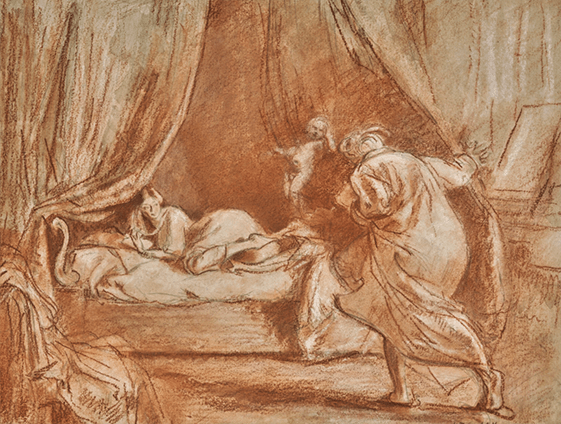
Circa 1920, aet. 68
10.25 x 15.25 in; 26.04 x 38.74 cm
Graphite and chalk on card
Sotheby’s page. Also MutualArt and Artnet
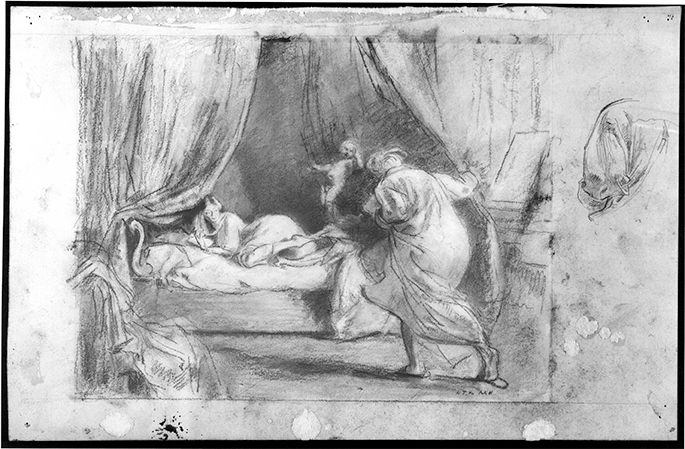
Circa 1920, aet. 68
8.5 x 11 in; 21.59 x 27.94 cm
Graphite and chalk on paper
The uppermost image is from a Sotheby’s webpage (echoed by MutualArt and Artnet). Below is the same composition with more details surrounding the subject. Both pictures are initialed and inscribed by the artist H.T. to MH. [Henry Tonks to Mary Hutchinson]; they are probably different photographs of the same artwork.
Present whereabouts unknown.
Exhibition of Works by Professor Henry Tonks
Illustrations by Henry Tonks for George Moore’s “The Lovers of Orelay” were exhibited at the Tate in 1936. Here is the catalog for that exhibition. It is not illustrated but may guide searches for pictures that I haven’t found.
To Encourage Bad English
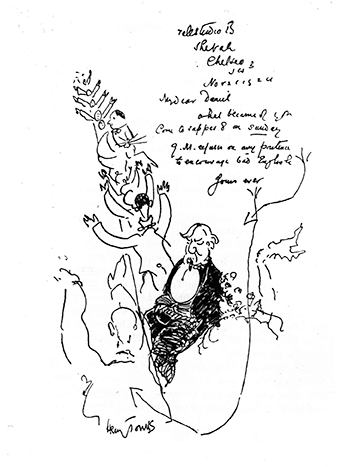
26 Novermber 1924, aet. 72
Ink on paper
Inscribed Vale Studio B, The Vale, Chelsea, SW3. Nov 26 1924. My dear Daniel, What became of you? Come to supper 8 on Sunday. G.M. refuses on any pretense to encourage bad English. Yours ever, Henry Tonks. George Moore full-length in evening clothes, angrily seated and puffing a cigar, while others including the artist at a banquet table rise to acclaim a dignified person in the middle ground.
Published in Joseph Hone, The Life of Henry Tonks (1939). Present whereabouts unknown.
George Moore Reading, No. 1

Signed Henry Tonks. George Moore full-length, seated in the foreground, reading from the manuscript Aphrodite in Aulis. In the background St. John and Mary Hutchinson, Philip Wilson Steer, and Henry Tonks standing. Commissioned by William Orpen, who bequeathed it to the present owner in 1932.
Provenance, exhibition and publication history on the owner’s page where the picture is named Saturday Night in the Vale (the artist’s home was called The Vale).
Owned by the Tate, London, England.
George Moore Reading, No. 2
A second version of George Moore Reading was owned by Mrs Leverton Harris and exhibited at the French Gallery (London, 1931). Present whereabouts unknown.
The Conversation Then Turned
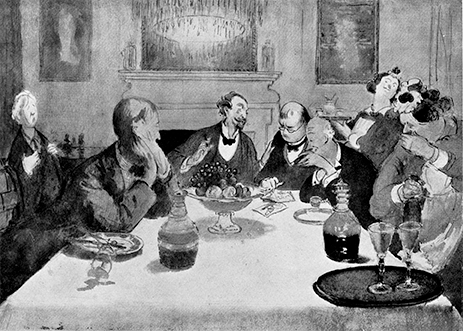
1930, aet. 78
12,5 x 16 in; 31.75 x 40.64 cm
Watercolor on paper
Captioned The Conversation Then Turned on Tonks. George Moore half-length half-turned to his left, hands gripping his lapels, disconcerted and seated alone at the left border of the picture. Seated around dinner table center are Lawrence Alexander Harrison, Philip Wilson Steer, Henry Tonks, Nelson Ward; and two servers standing in the right side of the picture.
Exhibited in the Tate (London, 6 October 1936 to 15 November 1936). Published in Joseph Hone, The Life of Henry Tonks (1939). Owned by Mr. L. A. Harrison in 1936.

Leave a comment