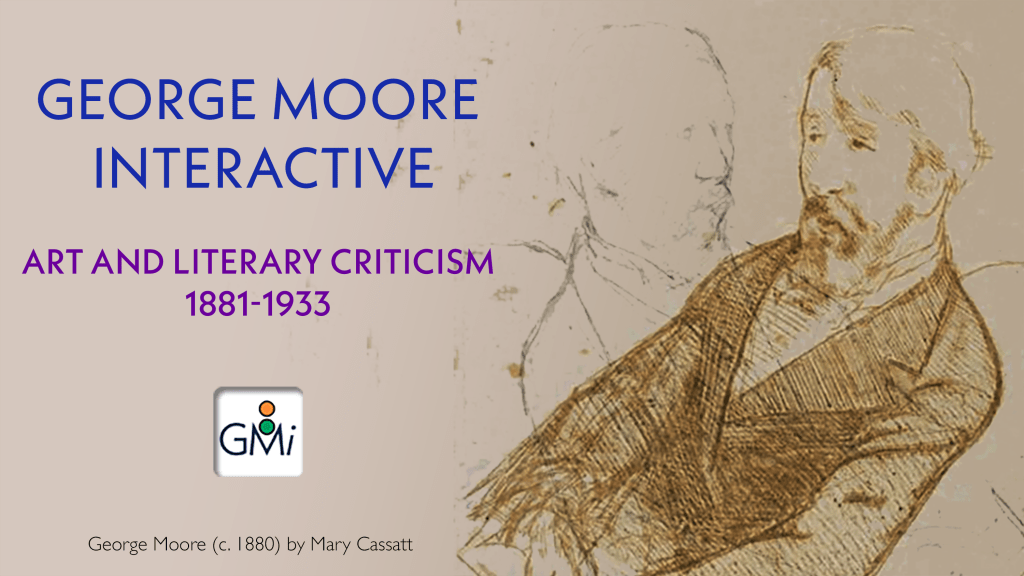
The graphic theme of my first Gofundme Campaign features details from a pencil sketch of George Moore aet. 28 by the American impressionist Mary Cassatt. The sketch, now in the Williams College Museum of Art, was made for an etching that I call “Armchair Critic” in the Iconography. At the time Mary made it, George was at the end of his lengthy stay in Paris and launching himself in London as a modernist literary critic. The sketch appears to show him talking to himself, anticipating a style of informal, conversational writing that he later perfected.
GMi is approaching an important milestone: publication of the complete essays of George Moore. As I turn into the home stretch, only 83 essays have still to be added to hundreds that are already online.
When that happens, all of George’s critical writing about art and literature will be freely accessible, searchable and readable. All will be available for machine learning and AI. People won’t need to travel for it.
But I have to travel to bring it to them.
For that reason, I am seeking donations to cover out-of-pocket travel expenses to get the 83 essays. They were originally published in newspapers from 1881 to 1933. None has been scanned or printed since.
Moreover none can be obtained by ordering online. The only way to get the essays is to visit the British Library in London, find the pages where they were printed years ago, and photograph or scan them on the spot.
You can support me by going to the campaign page and pledging a small or large donation. You can’t make a huge donation because the campaign goal is only $5,809. I’m seeking small. We can get there with baby steps.
George Moore Interactive LLC is a self-financed nonprofit. Someday it will seek grants and investments to develop advanced technology. We’re not there yet.
This campaign only covers travel expenses to obtain content that can’t be obtained any other way. Donations will not be used to pay for labor, tools or time to curate the content for publication.
Thanks for considering this. In addition to making a donation, you can help the campaign by sharing the link with others who might consider donating.
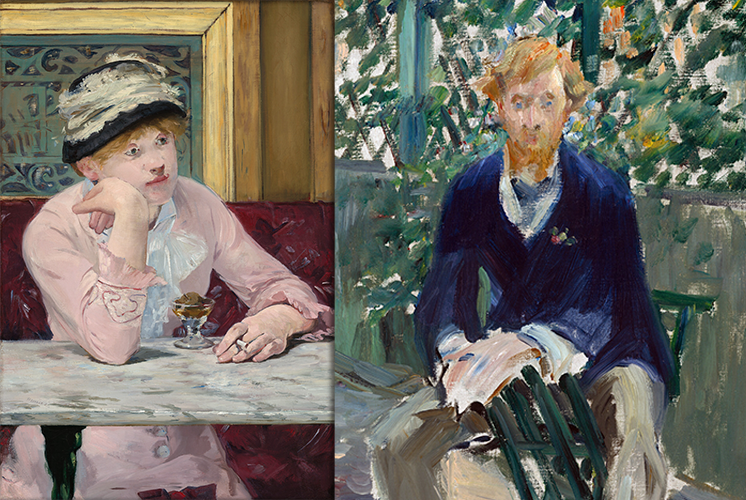
Two paintings by Édouard Manet in the National Gallery of Art, Washington D.C. In Gallery 89 on the left is Plum Brandy (circa 1877) depicting Ellen Andrée in the Café de la Nouvelle-Athènes (where she was also painted by Edgar Degas). In Gallery 87 on the right is a crop of George Moore in the Artist’s Garden (circa 1879). Manet also painted George in the Nouvelle-Athènes, but that picture is in a different museum. Visitors to the National Gallery who view these portraits in close proximity will be tempted to imagine what the young man was like in the exuberant days he later recalled in Memoirs of My Dead Life (1906).
This is a grand exhibition from the Musée d’Orsay that epitomizes the art and culture of Paris during George’s formative years there.
It covers both the Salon of 1874 and a momentous show of the Société Anonyme des Artistes Peintres, Sculpteurs, Graveurs, et Lithographes, at the former studio-gallery of Nadar in the Boulevard des Capucines.
I recently went to the National Gallery to see George in the artist’s garden for the first time. Oh my, oh my… it’s electric! Then I was awestruck by Paris 1874.
The exhibition documents the seminal event of impressionism and is just as spectacular as the Manet/Degas exhibition at the Metropolitan Museum of Art in New York — and that’s saying a lot! (George and Ellen were also seen there.)
The paintings are individually and collectively… incredible!
If you can’t get to Washington in time for Paris 1874, consider reading the catalog. It’s large and heavy. I place it on a pillow on my lap to get comfortable while reading.
It contains not a single mention of George Moore, though he lived in Paris in 1874 while learning how to paint. Still, the catalog relates a great deal about the world he observed, and pondered, and interacted with, and later celebrated in the books and articles that are coming back to life on GMi.
It’s lavishly illustrated of course, though nothing compares with luminous paintings on the wall.
The scholarly essays deepened my understanding of the artists’ lives and work. They offered a different way of thinking about impressionism. Truer to life; and truer to George!
More Memories
Last month I promised to publish A Communication to My Friends (1933) in Apple Books. I’ve done that, and also published Memoirs of My Dead Life (1906). Both ebooks are free to download in the GMi Shop; they’re also published in the Worlds pillar of GMi.
The closer I read George’s numerous memoirs, the harder it is to classify them. Are they autobiography, or autobiografiction, or autofiction, or even fiction?
One would think fiction of some sort because they’re written in the fluid style of a novel. Yet time and time again, the ingenuous author pauses to assure his readers that he is relating facts, not making things up; moreover that the literary value of his text depends on its fidelity to actual, lived experience.
Shall we take him at his word?
One of the benefits of a project like GMi is to subject George’s canon to textual analysis by computer; to use artificial intelligence to summon and evaluate all the evidence embodied in his art.
So eventually, the truth will out!
Meanwhile, I do take George at his word. What he says happened, in point of fact did happen according to his memory and belief.
Still, does he accurately remember everything? That’s a different question.
For example, he recalled living in the Rue de la Tour des Dames, Paris, in the afterglow of the “Impressionist Moment.” Did he really? I suspect not, though at the same time, weirdly, I’m sure he was telling the truth.
Biographer Joseph Hone mistook Octave Barrès for a writer and man of letters named Maurice Barrès. But I doubt that Maurice ever wielded brushes and a palette, and besides his full name was Auguste-Maurice, not Octave. Seems like a different person!
So who was Octave Barrès and where is his portrait of George Moore? I can’t allow that George invented Octave in order to tell a story. George insisted that he didn’t do that kind of thing.
I searched for Octave Barrès on the Internet and in my professional network, but found not a trace.
Can you help?
And what about Sargent?
If you mumbled “eh, maybe” under your breath so I wouldn’t hear, let me assure you that your efforts would not go unappreciated. When you pull back the curtain on Octave, George Moore Interactive will loudly applaud you.
And while you’re solving mysteries of art history and iconography, please consider telling me where to find the known portrait of George Moore by John Singer Sargent. What little I know about it is published here.
Unlike autofiction, this picture is real and probably owned by a private collector somewhere in the United States. I should have asked about it when I visited the National Portrait Gallery in Washington, but I forgot.
No, I didn’t forget; I was distracted by another portrait that took my breath away:
Portrait of Gertrude Stein by Pablo Picasso, finished in the year that George Moore finished Memoirs of My Dead Life (1906).
If you download and read Memoirs of My Dead Life, be aware that George saved the best for last.
The last chapter is named “Resurgam” (look it up). It’s an exquisite blend of the lyrical and the profound, but that’s not why I’m bringing it up here.
The author fantasized about his final return to Ireland, 27 years before it occurred. In his fantasy he abhorred the prospect of being buried with his parents in the family crypt at Moore Hall.
He instead imagined being cremated on a huge funeral pyre on an island in Lough Carra, and then having an urn of his ashes suspended in the lake for all time to come.
Resurgam is a memoir projected into the future, and really moving, but of course that’s not what happened after George died in 1933.
What happened is this. He was cremated in Golders Green near London. His ashes were placed in an urn, though probably not the urn he envisioned. The urn was rowed out to little Castle Island in Lough Carra and buried under a pile of rocks near the shore.
That is what happened, and that’s why people like you and me cannot pay our respects to George Moore unless we go to a great deal of trouble — even more trouble than getting to Moore Hall in the first place.
I have said before, now I say it again: it doesn’t have to be this way. Nobody — least of all one of Ireland’s greatest writers — benefits from a grave in the middle of nowhere!
Hear my prayer. Bring him home.
The Sensible Text
I wrote last month about a way to incorporate the letters of George Moore into GMi using new scanning technology. And behold, it is happening and it’s fun.
The letters of George Moore from 1863 through 1884 are now online. Many more are in the pipeline.
Like most kinds of brainy fun, this effort depends on heuristics, or figuring things out: on deciding what is the right and best way to do something.
That’s because editing letters in the past, for a dissertation or print publication, was a hardened professional discipline. So hard, in fact, that nobody could simply read letters after they were published.
Letters were examined like depositions rather than read.
My goal is pure and simple: to publish letters that are readable online. We can leave all the searching and analytics to machines that do it better anyway.
To reach my goal I am making editorial decisions that are unconventional, at least in academic publishing (which GMi is not). These are my (still evolving) practices:
Regarding structure…
Publish each letter in its own WordPress page
Title each page with date and recipient of the letter
Place a button under the title for navigating away from the page
Give a concise explanation of the letter’s obscure content
Display my transcription of the letter in an embedded Google Doc
Within the embedded Google Doc…
Repeat the title of the letter, left justified
Under title, say in what medium the letter exists, left justified
Next to medium, identify the owner of the letter
Next to owner, state the number of words in the Google Doc
Under word count, write the sender’s address on one line, right justified
Replace line breaks in the original address with commas
Under address, write the date of the letter on one line, right justified
Add day of the week to the calendar date
Under date, write the salutation on one line, left justified
Under salutation, write the body of the letter, left justified
Under body, write the close and signature, right justified
Within the body of each letter, normalize…
Paragraph breaks
Capitalization
Spelling
Punctuation
Character spacing
Moreover…
Replace each line break of the original letter with a space (except verse)
Insert a blank line between all paragraphs (no hanging indents)
Append hyperlinks to words that benefit from expansion
Do not insert footnotes (no annotations)
I use that word “normalize” to connote common usage of British English during George Moore’s life; and also idiosyncratic usage that is typical of his published writing.
My prohibition of footnotes is to prevent editorial clutter from interfering with reader focus and attention. I don’t permit any interruptions when a reader is reading a letter.
Wait a minute!
Scholarly editors may object to both of the foregoing editorial principles, claiming that chaotic typography is potentially meaningful and footnotes likewise increase meaning.
To them I respectfully submit:
(A) The original, physical letter may be examined by anybody who wants to interpret orthography. I identify the owner of each letter, making it much easier to find than it was for me.
(B) In any case, holographic and printed language are different media. If anybody thinks they can reproduce the holograph with type, they are naive a.k.a. wrong (in my opinion).
(C) One of the benefits of interactive publishing, when done properly, is that it promotes reader exploration and discovery. Footnotes stymie same.
Footnotes are means for subject-matter experts to share their knowledge whether or not it is wanted; and the effect is to inhibit readers from making (rather than learning) new knowledge.
If readers want to know more about a person or event or thing that George mentioned in a letter, guess what, they can go search the Internet without leaving their seat.
That behavior — that act of investigation — is just as important as the knowledge they are seeking. Maybe more, depending on your philosophy.
Philosophy aside, it’s worth saying, I think, that the correspondence of great men and women (including George Moore) may be analogous to Frodo under the caressing arms of Shelob.
Why? Because in the highest academic traditions, letters are devoured rather than edited for readers.
By that I mean holographs have gotten sucked into a “word chipper,” where they lose their organic properties and become… well, the kind of text you sadly remember from homework.
Planks and blocks, littered with bracketed insertions, cluttered with superscript numbers, rigged like a mannequin with an editor’s relentless acts of informing the reader.
Such letters pass beyond writing by a human hand. They are unreadable.
Let it also be said that holographic writing is usually (not rarely) full of “organic” mistakes of all kinds: linguistic, grammatical, orthographic, stigmeological.
Some of those errors are intended to make a point. (Think about the last time you waded into Finnegan’s Wake.)
Most errors are careless and have no exclusive meaning. They are slips of the pen or keyboard. They obscure rather than enhance meaning.
My choice is not to represent holographs in type. My alternative is to present letters that are as readable as I can make them, according to the rules I have made for this project (and more than may occur to me).
Years ago I called this The Sensible Text (as in common sense). I viewed the alternative, which I produced for my dissertation, as The Sacred Text — the object of reverence, perhaps idolatry, by people who want to seem more clever than they actually are.
Yes, that was me.
I repeat: nobody reads letters that editors have treated as Sacred Text. To me, that kind of editing is like throwing a pot of paint at the Mona Lisa and claiming it adds color.
Speaking of which, if you get to the National Gallery of Art in Washington, just down the hall from George Moore in the Artist’s Garden, you should look at this miracle from the hands and mind of Leonardo da Vinci:
My devotion to The Sensible Text poses a challenge to editing George’s correspondence. Lots of his letters are written in French to French recipients, and they are beyond my ability to normalize.
I will require the help of a native French reader to do with George’s French what I myself do with his English: normalize it.
For now I am publishing the French letters just as they were written. That’s a stopgap, not a solution.
If a native French volunteer wishes to normalize French text for GMi, please step up. I will make it very easy and convenient for you to help, and you may have fun doing it.
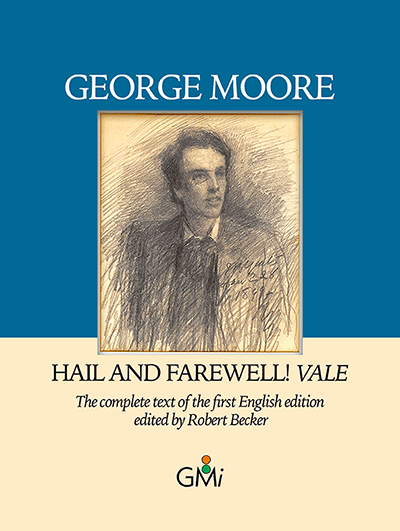
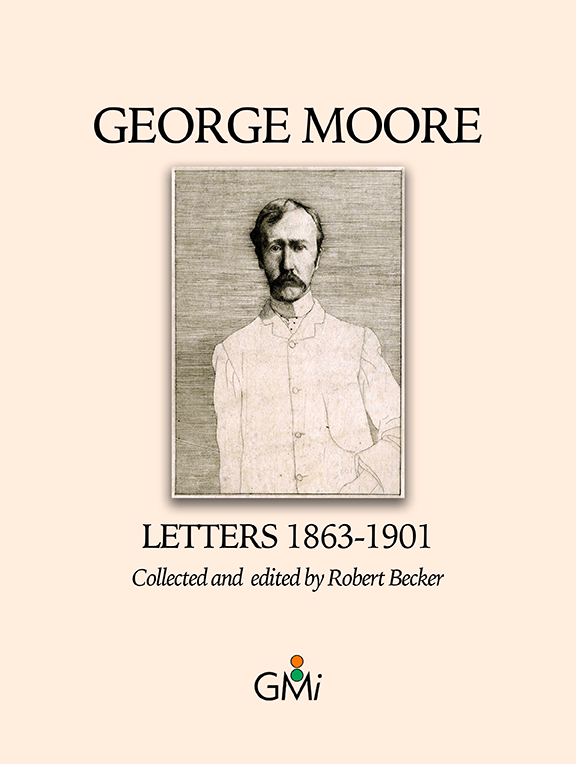
The cover of an ebook — 40 years in the oven and still not ready to come out — with a portrait of George Moore aet. 36 by William Strang (see Iconography). This etching was the frontispiece in an edition of Confessions of a Young Man where George admitted “Two dominant notes in my character — an original hatred of my native country, and a brutal loathing of the religion I was brought up in” (Chapter 7). Why do I find that endearing? It’s a puzzlement.
I believe in crowdsourcing; in particular the crowdsourcing of quality.
We know that quality can mean almost anything. Here it refers to the high fidelity of transcribed text to sources.
My sources are pages printed more than a century ago, that have aged ever since on the shelves of librarians and collectors. Sources are also handwritten sheets that were never printed, but likewise ossified in archives and attics.
The purported fidelity of my transcriptions is a promise of accuracy. A promise that the language I found on yesterday’s paper is accurately reflected in today’s digital media.
But transcription ain’t replication. The higher calling is to represent both evident and latent intentions in sources, not just copy them like a Xerox machine.
In more than 1,000 web pages on George Moore Interactive, I’ve gone a long way to assuring quality by adhering to Deming’s cardinal rules of process control. Every text of George Moore that you read on GMi is the outcome of systematic steps that should have prevented defects from creeping in.
Should, but not must. There’s no doubt in my mind that errors are present in what I have published.
That’s where crowdsourcing comes in. I admittedly publish imperfect texts that are as high in quality as I can make them, given my rapid pace of development. I am relying on the crowd — people who use the texts — to tell me when they suspect errors.
That’s why every GMi webpage (including this post) has its own comment box. When somebody reads something that doesn’t seem right, they needn’t wonder. They can leave a question or suggestion for me to investigate.
My vision, my design and development of George Moore Interactive are founded on a belief in crowdsourcing. The ultimate success of the mission hinges on it.
% Complete
George Moore’s literary legacy is being reconstructed for the digital age in seven august pillars. They are the main menu items listed on the GMi home page. Here’s a quick recap of where things now stand:
Aesthetics: 80% complete
Iconography: 100% complete
Worlds: 10% complete
Letters: 0% complete (see below)
Bibliography: 100% complete
Chronology: 0% complete
Collections: 0% complete
By complete I don’t mean finished, dead and buried. Complete means “the best I can do until the crowd steps up to make GMi better.”
GMi Ebooks
My anticipated migration out of the Kindle Store has begun. Loyal fan of Amazon though I am, I have little respect for their ebook business.
Currently in the GMi Shop there are seven ebooks. Five are Apple Books and two are Kindle editions. I’ll soon create Apple Books to replace the Kindles so that all GMi ebooks can be downloaded from the store I prefer.
At the start of this migration, I decided to price GMi’s Apple ebooks as free. Why? It seems that charging even a small fee to download an ebook may create friction for potential readers while being inconsequential to me. It feels better to give the ebooks away.
Apple Books are not for everybody. To ensure digital rights management, they can be downloaded only to Apple devices (as far as I know). Remember though, the text of every GMi ebook is also available for free on the GMi website, in a different format.
The next ebook in the pipeline is A Communication to My Friends. Coming soon.
GMi Audiobooks
I had a dream that one day George Moore’s fine stories and essays would be released as engaging audiobooks. It may no longer be a dream. It seems to be happening.
During migration to Apple Books I stumbled upon technologies for generating audiobooks out of ebooks. Who knew this was possible? The audiobooks purportedly have naturalistic digital voices — not perfect, not famous, not Her — but not bad either. Moreover these generative audiobooks are fast and easy to make when a producer comes on board.
While I wait for Saoirse Ronan and Colin Farrell to get with the GMi program, I will proceed with this crazy AI alternative. GMi audiobooks performed by non-human, humanlike voices will not be free to download, but they will be reasonably priced and perhaps help me land George’s literary legacy more firmly in the digital age.
Letters Launch
Thanks to new and affordable scanning technology (described below), my work on the Letters pillar of GMi has begun. This pillar is designed to hold careful transcriptions of George’s 6,000+ extant letters: handwritten, typed, and printed between 1863 and 1933.
I located most of those letters around 40 years ago. The Letters of George Moore 1863-1901 was my unpublished doctoral dissertation at the University of Reading, England. I transcribed many more letters as an independent scholar at the Berg Collection of the New York Public Library, a postdoc at the University of Pittsburgh, and a naive professor at Emory University before deciding that I’d had quite enough of the ivory tower.
I suddenly stopped work, stored everything in the unlikely event that I would ever want to see it again, and went looking for a real life. (I found one.)
Before that extinction event of scholarly aspiration, all of my independent and academic work had been accomplished without a personal computer, without a printer or scanner, and without the Internet. I owned a portable Smith Corona typewriter, a desk and chair, a file cabinet; and honestly not much else. Bob Becker in those days bore a striking resemblance to Bob Cratchit.
So you may imagine my excitement and trepidation when I unboxed and organized my old files a few months ago, suspecting that the time for reviving the Letters was approaching. I spent many hours resurrecting my dormant analog office — minus the typewriter — so that I could once again see what I have, what I had created, what I needed to make sense of and work on.
I didn’t get far beyond that. I was stymied by a question: how can I digitize so many letters without doing what I generally hate to do: seek funding. George Moore Interactive is self-funded, but there is a limit to my generosity, even to myself. Making stuff and giving it away is deeply satisfying to me, but not rewarding. I didn’t wish to spend thousands more dollars to carry the letters of George Moore across the chasm into the digital age.
Instead I spent hundreds. Overhead scanners that I serendipitously discovered a few weeks ago triggered the first of two eurekas. I read about how they worked, marveled, settled on a make and model that seemed to fit the needs of GMi, and quietly murmured “Eureka?” After much anxious self-doubt of the too-good-to-be-true variety, I plunked down the cash.
Not an obscene amount of cash, because I would live on even if the scanner failed to live up to expectations. But I suffer from anti-early-adapter syndrome, which causes me to avoid purchasing bad shit because I don’t want to feel like a fool afterwards.
Anyway, I cleared space in my office for the scanner and it arrived the following week. It stayed in the box for a week after that, like a UXB, until my courage (fortified with single malt Scotch) returned.
Then in no time at all, the box was open, the tech was configured, the minimal documentation was read, and a test was conducted. “Eureka!” I exclaimed. The scanner does just what it’s supposed to do — that well, that fast, that easily.
What I had foreseen as a slow, expensive, cumbersome Letters project was transformed into fun and elegant. Many details must still be decided, about how to publish the letters in a way that complements the GMi mission, but those are good problems to have and to solve.
Breakthrough Scanning
The maker of my overhead scanner is a Chinese firm named CEZUR (pronounced caesar). They have a very light footprint in the United States, basically a warehouse on the West Coast, and that initially worried me.
Why aren’t they everywhere? Where are the resellers? How will I obtain service? My emailed questions were answered in English by HQ in China. To my satisfaction, though I still had doubts. Fear of the unknown.
The scanner is overhead rather than flatbed. An elevated arm floods the scanning platform (a black mat) with just the right kind and amount of light, from multiple angles.
An image of the targeted object appears on my computer screen. Using software controls I optimize the image and then press to scan it; pressing either a button on my screen, a button on my desk, or a pedal on the floor. That pedal expedites scanning of multi-part objects.
Anyone familiar with flatbed would be amazed, as I was, by the speed of this machine. Each scan takes about one second.
CEZUR ET24 Pro scanner configured by GMi for the Worlds and Letters pillars.
If the object I’m scanning is an open book (often it is), CEZUR software automatically corrects the position of the book and the roll of the pages. These two factors are death stars to optical character recognition, as I know from painful experience. Like magic, software makes a scanned object appear perfectly straight and flat on my computer screen, no matter how awry it is on the mat.
The magic continues with advanced OCR that transforms a two-page spread into separate consecutive pages. I can configure OCR for different languages.
The French language in many of George’s writings has been a minefield for me, because the conventional OCR I was using didn’t recognize uniquely French letterforms. That minefield is now clear. Electric sheep can graze there.
At last I batch export my optimized scans to Adobe PDF and Microsoft Word; the former is for reference images, the latter is to open in Apple Pages for initial editing (I prefer Pages to Word) before importing pristine text into Google Docs for final editing.
To those who have never suffered the technical woes of flatbed scanning or the time and expense of outsourced book scanning, this overview may seem trivial and boring. Everybody else may stand up and shout “Hail CEZUR.”
By George he’s got it!
I have previously mentioned A.O. Scott of the New York Times. He was formerly a movie critic, now he’s a literary critic of exceptional ability. Like Fintan O’Toole in the New York Review of Books, he never fails to write well, no matter what the topic, and he always writes things that I find interesting if not inspiring. Take for example this quote from a book review:
“She belongs in an as-yet-undefined and perhaps undefinable class of prose artists who blend feeling and analysis, speculation and research, wit and instruction as they track down the elusive patterns and inescapable contradictions of modern experience.” 1
I wrote to Mr. Scott after reading his startling review, explaining that George Moore was a member of the distinguished class, perhaps even a founding member. He replied by assuring me that George is now on Anthony’s reading list!
I hope George won’t disappoint. Given Anthony’s exquisite taste, I doubt that he will. Because George wrote about himself, before Anthony or I were born, anticipating that we would someday come along:
“Other men write for money, or for fame, or to kill time, but we are completely disinterested. We are moved by the love of the work itself, and therefore can make sacrifices….” Hail and Farewell! Ave, (London 1911, page 73).
“An Ode to Gardens That’s Also a Bouquet of Idea,” by A.O. Scott in the New York Times, reviewing The Garden Against Time: In Search of a Common Paradise, by Olivia Laing. ↩︎
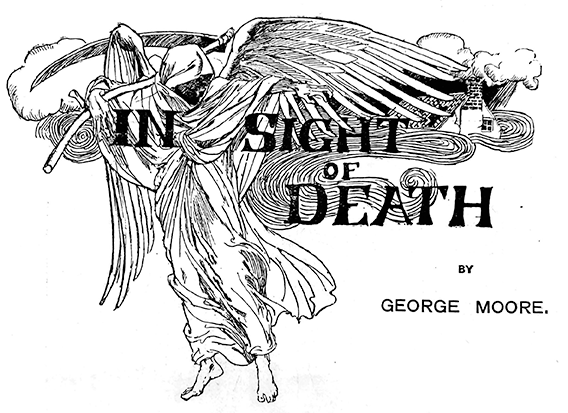
“In Sight of Death” is a short story by George Moore in the Illustrated News of the World (New York, 27 August 1892, pages 202-203). This imaginative rendering of an angel investor in startups is one of four unsigned illustrations of the story. Just kidding, angel investors are flightless. My transcription of the story, along with its later incarnation as “A Flood,” will soon appear in the Worlds pillar of GMi. The only other place you’ll find it, maybe, is in a distant library. (Courtesy of Kathi Griffin)
The Aesthetics pillar of George Moore Interactive has bulked up nicely.
It now contains 227 essays of art criticism and 215 essays of literary criticism originally published in periodicals and books during the author’s lifetime. That’s a total of 442 essays — but not a grand total.
I have yet to acquire 90 outliers: 22 essays of art criticism and 68 essays of literary criticism squirreled away in periodicals that have not been scanned or stored in a conveniently located library. Convenient to me, that is; I’m situated in Chicago.
To acquire these 90 outliers, I must leave my virtual tower and travel to the British Library in London. Once ensconced in the Reading Room, I shall order up the periodicals, one at a time, so that I can locate, transcribe and edit the essays I need, and use them to complete the Aesthetics pillar.
At that momentous milestone, there will be 532 critical essays — the whole shebang — live on George Moore Interactive. As always, they will be freely accessible to readers (human and machine) all over the world.
I know, know, it’s about time.
Assuming that the 90 outliers are similar in length to essays already acquired, I estimate that each contains an average of 2,000 words. That being the case, the completed Aesthetics of George Moore will contain 487,191 words of art criticism and 732,924 words of literary criticism for a grand total of 1,220,115 words.
That is obviously more than most people will ever get around to reading or even skimming. However it should take just a few minutes for machine learners to suck all 1,220,115 words into a large language model.
Not long after that, a reanimated George Moore will resume speaking for himself in response to questions about the art and literature of his time, and of ours. Pretty cool!
Can’t Go Yet
I’m fully prepared to go after the needed 90, but the British Library is not ready to host my visit. You may have heard that cyber criminals kidnapped the Library late in 2023 and held it for ransom. Their dastardly behavior is described here and here.
I pause to ask myself: who would want to attack a library, any library, for money? What lowlife would choose to attack the British Library, of all libraries, a pinnacle of western civilization?
I don’t have any answers, but I’m generally aware that some of our fellow citizens rarely hesitate to do any awful thing that lines their pockets and strokes their egos. A library today. The planet tomorrow.
The ransom wasn’t paid, thank heavens, but the cyber criminals didn’t undo the damage they caused; instead they wound up damaging the British Library for free.
The Library has been in recovery mode ever since, rebuilding their legacy information technology so that even the remote collections I want to browse can be accessed once more.
There is light at the end of the tunnel, though I don’t know how far off it is. My plan is to visit London in the spring of 2025 when, hopefully, all Library systems will be go.
Where Angels Fear to Tread
My trip to the British Library will not be nostalgic.
In the 1970s I spent five years under the luminous dome of the old Reading Room, that hallowed Victorian temple of the human spirit. Back then I was a graduate student from the University of Reading in Berkshire, trundling down to Bloomsbury and over to Colindale on my motorcycle, rain or shine, from my quaint mews house in Hampstead.
Though the luminous dome is still attached to the Museum in Bloomsbury, the Library long ago moved to a modern campus headquartered in St. Pancras. That’s my new destination, half a century after my innumerable visits to the original.
Based on the average time that orders take to reach readers in today’s British Library, and the limit on how many orders may be submitted in one day, I have planned a stay of two full weeks to acquire the outliers.
Even as an American citizen, my use of the British Library is to be free of charge; but airfare, hotel accommodation, meals, and ground transportation are not. And by the way, London is not the cheapest town to dally in.
Hence my wish for an angel investor to help cover the travel expenses. What is an angel investor? Somebody who proffers a small amount of capital for a short time, say three years, in order to make 10x return on that investment. Doesn’t sound very angelic, does it? More like usurious, but I didn’t invent the moniker.
Unable to promise 10x or even 1x to a so-called angel, I’ll instead create a crowdfunding campaign to cover the travel expenses. What is crowdfunding? That’s when individuals (and maybe institutions) pledge small donations to kickstart an untested venture, and in return donors receive a tangible thing of value.
My crowdfunding campaign will most likely offer donors a collectible: for example, a signed, maybe illustrated hardcover of select, uncollected essays of George Moore. A fine limited edition that could retail for more than $50 and over time appreciate to multiples of that.
Collectors of George Moore and his period may covet a copy of the book for their physical shelves. My goal is to raise enough small donations to cover all or most of my travel expenses and costs of manufacturing the book.
My crowdfunding campaign will make clear that donations help complete the Aesthetics pillar of GMi; and more importantly move the project closer to its noble goal of kickstarting literary legacies in the digital age.
The limited edition will not be a commercial product, but a token of appreciation to folks who volunteer their support.
Ireland Redux
Spending two weeks from morning to night, head-down in the British Library, eating takeout tandoori when I return to my rented garret, must be balanced by a personal reward of some sort; otherwise my sparkle may dim.
The reward I have in mind is a visit to Ireland, my first in about 20 years. My daughter Elayne may join me to celebrate completion of her third novel (you should read or listen to the first two, they’re great).
In Dublin I may meet Michael O’Shea at Joyce’s Martello Tower for a chilly spring skinny-dip. I may drive around both Irelands as I did more than once upon a time, admiring the beauties and puzzling over the personalities.
Confessions of an Irishman
The other day Michael managed to find a copy of Terre d’Irlande (1887), a cornerstone of any rare book collection of George Moore. I was just then finishing my edit of Confessions of a Young Man (1888) for GMi and still undecided about what to slate next for the Worlds pillar.
My memory of the English translation of Terre d’Irlande, entitled Parnell and His Island, was admittedly poor and not very positive. I had a vague feeling that it was a nasty little rag about a beloved emerald island.
But is it? I decided to check.
Fast forward to now: all sixteen chapters of Parnell and His Island are published in the Worlds pillar of GMi. And I do declare, they are fine: thoughtful, beautifully written, not nasty though occasionally arch. They cover more than a dozen thematic aspects of mid-nineteenth century Irish culture from a biased, Anglo-Irish, eyewitness perspective. I love them all.
Moreover I think Parnell and His Island is intriguing when juxtaposed with Confessions of a Young Man. Both are nonlinear collections of essays that appeared one after the other and were probably written at the same time.
Parnell is all worldbuilding, Confessions is half worldbuilding, half criticism. Together the volumes reflect the perspicuity and sensibility of an emergent author testing his elastic limits.
Next up in Worlds: “In Sight of Death” (1892), later called “A Flood” (1911); the earlier text courtesy of the collection of Kathi Griffin.
Agon of the Agora
Having uploaded first edition texts of Parnell and His Island and Confessions of a Young Man to George Moore Interactive, I’m now wondering if I should also publish them as Kindle editions.
I already have four Kindle editions in the GMi Shop, so I’ve had enough experience of that marketplace to form personal opinions. So far they include:
Kindle Create is lame desktop publishing software
Kindle Direct Publishing is slow and time-consuming
The Kindle Store is a big box rather than a boutique
I’m not sure how much time I have wasted making Kindle editions, but it’s beginning to add up. What’s worse, it’s been neither fun nor profitable for me.
Is there a better way? I have decided to explore other options for ebook and audiobook creation, production and sales.
If I learn it’s possible to increase the quality of GMi editions in any of those three categories by changing platforms, I will. That will mean moving my wares from the big box to a boutique, but I think that will be okay. More my style anyway.
Responsive Web Pages
A quick technical note about embedded Google Docs on the GMi website.
There are now nearly 1,000 live GMi web pages, most of them containing embedded Google Docs of what scholars call primary source material. The embedded docs display in a white box on this standard dark background.
I have discovered that embedded Google Docs display perfectly on computers and mobile devices held in landscape orientation. All good.
However due to technology that I don’t control, embedded Google Docs do not display properly on mobile devices held in portrait orientation.
One fix for this is to spend boatloads of money to write custom code. Another is for people visiting the GMi site on a phone to hold the device sideways, in landscape orientation, to view the embedded content.
For obvious reasons I opt for the second solution. However if a skillful code developer with a literary bent wishes to volunteer to write that custom code, the job can be theirs. If they succeed they can license the code to WordPress or Google, who could sure use it!
BREAKING NEWS 2024-07-26. The technical issue described above was solved by code developer Onur Demir through Codeable. GMi pages with embedded Google Docs now display properly on mobile devices held in portrait or landscape orientation.
Letters 1863-1901
My unpublished PhD dissertation The Letters of George Moore, 1863-1901 contains about 1,000 annotated letters with other scholarly stuff.
The time has come for me to have it scanned as a first step toward integration in the GMi project. I may also produce an ebook of its massive content, since I don’t plan to put “stuff” on this website.
My preferred book scanner in Missouri seems to be AWOL. I can’t seem to get his attention. As soon as I qualify a new vendor for scanning, Letters production will proceed.
Three heavy oversize volumes are not the easiest things to mount on a book scanner, so my choice of a new vendor must be cautious.
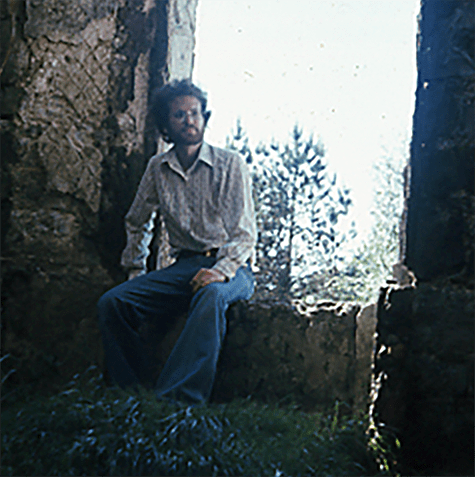
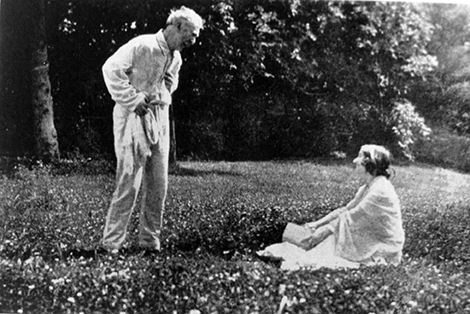
Detail from an undated photograph of George Moore with Édouard and Marie Dujardin to his right and Wanda Landowska to his left, at Dujardin’s home Le Val Changis near Fontainebleau, France. I scanned and colorized a black and white print in my collection. See the Iconography of George Moore for more images and information.
Shelves in the GMi Shop are (awkwardly) kinda bare. Remember though, a shingle was hung only yesterday!
But check this out: a few things are now in the shop window: e-books of Martin Luther (1879), A Mummer’s Wife (1885), Avowals (1919), and Conversations in Ebury Street (1924). Each is edited by me, contains the text of the first English edition, and costs about the same as a cup of morning joe.
What? that’s too expensive? I agree, the price really should be free, but for structural reasons I can’t give titles away in the Kindle Store. Instead I do that in George Moore Interactive. The contents of these e-books are published hereabouts in the Aesthetics and Worlds pillars, for free.
The dual publications are not duplicative. Readers who want to enjoy Moore’s writing will do that better with Kindle editions. Those digital texts are faithful to the printed originals; moreover they aren’t cluttered with new introductions that tend, in my experience, to prevent the average reader from enjoying what follows.
Instead of opening with a pooh-bah’s footnoted explanation of what the book means to him or her or them, readers of these e-books dive in and decide what it actually means to themselves. An experience of engagement and discovery, lofted by canonical text, is attainable.
This is partly what I mean when I talk about “kickstarting literary legacies in the digital age.” Empowering everyday readers to read what and how they want, primarily for the sake of personal enjoyment rather than edification. I am guided here by (George) Moore’s Law that “education is of no help to anybody except teachers” (see Chapter 17, Conversations in Ebury Street).
Yet there is more than enjoyment to reading in the digital age.
Readers who also want to scrutinize and interrogate the canon, and explore its larger historical context, will do that better on the GMi website. Here they can see what Moore was working on before and after each of his books came out. Here they can search his texts for keywords in order to find and connect dots of particular interest to themselves (and the author).
They can even share their thoughts by attaching questions and comments to canonical writing for fellow readers to ponder and discuss. And they can view pictures of their author around the time he wrote; of people who turn up in his writings; and of places where he wrote. For an immersive experience of the “life and work.”
Of greater importance to me (text maven that I am), they can point out errors in my transcriptions of the canon — typos, formatting — that I may correct and thus make better for readers who come after. (I say maycorrect because some errors appear to be intentional and self-expressive; beyond my reach.)
Readers can do all of those sticky things on the GMi website. I have also unlocked the gates to GMi stacks in the cloud where all of my transcripts and scans of printed and handwritten texts are filed. Unlocking the gates allows readers to search the canon globally, rather than one document at a time.
You can tell if you glanced at my uniform e-book cover design, my goal is to publish the entire GM canon in George Moore Interactive and the Kindle Store. That way, when future visitors to the website converse with the great man himself (AI generated), and he says something intriguing or puzzling (true to form), they can follow up by seeing just where he was coming from. Instantly and for free!
Next up for digital kickstart: Confessions of a Young Man. This remarkable expat memoir of 1888 (the author was 36) is the first (to my knowledge) Irish portrait of the artist as a young man. James Joyce followed some 30 years later (when he was 34) with the second.
Stochastic Dialogue
Creative writings like plays (Martin Luther) and novels (A Mummer’s Wife) are internally all of a piece. Their linear narratives are bookended by opening and closing acts; and their mass — from 20,000 to 150,000 words — is all one thing, date-stamped on the day of publication.
Critical writings are different. Avowals and Conversations in Ebury Street are nonlinear; their various chapters are discrete essays in art criticism, literary criticism, and worldbuilding; most are in English, one is in French, several are generously endowed with French interpolations; some essays were previously published in periodicals, others appeared for the first time in hardcover; but all were ultimately arranged in no discernible order.
The essays may be read in any order; their published sequence is neither chronological nor prescriptive and does nothing to enhance the meaning or coherence of each one. In effect, the placement is random.
GMi Kindle editions of Avowals and Conversations in Ebury Street preserve the placement of essays in the printed books. Not so the pillars of George Moore Interactive, where each essay is handled as separate document (what it is, in fact).
The rhetorical format of some essays in Conversation in Ebury Street is (as you’d expect) a dialogue between people. What you might not expect, given the book title, is that some essays are not dialogues, but straightforward articles.
Same goes for Avowals, which also veers from the straight and narrow path implied by its title into the format of dialogue or a lecture written entirely in French (years before revised publication in this book).
The bottom line is this: like much of George Moore’s writing, these two books of criticism don’t follow any rules. What they have in common are contrarian principles of self-expression and open aesthetic inquiry.
The essays are “all over the place” yet somehow present in the moment, and always “wholly and irreparably given to art” as Moore wrote about himself. They are confessional, yes, for sure; and also meandering like a conversation you would enjoy with an old friend in the garden or in front of a fire.
French agon
“Shakespeare et Balzac” is the lecture in French that appears as Chapter 13 of Avowals. A bit challenging for me to transcribe with the French alphabet, but a walk in the park compared to another essay that I recently published in the Aesthetics pillar: “Le Poète Anglais Shelley.”
I obtained a human-readable scan of this 1886 article from RetroNews, but since it was not machine-readable, I had to type all 3,200 French words. This was a bona fide agon between my old and young selves.
I think I got it right for the most part. If a French-fluent volunteer wishes to check my transcript for errors and send me corrections, I will be more than a little grateful. Step up on the Volunteer page of the GMi website.
At Le Val Changis
Speaking of context, years ago I visited the elderly Marie Dujardin at her home in a suburb of Paris. She is the unnamed young woman pictured in Joseph Hone’s The Life of George Moore (facing page 400):
She was previously mentioned in Chapter 14 of Conversations in Ebury Street; that chapter was George’s impressionist memoir of Le Val Changis, the home of Marie’s much older husband Édouard Dujardin. The memoir evokes the splendor and charm of the place, where George was an annual guest for several years.
Before my visit ended, Mme. Dujardin pulled a box from under her bed and retrieved the photograph that I placed at the top of this post. I call it Les lauriers sont coupés for obvious reasons. I asked Marie what George was like, as a friend and fellow writer and houseguest, and she answered with only one word: égoïste.
I can relate…
My personal fondness for George began in the early 1970s when Professor Warren Herendeen at New York University told me to read Esther Waters. I was already fascinated by modernism, without even knowing what it was; and this novel, by this author, seemed like the acme of that “transitional” movement.
A few years later, after earning my PhD in England with research on the letters of Moore, and after a postdoc and stints of undergraduate teaching, I decided to leave academia for a lot of good reasons, which we won’t go into. My work on GM ceased and I became just a collector.
Sure as I was and am about the wisdom of that decision, now that I am back in a wholehearted quest for George Moore, I am reliving the fascination that hooked me at the beginning. And thinking about roads not taken, as one should from time to time.
All of this is preamble to a quote I stumbled upon in Chapter 8 of Conversations in Ebury Street, a quote that illustrates a point I like to make about this project: that George Moore is a major writer whose legacy has much, very much to offer readers today.
In this quote he describes himself pivoting from a first choice of career to a second. He did not regret it, he did not second-guess it, but he acknowledged that the experience helped to make the man he became:
A man who leaves his profession faces the world naked and ashamed — ashamed because to leave the road he has chosen to walk in is a confession of failure, naked because he has to put off the old man (exact knowledge), and live henceforth amid ecstasies, dreams, aspirations; humble aspirations, mayhap, but aspirations after all. Think, reader, what a shock it is for a man to leave one self without knowing that he can acquire another self. I shed tears, and the bitterest.
Undated photograph of Honor Woulfe (private collection). Honora Euphrasia Woulfe (1871-1951) was a vivacious and independent Irish-American business woman and aspiring writer in Waco, Texas when she traveled to Dublin and met George Moore in 1907. It seems they had an intimate affair that inspired George’s fantasy Euphorion in Texas (1914). Their warm friendship continued for the rest of his life. More details
In the past month I have added a gallery of Girlfriends to the Iconography of George Moore. These 22 women were his pals, not necessarily his partners; and they seem too few for a guy who claimed he “had thousands of women.”
I’m not sure why George purportedly said that; probably to create a reality distortion field. To judge from his memoirs and biography, he was not horny; he was no Casanova or Marquis de Sade, and Don Juan wasn’t his alter ego.
I think he said it because he wanted to seem familiar and engaged with many women, though not to marry or have children with one.
The Girlfriends gallery may still be incomplete. I am relying on others to identify women I have overlooked. But even as it is now, the gallery indicates that George was enchanted by creativity and spunk rather than curves when he made friends with the opposite sex; he was normally courteous, discreet, empathetic, evidently something of a feminist, and he wasn’t a philanderer.
Another gallery named Cronies is coming soon to the Iconography. Probably men only in that case, and not too many either, because George didn’t seem to encourage male bonding beyond what I would call “work friendships.”
Fair use
Each page of the Iconography of George Moore displays one or more images that I mostly found on the Internet. Most are vintage pictures in the public domain, but that hasn’t prevented some owners of the physical media from claiming copyright.
Not being a lawyer, I wasn’t sure what to make of their claims. Imagine if I likewise claimed copyright in the oil portrait of George Moore by Henry Harris Brown that I own? I would not do that because I have no such right; nor do other owners like me, in my opinion.
That said, the copyright question may be moot within a legal framework of “fair use.” You can read about that in Wikipedia as I did. In order to do the right thing under fair use, I have linked every picture to its owner when I know it; and published only low-resolution reference images that can’t be reused for commercial purposes.
History says the doctrine of “fair use” originated in common law during the 18th and 19th centuries as a way of preventing copyright law from being too rigidly applied and “stifling the very creativity which [copyright] law is designed to foster.” Fostering creativity is important to me, but my primary MO is to find and freely share new knowledge.
Aesthetics
Also in the past month I have acquired 66 additional scans of essays for the Aesthetics pillar of George Moore Interactive. I got them from the British Newspaper Archive, Newspapers.com, and HathiTrust.
Many of the scans are of inferior quality, with muddy and faded text because the pages are lifted from old microfilms. Yes, I can read them on my screen, but no, I can’t run them through a gamut of optical character recognition (OCR) to make them machine readable.
Sample of muddy text from old microfilm. OCR software hates this stuff.
I know of two ways to overcome muddy text in order to kickstart literary legacies in the digital age. One is labor intensive: manually transcribe each publication. The other is efficient: run big batches of crappy text through AWS Textract in order to distill machine-readable text.
The efficient way isn’t free of manual housekeeping chores. But one way or another, these 66 essays will soon show up in the Aesthetics pillar as hitherto uncollected art and literary criticism of George Moore.
In addition to the aforesaid 66, I recently identified 79 articles in 19 vintage periodicals that need to be scanned for the first time ever; 33 of these articles are in the Hawk newspaper, edited by George’s brother Augustus.
No microfilms have paved my way here, so I will have to order new digital scans from institutionally archived hardcopy. This is slow, expensive, a damned nuisance, but probably the only way to finish the Aesthetic pillar with every known article ever written by George Moore.
The only way unless you come to the rescue! In case I have overlooked the existence of previously photographed or scanned periodicals that you have seen, here’s a list of what I need. If I listed anything you recognize, please leave a comment.
Thankfully I have located hardcopy of these 19 periodicals, so come hell or high water I will rope them in. There are four more periodicals that I haven’t located because my friend Edwin Gilcher, Moore’s bibliographer, didn’t say enough about them to tell me where to look.
I am listing them below in case you can tell me what and where they are.
If you’re very familiar with A Bibliography of George Moore you’ll recall that letters to the editor are included in Periodical Publications. I have excluded letters to the editor from the Aesthetics pillar of this project, feeling that a better place for them is the Letters pillar.
For that reason, you can find hundreds of essays of art and literary criticism in Aesthetics, but no letters to the editor. Such letters are listed in Periodical Publications of the Bibliography but not yet available for your reading pleasure.
Time now to tip my hat to a colleague who has proofread the Bibliography and confirmed a reasonable degree of fidelity to the printed original. She prefers not to be named at present, but her contributions to the mission have been huge.
With proofreading in the rear view mirror, she has turned our attention to collecting new entries for the Bibliography; by new we mean entries that postdate Edwin’s Supplement in 1988.
Are you the editor of an edition of George Moore’s writing that is not in the bibliography? Can you identify particulars of any such editions? If you meet either of these criteria, please email your suggestions to have them included.
Worlds
The Worlds pillar currently has two titles of creative writing: Martin Luther (1879) and A Mummer’s Wife (1885). I created three prototypes of each, not being sure which would best serve their users.
Recently I learned that dynamically embedded Google Docs on GMi are searchable using the Find command of any desktop browser. That was a eureka moment because of my false belief that dynamically embedded Google Docs are not searchable in the WordPress environment. But they are!!
Now that I know better, I have removed one of the prototypes of each title and kept the other two. Prototypes of dynamically embedded Google Docs (in a white box, as shown above) remain; their text can be keyword searched using the Find command in a browser.
By the way, if a user wants to keyword search the entire canon rather than a particular part of it, I have published instructions for how to do that as well.
I should explain that “dynamically embedded” means that text in the white box is filled with a Google Doc in the cloud. That text is easily updated, so readers can be sure that the text on their screen is the latest and greatest.
People who don’t want to keyword search text but simply read an ebook can get one in the Kindle Store. The texts of my Google Docs are identical to the Kindle editions I published; and both are faithful to printed first editions.
Next up in the Worlds pillar is Avowals (1919).
Participatory Publishing
George Moore Interactive is a paragon of “participatory publishing.” That means: I do what I can to make good content accessible and useful to people like you, and I rely on people like you to fill the blanks and connect the dots.
That’s why at the bottom of every GMi page you’ll find an invitation to “Leave a comment.” Not a smile sheet. Heaven forbid! I don’t need to be told what I’ve done well, but rather what I should do better! When you notice opportunities to improve a page, please “leave a comment” at the foot of that page and be specific.
If your feedback is not about a page, but an aspect of the project as a whole, you should surrender to your participatory urge on the Contact page. Write your suggestion, or at least identify an opportunity to do better, and I shall do my best.
Pedagogical Dilemma
Here is an interesting quote from “Llamas, Pizzas, Mandolins,” by Paul Taylor reviewing The Worlds I See: Curiosity, Exploration and Discovery at the Dawn of AI, by Fei-Fei Li :
Li’s conviction that universities are the best place to make a difference in AI is rather wonderful. I only wish I had a clearer idea about how we should be educating the young people who come to us, now that so many of the skills we teach are susceptible to automation.
Now that so many skills being taught are susceptible to automation, what are your ideas about how to educate young people? Mine are implied in the title of this post, which you may recognize from an old song:
If you wanna keep something precious Gotta lock it up and throw away the key You want to hold on to your possession Don't even think about me If you love somebody If you love someone If you love somebody If you love someone, set them free (Sting)
Folks who enjoy George Moore’s literary legacy probably love him. Love is a strange word to use for our feelings, but I think it fits.
And if you accept my premise, that people like ourselves love George, then also accept Sting’s advice and set him free. Empower him and his readers to meet each other on their own terms, for their own reasons, and then let them go. Magic awaits!
Resubscribe
There are currently two domains of George Moore Interactive:
georgemooreinteractive.blog where I publish newsy posts
Sometime after this post goes live, I plan to export all my posts to the .org site where they will join the seven pillars.
If you already subscribe to this blog and wish to continue receiving email notifications, please resubscribe to .org on the home page. That way you’ll continue to be notified when new posts go live.
George and Sarah (1920), by Guy Pène du Bois, depicting George Moore with a woman who may be the great actress Sarah Bernhardt. Oil on canvas owned by the Smith College Museum of Art in Northampton, Massachusetts. The National Portrait Gallery of the Smithsonian Institution calls this George Moore and Sarah Bernhardt, as did a patron of the painter and donor of the picture. The current owner calls it George Moore and Female Figure because the painter’s daughter doubted the identity of the strangely posed woman in red (as explained in the Iconography of George Moore). My title acknowledges all the possibilities. George Moore’s fascination with theater and dramatic literature is evident in his books Martin Luther (1879) and A Mummer’s Wife (1885), in several other books and productions, and also in his journalism and advocacy. He tried long and hard to succeed as a playwright and stage dramatically effective plays.
I have now published five prototypes — going on six — of two titles in the Worlds pillar of George Moore Interactive. Worlds is the part of this project devoted to worldbuilding aka creative writing aka imaginative construction of alternate or augmented reality: poetry, drama, fiction, memoir.
I include memoir because it seems when George Moore chose to remember anything, he engaged in worldbuilding to make it suit his purpose and fancy. He made up stuff despite assumptions that memoirs are true autobiography. Along with much else in his legacy, his memoirs resist easy classification.
Two-and-a-half of my new prototypes are the text of a verse play Martin Luther (1879). Moore wrote it in his late 20s with the Spanish playwright Bernard Lopez coaching him.
The play and its lyrical front matter come to 24,400 words. I didn’t include the amusing Preface (11,500 words), preferring to put that in the Aesthetics pillar, in the category of Literary Criticism (where it belongs in my opinion); moreover a seriocomic Preface doesn’t really go with a tragic play.
It seems to me that Martin Luther is a sophisticated and complex tragedy, not the juvenile throwaway that some folks (including the author) have said it is. It can be read as an intriguing exploration of faith and freedom, resonating in particular with the author’s mature novels Evelyn Innes (1898), Sister Teresa (1901), The Brook Kerith (1916), and Héloïse and Abélard (1921); and with his plays on the ecclesiastical theme of The Brook Kerith: The Apostle (1911) and The Passing of the Essenes (1930).
GMi being more concerned with text than interpretation, Martin Luther must also be read as an experiment in page layout and format. To put it mildly, both are complicated. Shaping the content of the play into a form that is suitable for the digital age has been challenging!
Unwilling to decide in advance what shape that may be, I published two versions of Martin Luther on this website; a third will be available soon in the Kindle Store.
The first version, Prototype A (PA), replaces printed page layout and format with a style imposed by my WordPress theme. All PA text is left-justified, indents are gone, line leading is regular, readable web fonts are bright on a dark background, and typographical eccentricities have been replaced with normal usage.
I am no longer objective about Martin Luther, but nonetheless it seems to me that PA, though less ornate, is more readable and accessible than its printed ancestor.
The second version, Prototype B (PB), simulates printed page layout and format within the default Google Docs style. Simulation is medium fidelity, since there’s been no attempt to reproduce the exact look and feel of the 1879 first and only edition. However most of the author’s editorial decisions have been preserved in PB.
Unlike PA, which is a series of web pages, PB is one Google Doc embedded in a web page. It is scrolling black text on a white background, the kind of text that hurts my eyes but which many readers prefer (Lord knows why).
A third version, Martin Luther Prototype C (PC), is on my workbench. It will become an ebook published in the Kindle Store. I’m still investigating the tolerance of Kindle Publishing for eccentric page layout and typography; it’s possible that PC will be a hybrid of PA and PB suitable for that medium.
What I don’t like about ebooks in general is that they are not socially interactive in the way that PA and PB may turn out to be. What I mean is, PC will support passive reading by individuals, whereas PA and PB have the potential to embody active text, ignite active reading, and promote dynamic community engagement. I hope.
Apart from Martin Luther, I have likewise prototyped A Mummer’s Wife (1885) in all three of the aforementioned modes: PA, PB, and PC. This is a straightforward novel without any eccentricities on the printed page. Yay!
I thought A Mummer’s Wife would be a slam dunk when I began, but it wasn’t quite that because of length. The first edition, the one I edited for GMi and the Kindle Store, has 174,600 words. That is a large pill to swallow!
Large as it is, the quality of the novel (in my opinion) is magnificent. So the 50 hours I took to transpose it into its new forms were enjoyable. I’ll say more about quality in a moment.
First I want to add a word about what all this effort is for. What is the use case in the digital age for Martin Luther, A Mummer’s Wife, and the rest of Moore’s worldbuilding?
My first use case, as usual, is for machine learning. Texts in the Worlds pillar are to be learned and analyzed by artificial intelligence, making them auto expressive of their author’s intentions, the culture they sprang from, their impact on peers, and the interests of readers today.
You may think that computer sciences aren’t needed to perform that service because professors and scholars are already doing it. I beg to disagree.
In my opinion, the service has not been satisfactorily performed for George Moore’s literary legacy, or for any legacy stored in cellars of the Ivory Tower. Like vintage wines, legacies have been “bottled” for experts and connoisseurs only, as remote from ordinary readers as it is possible to get.
Thus digitization and computational study of the canon may be as liberating for us as the philosophies and activism of Pierre Abélard and Martin Luther were for our medieval forebears. We shall see.
This is all very well for machine learning, but is there a use case for engaging human readers with dormant literary legacies? I suspect there is, but I haven’t worked it out yet. And that’s okay!
As is often the case in technical innovation, despite the maxims of Steve Blank, ideas may follow praxis rather than the other way around. Build it and they shall come? Not exactly, but more like build it and allow it and its users to decide what it’s for. If it’s for anything. We’ll all get to decide only if we build it first.
Literary Quality
I said a moment ago that I would return to the quality of A Mummer’s Wife. It was Moore’s first commercially successful novel. Nowadays it is caricatured as a drab imitation of French realist or naturalist fiction that preceded it. That caricature is, frankly, BS.
What makes the book relevant today is not its similarities to other books, but rather the pathos of its subject, its exquisite writing style, and the lift it gives to the author’s aestheticism. Or rather than “lift,” let me say the brilliant standard that it sets.
There is absolutely nothing, not a single word among more than 174,600 in the novel, that is argumentative or preachy or theoretical or vain. The story exists wholly as a gem-like work of art by a consummate young artist who had no axe to grind and no devoted fans to please. That is my opinion.
Rather than tell you more of my opinions, though, I will defer now to George himself. He wrote the following passage about another writer’s book that he loved, but did not imitate:
In these concluding pages [of Gustave Flaubert’s Sentimental Education], we feel that not one man has fallen, but that all have fallen; life has been ravished of all the enchanting illusion through which she works out her sublime deception for an end which we may never fathom, which lies perchance behind the stars. I do not stop to argue with those who ask of what use is the demonstration of such unpalatable truths? My concern is not with those who look upon literature as another form of bicycling, or with those who believe in the progress or the reformation of mankind. I write in the hope of attracting the attention of those few who understand that the sadness of life is the joy of art. Those few will lay the book down, when they have read the last pages, happy and exalted. Their thought will collect in the happy cloudland of contemplation, and they will see that this book is as wonderful as Michelangelo’s sculpture, Velasquez’s portraits, or Wagner’s operas. They will recognize that this is a tragic novel.
George Moore wrote that about fifteen years after he wrote A Mummer’s Wife. I must be one of those who understands that “the sadness of life is the joy of art,” because when I reread the last tragic pages A Mummer’s Wife, fifty years after my first time, I felt happy and exalted indeed.
But unlike fifty years ago, I can now say I have personally known real people like Kate Ede. I can appreciate how brave George Moore was to invent and ideate and sympathetically render her, with grace and delicacy and honesty, when the temptation (then as now) is to dismiss women like her as a “slut.”
Collections
Speaking of uncertain use cases, I recently stumbled upon an article in the New York Times about the The New York Public Library’s acquisition (by donation) of the late Jonathan Mann’s Abraham Lincoln collection. The article sheds light on the seventh pillar of GMi named Collections.
I am forever fond of the NYPL because it’s where my commitment to George Moore took root. After reading some of his books as a student at New York University, and then taking a grand tour by bicycle in order to ponder life’s unanswered questions (though I was not one of “those who look upon literature as another form of bicycling”), for a few marginal months I spent five days a week, from morning until evening, at the Henry W. and Albert A. Berg Collection of English and American Literature in the NYPL, Fifth Avenue at 42nd Street, transcribing George Moore’s letters. This I did as an unaffiliated scholar, like I am now but with no money to support my habit.
Anyway, my love of Moore took root in the NYPL, and now the Library has acquired a collection of Lincoln artifacts. Why mention it here? Because of this quote in the newspaper about collectors and collecting:
Mann’s other labor of love was The Rail Splitter, a journal for Lincoln fanatics that he founded in 1995 with Donald Ackerman, who remains editor in chief. Now a website, it offers articles, book reviews, announcements and gossipy “splinters,” geared to the particular interests of collectors, whose relationship with historians often involves plenty of mutual side-eye.
“Simply put, we offer in this forum exactly what WE want to read,” the founders declared. “New finds. Details on items in the market. What something sold for in an auction. Who are the players? And how do we know if something is a fake?” The community, it continued, “has no borders but enjoys the commonality of a shared passion: the love of Lincoln, the love of American history.”
The Collections pillar of GMi may similarly become a forum for exactly what WE (folks who “get” George Moore) want to read. If you’re a collector you surely understand what Mr. Mann meant. He has provided me with a model use case for Collections, expressed more neatly than I ever imagined it.
Special Thanks
My affection and gratitude are due to a volunteer in Dublin whom I prefer to call colleague, who created the first-ever digital transcript of Martin Luther (at least the first I’m aware of) at the National Library of Ireland.
I have already said that this rare little gem is a monster on the digital workbench. Without the thought leadership and technical skills of my Irish colleague, the revived Martin Luther on GMi and the Kindle Store simply would not exist.