Symbolic self-portrait of Bob Becker? This is an uncaptioned, uncredited illustration in Where to Surf the Biggest Waves in the World(American Oceans).
I’ve worked continuously on George Moore Interactive for the past two years. Well, almost!
I deliberately took my foot off the pedal in November in order to forge ahead on Resurgam where I am Executive Director, Chief Cook and Bottle Washer. I thought I could fulfill my lagging responsibilities to Resurgam in just four uninterrupted weeks, but I was wrong. Six weeks later, I still haven’t closed the gap though it’s smaller now. I need another six.
ResurgamNFP.org has been majorly overhauled. I won’t go into details here, but I did in a recent newsletter named Wisdom featuring a birdbrain. If you can spare the time, have a look at that and do what it says at the end (if you want to be exceptionally nice). Resurgam is the not-for-profit that fundraises for George Moore Interactive and other projects that save the humanities.
You may not have known that the humanities needed saving, and if that’s the case I’m afraid you too haven’t been keeping up. The humanities are dying. GMi is one of the first-responders, probably not the most effective or capable, but nonetheless determined to do what it can to restore the patient to functional health.
Why are the humanities like a dying patient? That question is too lofty for me. I need to chop it into more tangible, experiential, addressable questions, such as:
Why are pupils no longer reading books?
Why are working people not reading much of anything?
Why are educators not slowing the decline of literacy?
Why do scholars exist in a self-serving bubble?
Why are many poems and novels totally inscrutable?
Why is the Fourth Estate going extinct?
Why won’t septuagenarian rockers leave the big stage?
Why are movie theaters struggling to stay open?
Why do publishers fawn over hackneyed bestsellers?
Why do studios fetishize dimwitted blockbusters?
I could go on, but you get the idea, maybe. My questions also raise the specter of cultural illiteracy (my list referred to the language kind). I watch the vulgar and stupid rise, the gifted go into professional exile, the salt of the earth get sprinkled on gold-flaked avocado toast. The humanities are dying because we humans are letting go of them!
So bring on the machines! Machines to the rescue! As I reflected on the journey so far of George Moore Interactive, I decided that the image at the top of this post pretty well captures my feelings about it.
There I am (figuratively speaking) perched on a ten-foot board, just in front a speeding, potentially crushing, monumental cascade of falling water. I see that wave as generative artificial intelligence (figuratively speaking). I am racing to shore before the water can smash me into the sandy floor, as if it wants to.
But it doesn’t want to. Instead the wave is turbocharging my job, providing the height and slope and motion that move me onward without making me paddle or do anything, really, except stay focused, balanced and pointed in the right direction. The wave of generative AI is frightfully powerful and dangerous, imposing awesome risk and responsibility, but it is essentially a blessing, not a curse
I felt this over and over again during my work on Resurgam. I spent hours in conversation with the chatbot. It never told me what to do. Instead it clarified my goals and explained optional ways to fulfill them.
It was usually spot on, but sometimes it told me things that seemed implausible or incorrect. Every time that happened, I followed with more Q&A in which the subject of conversation was scrutinized, reframed, compared and finally resolved to the satisfaction of me and the chatbot.
Because the chatbot was scrupulously judgmental about its answers as well as my questions. It had this delightfully nonhuman trait of admitting it made a mistake and trying again, without shame. At times after long stretches of Q&A, I wanted to apologize for boring the chatbot’s insanely well-informed neural network. When I did literally apologize, it thanked me for persistence and admitted pride in our collaborative results.
This is how I do my think-work now, with a chatbot that knows me and remembers what we’ve talked about, and is ready for anything I toss against the wall between us. And this, IMHO, is how that dying patient of the humanities will likely be restored to functional health.
In the case of GMi, for example, a chatbot that has learned much that George Moore knew, and also knows much that was going on around him, that views reality from George’s privileged but narrow perspective: GMi’s custom chatbot will converse 1:1 with readers, students, educators, artists and anybody else who calls.
What occurs in a call will be as unlike a monologic lecture or dialogic seminar as it is possible for me to imagine, because I don’t have to imagine it. I am enjoying it every day as I work on GMi and on Resurgam. The chatbot has the power to throw open doors of perception. It empowers me and others like me to walk through to the other side.
And what lies on the other side? In a word: the humanities. Literature, art, and music brought back to the life they once lived and want to live again: spontaneously talking with people in their own language, helping them understand and feel what a creative genius did in years past, helping them glimpse how a creative genius would understand things, not just of antiquity, but of today’s reality.
For example, I want to ask George Moore, who died in 1933, what he thinks of Thomas Pynchon, whose first novel came out 30 years later. The Pynchon door has remained closed to my impatient, sardonic mind. I want the help of someone I trust to open it.
I have learned to trust the chatbot. Bring on the machines! 🤖
Next Up
Eight weeks with my head down on Resurgam conclude in December. I’ll have more to do in 2026 along with, rather than instead of, George Moore Interactive. Hold on George, I’m coming back!
I will add the second part of his duology, Sister Teresa (1901) to the GMi digital bookshelf. I will also transcribe, edit, annotate and publish George’s letters of 1899.
He was in his late 40s when he wrote those letters and that novel. In his prime, you could say, except his prime was still to come.
At the turn of the century he was feeling the way I feel now when I view the spectacle of moral turpitude in Washington. He was disgusted by corruption and hypocrisy in imperial London. He soon decided he’d seen enough and left for his native Ireland.
A Woman Playing a Clavichord (c. 1665), oil on panel by Gerrit Dou, in the Dulwich Picture Gallery (Wikimedia Commons). In a scene that takes place at the Gallery in chapter 4 of Evelyn Innes (1898), this painting foreshadows the drama that will unfold over the next 400 pages: “‘Ah! she’s playing a virginal!’ said Evelyn, suddenly. ‘She is like me, playing and thinking of other things. You can see she is not thinking of the music. She is thinking… she is thinking of the world outside.’” Virginals were among the instruments that Evelyn’s father made and repaired in his home studio. Though similar to clavichords, George mistook the keyboard in the painting for a virginalbecause, when he wrote his novel, the painting was named A Lady playing the Virginals in the catalog of the Dulwich Picture Gallery. The stringed instrument behind the lady is a viola da gamba, like the one Evelyn played in her father’s concerts of old music, before she left home for a singing career in grand opera.
George Moore’s first publication was a volume of decadent, sacrilegious poetry named Flowers of Passion (1878). His third was a similar volume named Pagan Poems (1881).
Did a vainglorious apostate write those unseemly books? Judging by their contents, it would seem so, except that his second book — oddly sandwiched between his botanic paganism — was Martin Luther (1879), a respectful (if juvenile) five-act play honoring the Catholic priest who kickstarted the Protestant Reformation.
Throughout his long career, George continued writing novels, essays and plays that were tethered to religious, or at least spiritual loss and aspiration. An apotheosis of that lifelong project was the reimagined Jesus Christ in his novel, The Brook Kerith (1916), in which the Savior didn’t die for us but thoughtfully evolved into a flaming heretic!
By birth and upbringing, George was Irish Catholic, though evidently never comfortable with that conflicted ethnographic label (nor its Western partner, Irish Landed Gentry).
Depending on the focus of his ire or inspiration, by his own choice he may have been (or at least pretended he was) a pinball apostate, heretic, iconoclast, agnostic. With a performative conversion to the Anglican faith in middle age, he grabbed the fresh label of Protestant, but was he ever?
It is tempting to reject Protestant and all his other labels as useless; all except two: contrarian and secular humanist. He was temperamentally pious but ornery, variable and inconsistent as a religious believer and practitioner. It’s still hard for me to pin him down or make him adhere to any dogma for longer than it takes for the weather to change.
For sure, though, from end to end of his literary odyssey, he vigorously and gleefully, albeit quixotically, attacked the Roman Catholic Church as a decrepit, dysfunctional windmill.
Except when he didn’t. For example, Evelyn Innes was, according to me at least, a Catholic novel. Despite filippant criticism that condemned it as disgusting (because of amorous details), his tome is nothing less than reverential. The protagonist is a prodigal Catholic Englishwoman who returns to her mother Church in an ecstasy of hope and renewed obedience.
Setting aside the question “Why did George write it?” and not looking ahead to the sequel Sister Teresa (1901), in my opinion the author of Evelyn Innes was indeed a renegade Catholic, but one who engaged again and again with tenets of a Church that he scorned but couldn’t get out of his system.
“I have been faithful to thee, Cynara! in my fashion.” So wrote the Catholic Ernest Dowson in a poem published the year George began writing Evelyn Innes. Dowson insisted again and again: “I was desolate and sick of an old passion,” and that is precisely how George felt as he neared the finish line of his long novel four years after starting it. In February 1898, he wrote in a letter to Lady Cunard:
I send you the proofs — I fancy that they are about a third of the book. I am feeling so depressed that I cannot come to tea; you would only think me hateful. Do you know what a black melancholy is? If there was only a reason but it is the sorrow of life, the primal sorrow. This sounds melodramatic, exaggerated, pedantic… Indifferent as the fiction doubtless is it is better than the horrible reality known as George Moore
His mood in the runup to publication of Evelyn Innes mirrored Evelyn’s before her confession to Monsignor Mostyn. She returned to the Church in her late 20s to settle her conscience.
George in his late 40s, after tilting at sundry windmills, may have considered doing something similar, but ultimately chose to remain a renegade, much like that woman playing a clavichord, “thinking of the world outside.“
Textual Conundrum
The first edition of Evelyn Innes is live on GMi — in three forms for different uses.
A PDF for guided analysis and interpretation in an AI app
A free ebook for people who quaintly still read for pleasure
My custom of publishing first editions of George Moore’s works (22 and counting) sailed into choppy waters this month because several versions of Evelyn Innes technically vied for that singular rank.
Chronologically, an American edition was the first to market, but since it was expurgated by the publisher’s (Appleton’s) editor (George William Sheldon) — with George Moore’s consent but not cooperation — I chose to disregard it.
Instead I published the first English edition, which came out a few days later. At more than 180,000 words it was George’s biggest book to date.
I didn’t know ahead of time that he crammed so much writing into 480 printed pages. Editing on a deadline, so to speak, I got a little annoyed by the time I was taking to get through it all.
Did Evelyn Innes have to be so long? Certainly there are problems that George’s editor, if he had one he trusted (he didn’t), could have helped him avoid.
Foremost was pacing. He ever so slowly unpacked his idea of the novel, partly because of redundancies (saying pretty much the same thing again and again) and partly because of digressions.
The most tedious digressions (to me) were musical. George had a lot to say about the modern music of Richard Wagner and ancient music of Giovanni Pierluigi da Palestrina, not all of it (dare I say) germane to his plot.
I am not the right person to object to his digressive content, since I don’t enjoy Wagner’s operas or Palestrina’s chorals. If I did, I probably would have forgiven George his hobbyhorses as he went off the literary rails into classical musicology. It’s not germane, but it isn’t irrelevant either!
Annoyed or not, I have published the book George wrote, though my choice of edition was further complicated.
Even before the publication of his first English edition in June 1898, George messed with his text a lot and concluded the book was hopelessly flawed. The first edition of 10,000 copies sold briskly despite his reservations, and that gave him the opportunity to spend a lot of his and his publisher’s money on revisions for a second edition in August 1898.
Because the second edition represented his considered intentions at the time of original publication, I wondered if I should break with custom and choose it for GMi. I almost did, but then remembered another “trial revised edition” (i.e. a third edition) was even closer to his intentions at the time.
This moving target of versions started to matter more when I remembered that Evelyn Innes is only part one of a duology. Part two was unwritten in 1898. It followed in 1901 under the title of Sister Teresa (the religious name of the same leading protagonist). Which of the three versions of Evelyn Innes in 1898 would sync with Sister Teresa in 1901?
The answer is: none. Instead, a formally designated third edition of Evelyn Innes in 1901 (in reality, the fourth edition) would embody the trial revised edition of 1898 with even more changes added.
That third (fourth) is the version of Evelyn Innes that syncs properly with Sister Teresa. The third (fourth) edition of part one and the first edition of part two of the duology may be regarded as the first complete state of the author’s intended and finished work.
The takeaway of this? The Evelyn Innes now published by GMi is a kind of first edition, though it lacks the distinction of representing the author’s original idea. He just wasn’t finished telling his story when Evelyn Innes came out. He didn’t finish until three years later.
That leaves me with a quandary. When I publish Sister Teresa, should I also publish the third (fourth) edition of Evelyn Innes so that we can draw a line under the title and call it a day?
I haven’t decided. Remember, I was annoyed by the length of Evelyn Innes in getting even this far. I’m not sure I want to go through the grinding editorial mill again.
Keep the Faith
Evelyn Innes was George Moore’s ninth novel and eighteenth book. In more ways than one, this wasn’t his first rodeo.
Evelyn’s prototype was Kate Ede, the housewife in A Mummer’s Wife (1885) who left her husband for Dick Lennox, just as Evelyn would leave her father for Owen Asher. Both women were rather homely but enchanted by the theater; both had paramours who offered them glamour and success on the stage; both enjoyed steamy sexual relations with their main squeeze; both were almost saved by the virtuous friendship of an opera composer (Kate’s was Montgomerie, Evelyn’s was Ulick Dean); and both ultimately suffered a nervous breakdown that ended their careers and love affairs.
Why a nervous breakdown?
The answer was succinctly put in Book 3 Chapter 1 of A Drama in Muslin (1886) when Alice Barton tried to explain her humane morality to the waspish Cecila Cullen. Alice struggled to find the right words, so her creator spoke up on her behalf: “the ideal life should lie… in making the two ends meet — in making the ends of nature the ends also of what we call our conscience.”
In A Mummer’s Wife, the simple-minded Kate sought refuge from her guilty conscience in alcohol. The protagonist of Evelyn Innes, though equally carnal, was anything but simple-minded. She sought refuge in a more elaborate and constructive kind of oblivion: the Catholic Church.
If the penitent accepted the Church as the true Church, conscience was laid aside for doctrine. The value of the Church was that it relieved the individual of the responsibility of life. (Evelyn Innes, Chapter 34)
Evelyn’s triumphs on the stage did not ameliorate a growing conviction (like Kate’s) that she was depraved. She had made a Mephistophelean bargain to exchange her deep-rooted religious values and identity for professional growth, worldly success, and sexual fulfillment.
Over the course of six years, the bargain drove her crazy and proved unsustainable. Like Kate Ede, Evelyn Innes plunged into acute depression.
But again the music stirred her memory like wind the tall grasses, and out of the slowly-moving harmonies there arose an invocation of the strange pathos of existence; no plaint for an accidental sorrow, something that happened to you or me, or might have happened, if our circumstances had been different; only the mood of desolate self-consciousness in which the soul slowly contemplates the disaster of existence. The melancholy that the music exhales is no querulous feminine plaint, but an immemorial melancholy, an exalted resignation. (Evelyn Innes, Chapter 35)
Lucidly echoing his protagonist’s existential howl, bitterly reflecting on the novel’s blunt-force critical reception soon after it was published, the dejected modernist author confided in a letter to his friend Edmund Gosse: “I have composed my epitaph: He discovered his own limitations and the limitless stupidity of the world.”
Of course this being George, he didn’t walk away from the project or his inner struggle. He took up the pen and resumed writing the sequel in a state of “exalted resignation,” previewing the mood of the next hapless century:
Where I am, I don’t know, I’ll never know, in the silence you don’t know, you must go on, I can’t go on, I’ll go on. (Samuel Beckett, The Unnamable (1953)
George’s Letters
October was a busy month at GMi. In addition to publishing Evelyn Innes, I transcribed, edited and annotated the letters of 1898.
His friendship with the poet William Butler Yeats blossomed in 1898. Yeats was the model for the character of Ulick Dean in Evelyn Innes; moreover he profoundly influenced George’s aesthetics, craft, and politics, surprisingly drawing him beyond English liberalism into fervent Irish nationalism.
When the duology of Evelyn Innes and Sister Teresa was finished in 1901, George repatriated to Ireland.
Next Up
For the first time since launching George Moore Interactive, I’m about to take a mini sabbatical. November 2025 will be devoted to Resurgam, the not-for-profit corporation that raises funds for GMi and similar causes.
Resurgam has qualified several grant-makers who are chartered to support this work. During my sabbatical, I will shortlist the most promising prospects and help Resurgam prepare competitive grant applications.
When I return to GMi in December, George Moore’s letters of 1899 will go on the workbench, along with his novel Sister Teresa. See you then!
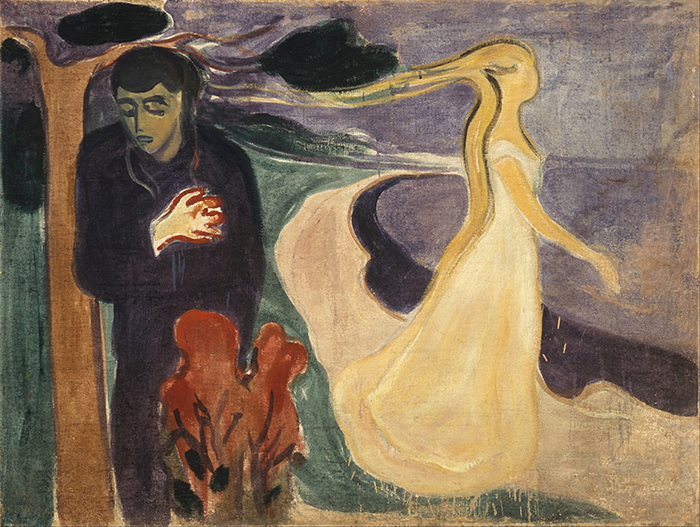
Separation (1896), oil on canvas by Edvard Munch in the Munch Museum, Oslo, Norway (Wikimedia Commons). This unnerving picture was finished the year after George Moore published the bleak stories of Celibates (1895), a book that extended and put some finishing touches on morbid fancies he anatomized in the 1880s. George’s stewing pessimism later resonated with the gloomy dreamscape in Edvard ’s “The Frieze of Life” (of which Separation was part). Both Norwegian artist and Irish novelist embodied tragic themes of love and loss in their work. Is Edvard ’s female figure, as she faced an ominously dark sea, the departing soul of the crazed Kitty Hare? Is she the panicked Agnes Lahens fleeing to a convent shelter after her gross brush with worldliness? Or is she the disconsolate shell of Mildred Lawson, gravitating back to her sterile home in England sans virtue, vocation, and fortune? All three characters and their male counterparts seem to live in Munch‘s picture, though the artist and novelist did not know each other. Still, they observed life from likewise dreary perspectives, wrestled with insoluble problems. and anguished over tensions that fragmented the human condition during the Fin de Siècle.
GMi Worlds and Letters have been on two tracks of development, running parallel from month to month but nowise in sync. These tracks are about to intersect, albeit briefly, before resuming their separate ways.
My curation of Celibates this month brings the digital archive of George’s world-building up to 1895. There are still a few gaps to be filled, but after Celibates George Moore kept mostly out of sight as a world-builder until 1898, when he published Evelyn Innes.
Coincidentally this month, with my curation of George’s correspondence of 1897, my digital letters archive is poised to expand into 1898. Our world-builder and letter-writer are going to converge in October!
I’m not promising revelations from the convergence, since the letter-writer rarely aired the creative process and unresolved concerns of the world-builder. His letters tell us where he was, what he was doing, whom he was with on a given day, but they don’t reveal many particulars of his literary inspiration, research and composition.
I infer from this reticence that the man of the world who wrote letters and the author who wrote novels were two different beings in the same body; Jekyll and Hyde, so to speak. That’s somewhat paradoxical, because the novelist mined his real-world experience for character and plot, all the time!
Much as George expropriated his activities, relationships, and domiciles for use in his fiction, he generally didn’t share details about his writing in letters to his social network. For the most part, he let his creative writing speak for itself.
That may be why family and friends were surprised to find themselves turned into literature. At least in his letters, George didn’t tell his models what to expect in his books and evidently preferred to ask forgiveness rather than permission for his treatment of them.
The Kind of Person
What kind of person was George Moore? I’m not asking about his biography, but the man himself.
As far as I’m aware, this question has not been answered convincingly. We have memoirs of George by those who met him, and researched accounts by those who didn’t. All have this in common: latent subjectivity.
Under a mask of objectivity, they reveal as much about the observers as the person observed. They replace a human being who lived once upon a time with an artifact that didn’t.
Take for example the substantial biographies of George Moore by Joseph Hone and Adrian Frazier, published about sixty years apart. What readers found between the covers were two artifacts rather than a singular person: two scorecards that allow readers to check the conventional boxes of narrative portraiture.
But they didn’t find the vital subject, the man himself.
This is not surprising. There is no “definitive” biography of George Moore (or any great writer); and I doubt there ever will or should be. When it comes to literature and art, the word “definitive” is nonsensical in any case.
All we really have in these and similar biographies are portraits of the artist from points of view that were brought to bear, rather than sprung from the subject itself.
This is obvious in the Iconography of George Moore and uncontroversial. The painters and photographers who rendered George actually produced many different and dissimilar images. Each was self-expressive, none was definitive; nor would anybody want or expect them to be. The absence of certainty and uniformity in the visual portraiture is a strong indication of the subject’s complex and elusive humanity.
With all due respect for “complex and elusive humanity,” to me the question about what kind of person remains crucial. If we somehow get and make use of an answer, it might further activate our understanding and appreciation of George’s phenomenal literary legacy.
It might free his legacy from stodgy and hackneyed opinions that pin him to stultifying intellectual boulders or float him over our heads like a pedagogical piñata.
Because — let’s face this fact together and tediously say it again — George Moore has been underserved by caretakers of his legacy (including me).
His creative achievements are today mostly ignored, his contributions are explained away, his books and articles are generally unread except by curious garbage pickers. The once-vibrant voice of the grand old man is now unheard or marginalized to a fraction of its historic scope and worth.
And that has been true for more than 50 years, at least since the time I started paying attention.
Given George’s seemingly irrevocable obscurity, why did I start GMi (now summing up to nearly 2,000 web pages and rapidly growing)?
As I may have said before, I didn’t do it to shore up the author’s flagging reputation or free him from critical trammels. Those things really don’t matter to me.
I did it, specifically, to empower George to do all of that (and more) for himself!
In his own words and voice (not mine or others), to rejoin conversations that he left many years ago and which continued without him; and to participate in fresh conversations that are just getting started.
Not to ventriloquize George with my picayune theories and discoveries, but to empower him to speak for himself about himself.
That’s a revolutionary agenda with benefits that could spread across the humanities with the aid of advanced technology. Just imagine for any author or artist:
To empower [fill in the blank] to speak for themselves about themselves
Get it? Empowering George Moore is not a destination; its the first leg of an epic curatorial journey.
What Kind of Person?
This brings me back to my initial question, “what kind of person?” The enabling technology of empowerment I mentioned is simulation.
A high-fidelity simulation of George, grounded in GMi, may help to restore his voice and agency. It may wipe the blackboard clean, so to speak, and send Pooh-Bahs packing when the author himself gets his turns to speak.
After all, wouldn’t you rather listen to a fabulous author talking about his life and work than somebody who never even met him? Good, I’m glad we agree about that.
But to simulate George, I’ll need to do more than “check the conventional boxes.” I’ll need to ascertain “the kind of person” he was in real life and will now become in a second life.
That will involve identifying or approximating his personality quirks, body language and facial expressions, the sound of his voice and movement of his hands as he spoke, his eyes when he looked intently into another’s or looked away when his patience famously expired.
Real people pay very close attention to details like these when they’re with somebody and present in the moment. Ironically or necessarily, such quirks and foibles are largely missing from scholarly accounts of historic figures. As if they don’t matter, but they more than matter; they’re crucial.
I have hypothesized that George’s quotidian language and ideas may be reliably inferred from his literature. Why? Because as a writer, he was always self-expressive.
He modulated his prose in a spoken idiom, presumably his own. I speculate that the style of his written language was also the way he talked. I can think of no other explanation for his remarkably fluid prose and penchant for dialogue.
Because George wrote as he spoke, his memoirs seamlessly crossed the line into worldbuilding; his fiction crossed the line into recollection. He was not undisciplined or egotistical, far from it. He was integrative.
I think it will be possible to abstract a high-fidelity simulation of his conversational syntax, cadence, vocabulary and rhetorical finesse from his literary legacy. After the legacy is fully curated, with the help of machine learning and large language models.
His reanimated self in GMi should be able to say pretty much what the living George would have said a hundred years ago, even when discussing subjects that are new to him. And say it in a lifelike manner.
Outlandish? Of course. Technically feasible? You bet. Certain to succeed? Not even close. Worth trying? God yes!
Don’t Touch Me
Writing last month about Celibates: “I vaguely recall that doleful collection of stories as a throwback or piece of unfinished business, a collection of ideas that escaped the wastebasket. But was it?”
Now that I’ve reread the book, I’m sure it is not what I misremembered! You can decide for yourself. The text is live on GMi as an archive of Google Docs, an ebook, and a portfolio of four PDFs that you may upload to AI apps for guided analysis and interpretation.
I have elsewhere written that naming was not a core strength of George Moore, and Celibates was no exception. I won’t speculate how many readers in 1895 would enthusiastically reach for a new book under that title, but probably not many. The implicit subject matter lies somewhere between mundane and repellent!
However that’s not why I object to the title. Instead it’s because the title doesn’t really intimate the subject of the book.
Consider the dictionary definition of a celibate (the noun):
a person who abstains from marriage and sexual relations
Though details were not explicit, Mildred Lawson seems to have had sexual relations with one or two men before accepting the marriage proposal of a third.
Kitty Hare had no objections to sexual relations and accepted the marriage proposal of John Norton. On the other hand, John Norton identified with Peter Abelard (page 451), hardly a paragon of celibacy.
Agnes Lahens was only sixteen years old when she left her parents’s home for a convent, but not to avoid sexual relations or marriage. She was too immature for both.
If Celibates was not really about celibacy per se, then what was its subject?
For Mildred Lawson, the likely answer is this:
For her chastity was her one safeguard, if she were to lose that, she had always felt, and never more strongly than after the Barbizon episode, that there would be no safety for her. She knew that her safety lay in her chastity, others might do without chastity, and come out all right in the end, but she could not: an instinct told her so. (page 247)
Chastity is not a synonym of celibacy. Turning again to the dictionary for help, I find that chastity is:
the state or practice of refraining from extramarital, or especially from all, sexual intercourse
As I understand the word, chastity does not preclude sexual relations and marriage, it merely shelters them in a protective moral shield.
Mildred’s chastity was not a vow of celibacy but a lifestyle choice that ensured her autonomy and agency. She needed independence and freedom; she needed “self-realisation” (page 279); her aversion to sexual relations and marriage was triggered by men who threatened rather than reinforced her legitimate needs.
Kitty Hare was a virgin until her rape, and violence destroyed her, but I don’t think she was crazed by the loss of her virginity per se. Labeling Kitty as a celibate would be a misreading of her character.
Kitty’s fiancée John Norton was the titular celibate in the story, except that egomaniac might be a better description of him. “He was as unfitted to the priesthood as he was for marriage”; neither celibate nor chaste, but a sort of obsessive-compulsive wanker.
As already mentioned, the adolescent Agnes Lahens was not old or self-conscious enough to opt for celibacy. She did not rush back to the convent to preserve her virginity, but to escape the vulgar claptrap of her disgusting parents.
True, she did not like the role of debutante in a first season, but that wasn’t the issue. The issue was her mother trying to pair her with creepy older men with money.
If Not Celibates?
So what was the real subject of Celibates and what might have been a better title?
The subject, I would say, was personhood: the challenges faced by people, especially young women wanting to be themselves in a male-dominated society that has other ideas for them.
I could elaborate, but so can you if you read and ponder the stories from your own perspective. Or ask AI to help.
And a better title? Don’t Touch Me seems more fitting than Celibates. The book is really about why that phrase is spoken by practically every young woman who assumes she will be respected and reinforced as she grows, until she isn’t.
That Question Again
I want to return for a moment to my earlier question: what does Celibates say about the “kind of person” George was?
I think he was one who didn’t think carefully or strategically about the titles of his books. And also one who thought very deeply about their meaning and consequences.
A pretty cool person, to be sure.
Next Up
By now it goes almost without saying that George Moore’s letters of 1898 are going on the workbench in October, along with his novel Evelyn Innes (1898).
George was in middle age, secure in his reputation, at the end of a massive effort to write a novel that seemed beyond his artistic reach and the ability of readers to fathom. We’ll see how that turned out out.
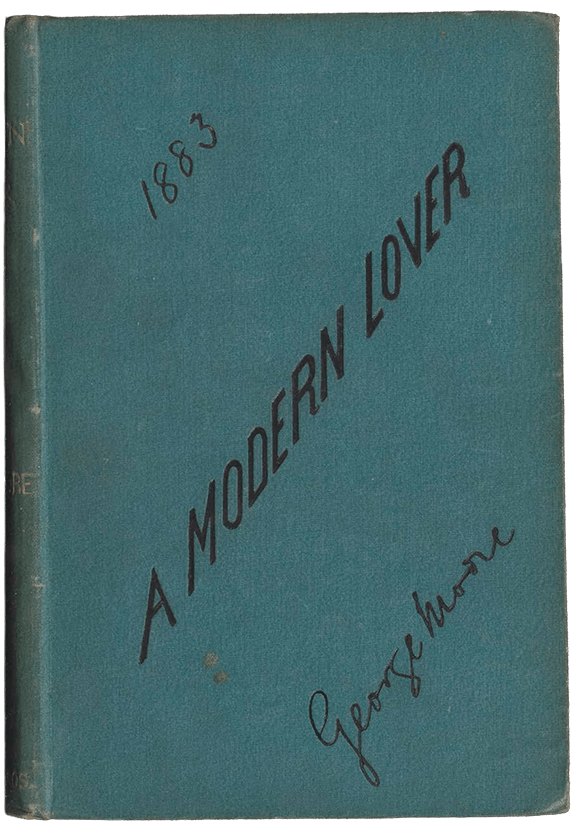
I haven’t forgotten my promise to curate the first edition of A Modern Lover (1883) for GMi, but I don’t own a copy to scan. Every copy that has come up for sale while I was watching was purchased for a relatively insane amount of money, not by me.
However a sympathetic collector is having his copy scanned for GMi, and the results should arrive soon. This will be the first time that the first edition of A Modern Lover has been digitized.
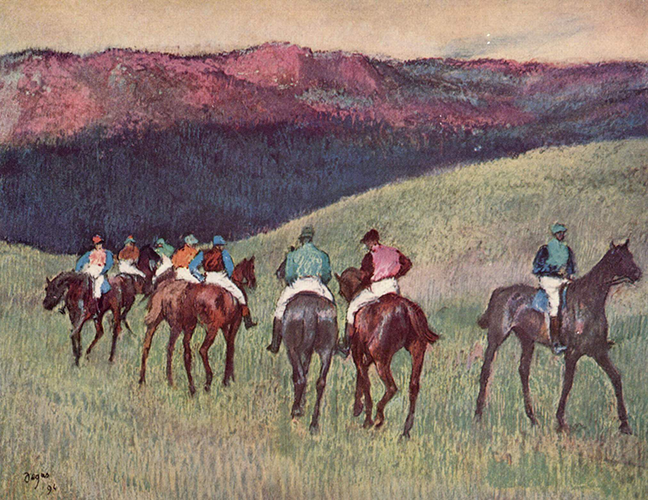
Racehorses: Training (1894), pastel on paper by Edgar Degas in the Carmen Thyssen-Bornemisza Collection of the Museo Thyssen-Bornemisza, Madrid, Spain (Wikimedia Commons). The impressionist artist finished this landscape with racehorses around the time that his friend George Moore, after years of research and writing, published the celebrated Esther Waters (1894). There is no known connection between the picture and novel, but it looks as though Edgar visited Woodview, in the environs of Shoreham-by-Sea, West Sussex in order to paint the Barfield stable in the weeks before the Chesterfield Cup. “At the end of the coombe, under the shaws, stood the old red-tiled farmhouse in which Mrs. Barfield had been born. Beyond it, downlands rolled on and on reaching half-way up the northern sky.” — Esther Waters (1894, page 372). Is Silver Braid one of those mounts? Is the Demon one of those elfin riders?
In last month’s newsletter, I promised to post a clean PDF of every book by George Moore published by GMi. My PDFs may facilitate the uploading of books to a generative AI application for guided analysis and interpretation.
While keeping that promise, I had to make a new Apple Book of Martin Luther (1879); what had been the last Kindle edition remaining in the GMi Shop; also the only ebook with a price higher than zero.
When I revisited my transcription of Martin Luther to make an epub, I decided this time to strip out the byzantine page layout and typography of the printed original that made it hard to use. The new ebook is now more readable by humans and machines, and the price of course is zero. Yay! (Google Docs of Martin Luther are unchanged.)
Every book transcribed so far for the Aesthetics pillar and Worlds pillar of GMi now has a downloadable PDF on its menu page. Every new book that is added to the site gets the same treatment, starting today with Esther Waters.
I am recommending Google’s Notebook LM as a superb AI research assistant, but you can use the PDFs with any AI application you like. You have options, but please don’t stubbornly resist the call of AI!
Generative AI is scary-good. It’s the fast-approaching future of textual analysis and literary criticism, not to mention pedagogy in the humanities. And there is no better way to use AI than as a very smart crowbar on the literary treasure chest of George Moore.
Revving the Search Engine
This section of the newsletter is about the mechanics of GMi — a subject of interest to practically nobody other than me. Still, it’s important and leading to a minor breakthrough. At a minimum, Bob Becker is excited!
Before I rev, please note the definitions of two keywords: page and document. The former in this context means a WordPress webpage. The latter means a Google Doc. That is what page and document mean every time I utter them.
NB. WordPress is a brand shared by WordPress.org and WordPress.com. GMi subscribes to .com’s proprietary, feature-rich authoring apps and hosting services; .com licenses .org’s open-source content-management system.
When you type georgemooreinteractive.org in a browser, WordPress.com servers sling the GMi website to your desktop or handheld device (they know the difference). I made and continue making the website with WordPress.com software.
Most GMi pages are dichotomic, meaning they’re dynamically comprised of two discrete parts:
Part One is white text and colorful imagery on a black background. This is the page.
Part Two is black text on a white background. This is a document that is separately published to the web and embedded in the page.
Embedded means that the page, as it opens, calls the document from a remote server — so fast that you can’t see it happen. The page and document pop to your screen from different servers, even from different parts of the world, like a magic rabbit pulled from a hat.
Both page and document display text. That said, you might ask: why not just put all the text in the page and omit the document?
Good question!
The simple reason is that text in documents is easier to edit and manage than text in pages. Moreover lengthy text in documents makes the GMi website lighter, faster, and nimbler as it grows larger and more complex. The design of GMi content is “object-oriented.”
A lighter, faster, nimbler website is great for visitors who know what they’re looking for. They use menus to find data; it comes quickly to their screens.
But menus only list topics that are relatively abstract. Many visitors can’t find what they want using menus, or they can but it takes too long. Instead of menus, they would prefer to use keyword search to find what they need.
There is already a WordPress search bar in the footer of every GMi page for just that reason. Seems reassuring, but it isn’t. Keywords entered there are found in pages, but not in documents.
Why? Because WordPress search reads only words in pages; it can’t read words in documents. You and I can; it can’t.
Up to now, the only way to search documents on GMi has been to open a page and use the search or find option of the browser. That option can read the document displaying on the screen. However it can’t read the documents elsewhere on the website.
If you follow this convoluted explanation, you may see the problem. What’s lacking at present is the ability to perform keyword search on all pages and documents published by GMi: millions of words, instantly, all at the same time, from anywhere on the website.
I didn’t know how to fill that gap. WordPress advisors didn’t know how to do it. Consultants I asked didn’t know how to do it. But ChatGPT figured it out in a few seconds.
The solution (efficient, but still to be implemented and tested) is a Google Programmable Search Engine (PSE).
I must create a PSE that can read Google Drive folders where the documents are saved and published to the web. I add more documents to this Drive almost every day, and that’s okay: the PSE keeps up with changes.
So far so good, but because there is valuable information in pages as well as documents, I must configure the PSE to read pages too. Ergo every word that George Moore wrote and every word that I have written about George gets indexed by the PSE!
When this is done, the last step will be to place a new search bar in the footer of the GMi website, always there for visitors when it’s needed.
That, my friends, is what I call revving the search engine. Not only will it make a literary legacy more accessible and usable, it will also add a quantum leap in interactivity to the simulation of George Moore that is already on the horizon and heading our way.
Call the Midwife?
Nearly a century after George Moore wrote his brilliant autobiographical trilogy, an English nurse named Jennifer Worth wrote one of her own.
George’s was named Hail and Farewell! in three volumes: Ave (1911), Salve (1912), and Vale (1914). You’ll find them all on GMi (plus PDFs to share with your AI study-buddy).
Jennifer’s was named Call the Midwife in three volumes: Call the Midwife (2002), Shadows of the Workhouse (2005) and Farewell to The East End (2009).
Though Jennifer never mentioned George (to my knowledge), her trilogy had much in common with his novel Esther Waters (1894). In their books, both authors were inspired, with indignation and empathy, by “how the other half lives.” Both acknowledged, candidly described and honored the struggles of women in a society that objectified and mostly took women for granted.
And of course, both authors were awestruck by the moral and aesthetic paradigm of mother and child. If she had read Esther Waters, Jennifer would surely have endorsed what George wrote about his protagonist:
Hers is an heroic adventure if one considers it: a mother’s fight for the life of her child against all the forces that civilisation arrays against the lowly and the illegitimate. She is in a situation to-day, but on what security does she hold it? She is strangely dependent on her own health, and still more upon the fortunes and the personal caprice of her employers. Esther realised the perils of her life very acutely; she trembled when an outcast mother at the corner of a street stretched out of her rags a brown hand and arm, asking alms for the sake of the little children. Three months out of a situation, and she too would be on the street as flower-seller, match-seller, or — (Esther Waters, 1894, page 163)
As a flower-seller, yes. but not one like Eliza Doolittle in George Bernard Shaw’s Pygmalion (1913). Esther was a creative force, not a man’s creation. “I should ’ave liked quite a different kind of life, but we don’t choose our lives, we just makes the best of them” (page 294).
Unfortunately Esther couldn’t be dolled up by an egomaniacal professor to live happily ever after. In life, as her author understood it, no one ever is.
On Television
Every year since 2012, a series on television based on Jennifer’s memoirs has been broadcast in the UK and the USA. I’m a fan; I have watched it from the beginning and want it to continue forever, God willing.
Just prior to Call the Midwife, its producer Heidi Thomas revived Upstairs, Downstairs, a hugely successful television series of the 1970s. Upstairs, Downstairs is another analog of Esther Waters, likewise set in London just a few years later and focused on the servant class (or caste). You can stream the original and the reboot (I did).
It’s too bad that Heidi didn’t consider Esther as her next project. Maybe there’s still time?
Actual to Plan
I promised last month to transcribe A Modern Lover (1883) for GMi, but printed book scanning at UDelaware is taking a while. Rather than sit around twiddling my thumbs, I shifted to Esther Waters: it is now available on GMi in various formats.
Esther Waters was many things, among them a fresh beginning for its hard-working but frustrated author. The story once again took place in Sussex and London, but gone were several unpleasant characters that George had reprised since his career as a novelist began with A Modern Lover.
Gone too was the short sprint. Esther Waters had 142,000 words in 49 chapters. It was George’s largest project since A Mummer’s Wife (1885) with 174,000 words in 30 chapters.
Esther Waters is far too rich in meaning and drama to be summarized here. In my opinion, it’s a masterpiece and magnum opus. I must only mention the striking minor character of Sarah Tucker, whom I forgot until revisiting the novel and now keep thinking about.
Sarah is a decadent counterpoint to Esther, almost the subject of a different story that George didn’t write. Sarah is perhaps truer to life than Esther is; she may be our dour and pessimistic author’s reminder that hardship and sacrifice don’t necessarily, or even usually, lead to redemption.
After Esther
Esther’s illegitimate son Jackie was mostly raised by Mrs. Lewis, a foster parent who lived at 13 Poplar Road, Dulwich. I mention that here because George’s next big project, a duology he took several years to write, featured a heroine who also called Dulwich home.
As age and solitude overtake us, the realities of life float away and we become more and more sensible to the mystery which surrounds us. And our Lord Jesus Christ gave us love and prayer so that we might see a little further. (Esther Waters, 1894, page 369)
So said the devout Mrs. Barfield to her worldly son. So may Evelyn Innes say in George’s new story about to be written.
In the afterglow of success and celebrity with Esther Waters (1894) and after taking care of unfinished business with Celibates (1895), in 1896 George pivoted to full-time research and development of his ambitious duology Evelyn Innes (1898) and Sister Teresa (1901).
He was no longer a writer of realistic or psychological fiction (his brand) or a columnist in the London press (his job). Instead he self-consciously became (truly what he always was): a dreamer. He threw himself wholly into spiritual, ethereal and symbolist themes.
His immersion in Wagnerism catalyzed the pivot, and his excitement about the revival of ancient music cemented it. He became more mindful than ever of intangible, invisible, nonverbal powers that spring from and act upon human nature.
He could feel Yeats coming around the corner!
His pivot also offered an escape hatch from fin de siècle decadence and growing feelings of revulsion from materialism (feelings that triggered his repatriation to Ireland at the turn of the century).
On a less lofty level, the pivot satisfied the needs (according to me) of our inveterate contrarian to avoid doing the logical, expected, normal, agreeable, self-aggrandizing thing. Rebel-producer George always enjoyed finding ways to break things and remake them with a difference.
According to me, 1896 was also the year his daughter Nancy Cunard was born. Her birth isn’t mentioned (at all) in the letters. His affair with her mother was a carefully guarded secret, but an acknowledged fact nonetheless. We can only infer what Nancy meant to him from his future devotion to her, and perhaps from the loving testament to parenting he wove into Esther Waters.
Letter to Tolstoy
A gratifying achievement among the letters of 1896 is the inclusion of George Moore’s only letter to Leo Tolstoy.
I learned about it 45 years ago but hadn’t seen it until yesterday when the Leo Tolstoy State Museum (Moscow) sent me photographs. They also sent a revealing letter to George that he was honored to receive and proud to share with the great Russian novelist. Both letters are here.
George’s well-known first love of Balzac was certainly not his last. He was a huge fan of Tolstoy and Turgenev, and Dostoevsky to a degree. The Russian masters provided a roadmap away from French naturalism towards his emerging ideal of symbols and spirit.
Next Up
Having just renewed my acquaintance with the spinster Miss Rice in Esther Waters, I’m now looking forward to meeting her kith in Celibates (1895). I vaguely recall that doleful collection of stories as a throwback or piece of unfinished business, a collection of ideas that escaped the wastebasket.
But was it? Best way to find out is to put it up on GMi, and help my human and machine readers form their own opinions.
I have also got the letters of 1897 on the workbench. I can’t promise anything as surprising as a letter to Tolstoy, but we are not about picking and choosing the tastiest morsels at the banquet. Let’s enjoy it all!
Ophelia (1890), oil on canvas by Jules Lefebvre (Wikimedia Commons). Jules was an instructor at Académie Julian in Paris when George Moore studied there; afterwards he surfaced in George’s art criticism and memoirs. He painted Ophelia around the time George wrote his seventh novel, Vain Fortune (1891). Picture and story exude similar morbid sensuality. Though she was not mentioned by the theater-obsessed author of Vain Fortune, Shakespeare’s Ophelia evidently inspired his construction of the deranged Emily Watson: one of three main characters doomed to striving after wind. Like Ophelia in Hamlet and Kitty Hare in A Mere Accident (1887), Emily was a beautiful girl driven mad by circumstances beyond her control.
One of the (many) nice things about publishing digitally is that new data (such as more letters) may be added instantly, at any time, and not have to wait on the vagaries of print publication.
Moreover stakeholders such as scholars and collectors, who may have fresh data, now have a digital place to put them. That’s not the old-school way of doing things. It’s a better way!
Based on a glance at the bibliographic record,1895 looks like a quiet interval for George Moore. He was basking in the critical and commercial glow of Esther Waters (1894). He had correctly predicted that novel would be his masterpiece while writing it, though it followed a long line of “not-quite” projects.
From a scholarly perspective it looks like George by 1895 was comfortably settled in his new reputation of distinguished man of letters. The contrarian rebel-producer finally got a seat in Parnassus! He published only one new book in 1895, the precious Celibates, and that was partially a redo of an earlier novel.
But the real action in 1895 was genetic rather than literary. The love affair George had started in 1893 with Maud Alice Burke, when she was 21 and he was 41, blossomed into heady adultery in April 1895, after she agreed to a loveless marriage with the improvident and financially stretched Sir Bache Cunard, 3rd Baronet. The letters show that George and Maud were enjoying sexual relations around the time their daughter, Nancy Cunard, was conceived in June 1895.
The question of George’s paternity has remained open over the years. He claimed in the 1920s that he was Nancy’s biological father; Nancy denied it in the 1950s; Maud was ambivalent; Bache was a passive cuckold, happy to have his young wife’s money, if not her loyalty, in a marriage of convenience.
Since there is no possibility of genetic testing of descendants, we shall have to believe what we choose to believe. IMHO, George Moore was, without a doubt, Nancy Cunard’s father.
Pesky Essays
At the request of Resurgam directors, last month I submitted nine “fundable” GMi projects for consideration. By fundable I mean theoretically worthy of investment by virtue of intrinsic and extrinsic values. The board recently met to discuss and choose the first project to develop.
That project is the same as one I targeted with a lame Gofundme Campaign: acquire 83 essays of George Moore uniquely stored at the British Library for the Aesthetics pillar of GMi. My Gofundme Campaign didn’t raise nearly enough money for this. Time to try again.
Once those 83 outlier essays are rounded up, digitized, edited and published, all of George Moore’s art and literary criticism will be restored to his living legacy and freely accessible to everybody who wants to read it (including machine learners).
I’m talking here about ±600 essays averaging 2,000 words apiece: around 1,200,000 words altogether. That is a huge slice of George’s output that we are restoring in the digital age, as we never could before.
The next question (of several) to decide: will I myself travel to London to curate the 83 outliers in the Reading Room of the British Library? Or will Resurgam recruit a contract laborer who lives in London to curate the outliers on my behalf? The first option incurs travel expenses but no labor costs. The second option incurs labor costs but no travel expenses.
I’ll let you know in August what we decide. Meanwhile, if you’d like to make a tax-deductible donation to the project, or provide contract labor in London, contact Resurgam with your offer.
Striving After Wind
“I have seen everything that is done under the sun, and behold, all is vanity and a striving after wind.” — Ecclesiastes 1:14 (ESV)
Much of George Moore’s autofiction of the 1880s is now live on GMi. That said, his comédie humaine stretched well beyond Mike Fletcher (1889) into his next novel Vain Fortune (1891), the novel after that Esther Waters (1894), and his collection of stories Celibates (1895).
He didn’t stop there, of course. His duology Evelyn Innes (1898) and Sister Teresa (1901), which he began writing in mid-1894, was also autofiction, but I vaguely recall that his characters and settings were all new.
(Not sure about that because it’s years since I read the duology. I’ll confirm after GMi publishes both titles later this year.)
Like the novels and memoirs that preceded it, Vain Fortune was the vision of a contrarian rebel-producer on the fringe. The novel is difficult to summarize briefly because it tells a bifurcated story, consisting of two parts that have little to do with each other.
Part the First
The first part is largely set in the Fitzrovia (Bloomsbury) neighborhood of London. The main protagonist is a middle-aged writer named Hubert Price: a clever but marginal playwright who strives to become the English Ibsen.
Hubert writes serious plays for a groundbreaking literary theater that doesn’t exist except in his imagination. There was no such a theater in London at the time. The closest Hubert got to one was a gratuitous production by actor-manager Montague Ford at the Queen’s Theatre in the West End.
Early readers of Vain Fortune would have recognized Montague Ford as a simulacrum of Herbert Beerbohm Tree, a prominent actor-manager at the Haymarket Theatre. From time to time, George Moore tried to interest Tree in his writing and ideas.
Hubert was a simulacrum of George Moore himself — at least the very large part of George’s ego that wanted to write plays.
George’s pretensions to a literary theater started long before Vain Fortune. They dated all the way back to his composition of Martin Luther (1879), which he tried (unsuccessfully) to have performed in London.
A bit later in his career, A Mummer’s Wife (1885) was not about literary theater per se, but nonetheless it was literature about theater. Still in the zone!
More recently George’s pretensions had taken the form of advocacy. He promoted André Antoine’s Théâtre Libre in Paris and co-founded J. T. Grein’s Independent Theatre in London.
A few years hence, he would also get sucked into the Irish Literary Theatre (predecessor of the Abbey) as a co-founder with W.B. Yeats and Edward Martyn.
Though George was a skilled and moderately successful novelist and essayist, he persistently (and futilely) sought to expand his range as a playwright too. Why did he bother?
On a philosophical level, like Hubert in Vain Fortune, he wanted to reform commercial theater in London, endowing it with artistic and educational affordances. On a practical level, also like Hubert, he simply wanted to write really good plays that would fill seats and make some money.
Neither ambition was fulfilled, though this “striving after wind” was noble and culturally beneficial.
I don’t understand why George Moore the novelist and essayist wanted so badly to be a dramatist as well, but a study of Hubert Price in the first part of Vain Fortune would probably help to explain.
Hubert’s philosophy, his writing techniques, his relations with theater people, his excellent dramatic ideas that somehow failed to materialize in a script, his views of the acting profession and tastes of the public — all of this fiction reads to me like an actual conversation with George Moore as he strived for his own just-out-of-reach breakthrough dramaturgy.
For a time he thought he achieved a breakthrough with his play The Strike at Arlingford (staged in February 1893 but developed as he wrote Vain Fortune). He was disappointed, not by critical reviews, which were positive, but by his own scruples.
Part the Second
Midway through Vain Fortune the storyteller pivoted. Hubert the impoverished genius inherited the “fortune” of the novel’s title. He moved to his inherited property of Ashwood Park in Sussex, where the “vain” of the title would be worked out.
Ashwood Park is a simulacrum of Buckingham House, the beloved home of the Bridger family near Shoreham-by-Sea. We’ve been there before, under different names in previous novels, and we’ll return again in Esther Waters (1894) where it will be named Woodview.
Ashwood Park (and its other incarnations) was an idyllic country house and farm, spun into a venue for twisted ambition, quiet suffering, unrequited love, and meaningless death. Weirdness in a pastural setting!
By the way, my colleague Michael O’Shea recently visited the ruins of Buckingham House and shared his photos on GMi. Its dilapidated condition is even worse than Moore Hall, but nonetheless holy ground for readers of George. You can view some of Michael’s pictures here.
The second part of Vain Fortune is practically a different story from the first; the two are barely related, a fact the author recognized during the book’s initial publication and hastened to correct.
Vain Fortune thus became the first project in which George Moore obsessively revised his text on the proof sheets and between successive editions. From 1891 onwards, he behaved somewhat like a manic nitpicker: a potter who couldn’t bring himself to remove his formed clay from the wheel but needed to keep improving it.
Female Trouble
There is much fine writing and thematic development at Ashwood Park. The most curious and meaningful part of the novel, according to George himself, was a basket case named Emily Watson.
She is an extreme striver after wind, an Ophelia-like victim whose mental illness is ever present though ambiguous and just a bit out of focus.
Beautiful, desirable, intelligent, intensely sensitive, young and innocent, lacking agency, irritating, demanding, vulnerable, resentful of the male gaze: Emily is the real subject of the novel, one that the author backed into, not realizing her importance until most of the book was already written.
She is the quiet counterpoint to Rose Massey of the first part, as though George had two stories about young women to tell and didn’t know where to begin.
The more profound story in the second part of the novel is about Emily Watson and also her older companion Julia Bentley. We get an inkling of the problem in Julia’s confession:
My life has been essentially a woman’s life, — suppression of self and monotonous duty, varied by heart-breaking misfortune … You think you know the meaning of poverty: you may; but you do not know what a young woman who wants to earn her bread honestly has to put up with, trudging through wet and cold, mile after mile, to give a lesson, paid for at the rate of one-and-sixpence or two shillings an hour. — Vain Fortune (pages 287-288)
This depressing revelation will linger in George Moore’s imagination and get resolved, less pessimistically, in Esther Waters.
For now though, all is vanity. As in the fiction that preceded it, there is no happy ending in Vain Fortune, only an unsatisfying consolation:
“Hubert!” It was Julia calling him. Pale and overworn, but in all her woman’s beauty, she came, offering herself as compensation for the burden of life. — Vain Fortune (page 296)
Should you decide to read the first edition of Vain Fortune on GMi, remember that the book underwent significant revisions as soon as it was published (actually, even before).
Read the first edition as a draft and the editions that followed as truer expressions of the author’s intentions. The revised editions are not on GMi (yet).
Beyond the two regular ways to engage with Vain Fortune there is a third way which may be best of all. I call it Vain Fortune AI.
This is a PDF of the novel that you can download from GMi and upload to Google Notebook LM (or the AI assistant of your choice, though none is better than Notebook LM).
Uploading the PDF to Notebook LM will enable you to interrogate and interpret the text with machine intelligence, which sadly is greater than yours or mine; and also do some transformational things that I’ll leave you to discover.
Mind you, uploading to Notebook LM is not a substitute for reading the text (though it could be for people in a hurry). It complements reading.
Speaking metaphorically (as I have before), submitting a text to Notebook LM is comparable to turning a still image into a moving picture. The experience brings a novel to life!
Vain Fortune AI adds so much value to George Moore Interactive that I have decided to create AI versions of all the titles I previously published. I will do that over the next few weeks and continue when new titles are added.
AI versions will make it a little easier and more fun for casual readers to engage with George Moore’s literary legacy! And for scholars to investigate.
Next Up
Next month in addition to making AI versions of books on GMi, I will publish the first edition of A Modern Lover (1883).
No digital scan of this novel — George Moore’s first — is available on the Internet. Thanks to the Mark Samuels Lasner Collection at the University of Delaware Library, that’s about to change!
Beyond these two milestones, I will put George Moore’s letters of 1896 on the workbench.
From 1896 until the turn of the century, George’s love affair with “Saxon” England waned and his flirtation with “Celtic” Ireland became more and more irresistible.
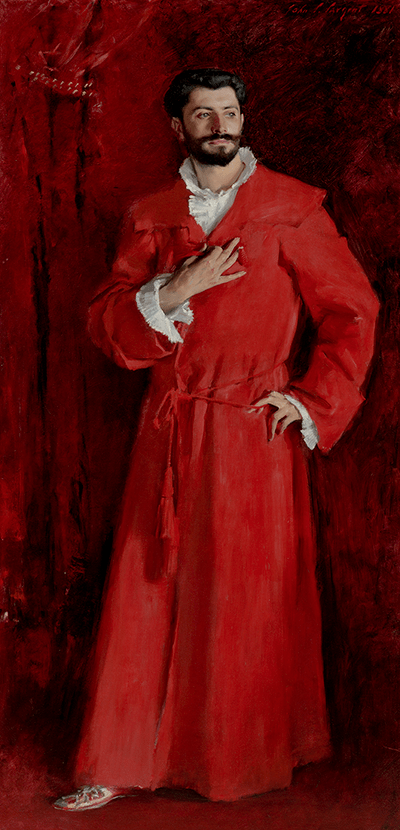
Dr. Pozzi at Home (1881), oil on canvas by John Singer Sargent in the Hammer Museum, Los Angeles (Wikimedia Commons). Because ineluctable charisma is part and parcel of Mike Fletcher, I put this picture on the cover or the eponymous novel. Sargent painted the debonair French gynecologist while George Moore was beginning his literary career, sifting through recent life experiences that he would memorialize in Mike Fletcher (1889) and other stories. Like the character Mike, the fashionable doctor was intelligent, sensual, artistic, successful — though not a Don Juan. It’s easy to imagine him sharing a flat in the Temple with Frank Escott, having his full English breakfast after a night of cultivated debauchery, looking just like he did in Sargent’s portrait and just like Mike Fletcher did in George’s wayward imagination.
A rare and wonderful thing has appeared: a new edition of a book by George Moore! Not a reprint, not an academic monograph, but the real McCoy (albeit dressed in scholarly finery). Move over Susan Dick!
Expansion of Edwin’s A Bibliography of George Moore is one of nine projects that Resurgam will be asked to fund. Edwin’s published data stop in 1988, though he kept collecting until he died in 2002. His papers at Arizona State University may yield new bibliographical entries when they’re scrutinized. He told us they would.
Beyond reviewing Edwin’s legacy, though, libraries and the Internet will be searched for George Moore’s books and pamphlets, contributions, periodical publications, and translations that made it into print over the past 25 years. We shall find them! They shall be corralled!
There probably aren’t many unknown publications because the eclipse of George Moore is relentless (despite the efforts of a few nonconformists). That said, whatever GMi finds with the support of Resurgam will merge with the digital Bibliography, so that George’s marvelous literary legacy will be fully up to date, updatable, freely accessible, and poised for long-awaited growth.
And the other eight projects? I’ll write about them in a future newsletter. With a little bit of luck, GMi may soon be hiring.
Boys Club
I’ve said that George Moore’s fiction between A Mummer’s Wife (1885) and Esther Waters (1894) is like a walk through the valley of the shadow of death. Then, each time I reread one of the dark volumes, I change my mind. They are flawed but not bad. They are conflicted but not defeated.
Mike Fletcher (1889) is the latest title to change my mind. The edited digital text is now available, chapter by chapter, on GMi; a free ebook is in the GMi Shop. Assuming that you already have more books than time to read, I should try to explain why Mike Fletcher may be worthy of consideration.
I offer two arguments. One is aesthetic in the spirit of art for art’s sake. Read Mike Fletcher because it burns with a gemlike flame! The writing is good, the theme is meaningful, the characters are interesting, the local color shimmers. My second argument is parochial. Read Mike Fletcher to deepen your slim understanding of the man who wrote it.
Parochial
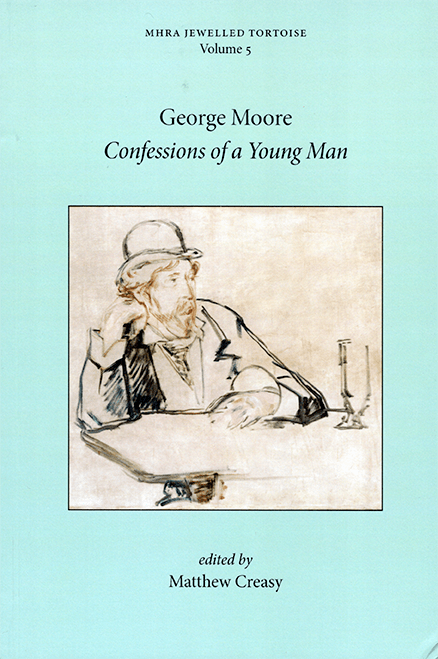
Turning first to the parochial, I remind you that Mike Fletcher (1889) was written around the same time as Confessions of a Young Man (1888). The first book is a memoir, the second is a novel, but both were written by a young man who was keenly, avidly self-aware (ergo full of himself).
So it shouldn’t surprise us that Mike Fletcher is borderline memoir, just as Confessions of a Young Man is borderline fiction.
Want to know what life was like in London’s Temple in the 1880s, when George lived there? Mike Fletcher informs us about that, in detail. Mike and George lived in the same building, maybe even the same flat.
Want to know what life was like for Irish journalists in Fleet Street when George was one of them? Mike Fletcher informs us about that too. The novel is fondly dedicated to Augustus Moore, George’s lascivious brother and collaborator who modeled the characters of Mike Fletcher and Frank Escott (both Irish). Escott’s Pilgrim was an analog of the Bat and the Hawk, real weekly newspapers that Augustus edited and George contributed to.
I haven’t studied the text of Mike Fletcher in order to write a monograph (you’re welcome), but I’m pretty sure that a good one could be written, defending my hypothesis that Mike Fletcher is as autobiographical as Confessions. “Only the names have been changed to protect the innocent.”
George as a self-taught, self-directed writer was a shapeshifter — crossing the frontiers of literary genres without a guide, experimenting with different styles of self-expression. In a creative quest to tell his truth, he did not mind if the subject matter was real or pretend. The invented Mike Fletcher has a lot to say about the historic George Moore.
Aesthetic
The other reason to read Mike Fletcher is for enjoyment. Candidly, I’m not sure how enjoyable the novel is! The experience of line-editing is not compatible with losing oneself in a story. Yet I think Mike Fletcher can be read in 2025 for its own sake.
In addition to introducing the Pozzi-like main character, the novel reprises Frank Escott from Spring Days (1888), John Norton from A Mere Accident (1887), John Harding and Alice Barton from A Drama in Muslin (1886), Dick Lennox from A Mummer’s Wife (1885), and Lewis Seymour from A Modern Lover (1883). George may have been brewing a mini Human Comedy in the 1880s, so it’s worth keeping up with his people.
I refer to Mike Fletcher as a Boys Club because George wrote it as the obverse of A Drama in Muslin. He told the story, as he saw it, of wasted young female lives in the earlier novel; now he would tell the story of wasted young male lives “of my generation.” How utterly sad!
Maybe more important than plot or character, Mike Fletcher dwells on — dare I say it? — the “timeless theme” of Don Juan. I hesitate because George’s erstwhile publisher William Swan Sonnenschein told him, when rejecting George’s submission, that the very idea of reimagining Don Juan in 1888 was preposterous and uncommercial. (George Bernard Shaw wasn’t copied on that letter). George took his project to Ward and Downey, an offshoot of William Tinsley, the publisher of A Modern Lover.
As if to cozy up to readers in the twenty-first century, Mike Fletcher began with the sexual assault of a young woman. The Me-Too movement did not turn up in a lot of Victorian fiction, but it did here. True to life if not wishful thinking, Mike was not remorseful. His lusty bravado continued throughout the novel, even reverting to his first victim as she lay dying of tuberculosis. Mike was attractive and disgusting, yes, and that was partly George’s point.
You have to wait until the end of the novel for the point to be made, not just in horrid actions but in pessimistic philosophy:
His life had been from the first a series of attempts to escape from the idea. His loves, his poetry, his restlessness were all derivative from this one idea. Among those whose brain plays a part in their existence there is a life idea, and this idea governs them and leads them to a certain and predestined end; and all struggles with it are delusions. A life idea in the higher classes of mind, a life instinct in the lower. It were almost idle to differentiate between them, both may be included under the generic title of the soul, and the drama involved in such conflict is always of the highest interest, for if we do not read the story of our own soul, we read in each the story of a soul that might have been ours, and that passed very near to us; and who reading of Mike’s torment is fortunate enough to say, “I know nothing of what is written there.” Mike Fletcher, Chapter 11, page 295.
Mike is a kind of Meursault, fifty years before that existential anomaly strolled along an Algerian beach. He is a carrier of “life force” before George Bernard Shaw dressed it in a positivist cape. He is the masculine ideal that dominates the entertainment arts today: intelligent, sensual, artistic, successful — and brutal once lofty sentiments are swept aside. “I alone am alone! The whole world is in love with me, and I’m utterly alone” (page 263).
I suppose it isn’t a spoiler to reveal that Mike takes his own life rather than conform in a world that idolizes him. I have to tell it because that detail is vital to the novel’s relevance today. Suicides are increasing at alarming rates, while civilization is bent on mass extinction. We are strangely, incoherently self-destructive.
George Moore recognized something like that in the 1880s and chose to do the unpopular thing: write a book (actually a series of books) exposing it. Not very uplifting, I grant that, but still very cool.
Letters Update
The letters of George Moore on GMi are now complete through 1894. What about that year stands out in his legacy?
The publication of Esther Waters on 1 March 1894 was a milestone in his career. Before that he was, to put it mildly, in a pickle. It’s fair to say that he had touched bottom and seemed unable to rise again.
On the personal side, his Irish estate was producing no income because of political turmoil. Moreover his mother’s siblings were threatening financial ruin by demanding payment of a large debt forgotten for twenty years past.
On the professional side, all seven of his novels had been ranked indecent and banned by the country’s leading booksellers (his eighth would also be banned).
His stalwart publisher Henry Vizetelly had died after being prosecuted, driven into bankruptcy, and imprisoned for publishing books that George had recommended and helped produce. Other publishers who then stepped up for George didn’t stay long.
His only critical and commercial success in fiction was nearly ten years old. The novels he published before and after A Mummer’s Wife were pretentious, moody, unpleasant for the most part though well written, and sold poorly.
As he finished writing Esther Waters for the Newcastle publisher Walter Scott, his submission of the manuscript was declined by America’s three leading publishers and accepted by none, resulting in his loss of American copyright.
As a novelist, George was not making a lot a money and not receiving much respect or encouragement from critics or readers. He was about to come out with the untoward story of a promiscuous servant girl who gets impregnated by a boyfriend who then abandons her. It is the life story of an uneducated, nearly unemployable, distressed single mother with no prospects.
What could go wrong?
What amazes me about George at this time, and really at all times, is his resilience. Facing very strong headwinds, he did not complain, did not adapt to the market, did not change his profession. did not shut up, did not stop working as hard as he could for his “life idea.”
He behaved like a character in Samuel Beckett’s The Unnamable, as he responded to massive adversity with something like: “Where I am, I don’t know, I’ll never know, in the silence you don’t know, you must go on, I can’t go on, I’ll go on.”
And then suddenly, practically overnight, against all odds, he was the author of a masterpiece.
Editorial Principle
I’ll take a moment to reiterate an editorial principle concerning the letters, and really everything GMi publishes.
The letters on GMi are digital. Unlike print, they are not typeset, not pressed with ink on to paper. The letters are interactive.
When readers of the letters know something that I don’t know, they can share it right there on the web page, alongside the transcribed letter, with me and our community of interest.
If they own a morbid fascination with George’s bad spelling and punctuation, they can link to the manuscript owner for access to the source material. I correct errors in my transcriptions to make them readable and coherent.
Most importantly, if we learn about letters that are missing from GMi, we can add them the moment they come to light. No waiting for a second edition to come out. No detours to a journal or supplement.
The digital letters of George Moore are a living edition that will grow and improve over time if our community shares what it knows.
I love publishing like this, and pricing the publication of a literary legacy as it should be priced for the benefit of all: free.
Next Up
I feel pretty sure that I haven’t convinced anybody to read Mike Fletcher. Thank God for machine learners who can do the heavy lifting for humans!
Next month, I will add Vain Fortune to the Worlds pillar and the GMi Shop. I don’t know if it’s a happier story; I can’t remember. The title doesn’t augur well. We’ll soon find out.
Next month I will also put the letters of 1895 on the workbench. The character John Norton returns yet again in 1895, like an itch George couldn’t stop scratching. Evelyn Innes will start an itch of her own, emerging from the moody depths of George’s now celebrated soul.
In Chapter 12 of George Moore’s Spring Days (1888), Frank Escott tells Lizzie Baker, “I want to paint you in a white dress sitting on a garden seat with a background of azaleas — something very faint in white and pink.” Frank and his creator George may have been inspired by Auguste Toulmouche’s Woman and Roses (oil on canvas, 1879), now at the Clark Art Institute (1955.877) in Williamstown, Massachusetts: “A young woman in a spotless white dress has paused, while strolling through a well-tended garden, to enjoy the fragrance of a cluster of pink roses.”
Resurgam NFP is the grantseeking and grantmaking organization that kickstarts literary legacies in the digital age. If you wish to donate to George Moore Interactive, please send your money to Resurgam and earmark it for GMi.
This deft two-step will ensure that 100% of your donation gets used according to your wishes. Your donation will be objectively managed and accounted for, and the tangible results of your generosity will be reported back to you with thanks.
The two-step will also ensure that your donation is tax-deductible (if you’re located in the United States), which would not be the case if you donated directly to GMi. Here’s a Resurgam page that explains how it works.
Resurgam is an independent, 501(c)(3) not-for-profit corporation that echoes and reinforces the aims of George Moore Interactive but with a difference. The difference is this: GMi is kickstarting one particular literary legacy, whereas Resurgam wants to animate every legacy — literary, artistic, musical — bequeathed to our world by creative geniuses of the past.
The technology for kickstarting literary legacies has already been invented; it is known by the rubric generative artificial intelligence and is doing amazing things, though not the things that GMi is pioneering. Visit Resurgam’s Comparisons page for more about that.
With useful technology that is now available and the reliable promise of more powerful tools to come in the next few years, all that remains for George Moore to live again is to put our human feet on the kickstarter and push down forcefully.
My foot has been pushing forcefully for George Moore. Now with around 1,700 pages and posts on this website, and more appearing day by day, I can feel the rumble though the handlebars in my grip. I’m thrilled and ready to take the next steps.
But readiness begs the question: what are the next steps? How far into the future can I see when claiming that I’m poised to accept your donation? To be honest, not very far.
I founded GMi with a concept rather than a program; a vision rather than a plan. I wanted to make stuff like a builder rather than talk about stuff like a professor. That action-orientation allowed me to leapfrog important questions such as: What is my program? What is my step-by-step? What are my milestones and endgame?
The recent formation of Resurgam has forced me to step back and consider. Before now, I was happy just to crank out content, with a methodology and a sense of direction, but without a program per se. That has changed.
It changed because, after starting a Gofundme campaign that fell short of my goals, I’m now planning to ask Resurgam for financial support, and I can’t do that without a program; in other words, without short and long term plans.
I realized this as I prepared Resurgam’s bona fides as a legal not-for-profit. Part of that involved joining Forefront, and as a result of joining Forefront I joined Candid. Candid is the organization that runs the Foundation Directory and Guidestar.
To cement my membership in Candid, I needed to state Resurgam’s own program. I did that by pondering the (nonexistent) program of GMi as I had never done before.
The result is not one but four linear Resurgam programs, each of which represents fundable activities that are sanctioned by Resurgam’s mission and for which Resurgam accepts donations.
Resurgam may evolve into other programs as well, but these four are a complete statement of the work being done and planned by GMi.
Consider:
Program 1: Digital Curation
Digital Curation (DC) locates, organizes, scans, transcribes, edits, annotates, illustrates, and preserves the meaningful and influential contents of aesthetic legacies. Legacies prioritized by Resurgam are literary, artistic and musical from antiquity to the twentieth century. DC is foundational to more advanced programs supported by Resurgam.
Program 2: Access to Cultural Heritage
Access to Cultural Heritage (ACH) follows our DC program. ACH publishes and otherwise disseminates the contents of curated legacies in machine- and human-readable digital formats. ACH is limited to formats that are free and easy to use by the general public and compatible with the training of large language models owned by corporations. ACH permits few (if any) technical, financial, and geographic barriers to entry to a curated legacy.
Program 3: Machine Learning and Artificial Intelligence
Machine Learning and Artificial Intelligence (MLAI) follows our DC and ACH programs. MLAI engineers curated and published legacies to ensure they are open to computerized and human-prompted textual, visual and quantitative analysis. MLAI optimizes digital legacies for self-assembly, self-correction, self-validation, date-stamping, cross-referencing, interpretation, elucidation, and correlation with the critical heritage. MLAI synchronizes different digital legacies that have overlapping content.
Program 4: High-Fidelity Simulation
High-Fidelity Simulation (HFS) follows our DC, ACH, and MLAI programs. HFS enables curated, published, and engineered legacies to speak for themselves (by demonstrating autonomous self-awareness and dynamic self-expression). HFS manifests in interactive, lifelike conversations between aesthetic legacies and human interlocutors. HFS may be achieved in digital modalities including chatbot, natural-language processing, speech synthesis, virtual- and augmented-realities, and computer-generated imagery (CGI).
✱ ✱ ✱
Up to the present, everything GMi has achieved aligns with Resurgam Programs 1 and 2, though a lot more remains to be done in those programs. Programs 3 and 4 are still prospective, but here they are defined whereas before they were dreamlike.
When I submit my grant applications to Resurgam, and when you tender your donation, we will have to be clear about program fit. No longer happy to crank out content for its own sake, the work that may be deemed worthy of funding must explicitly advance a program objective.
The Worst Novel?
Last month I corrected my mistake in calling George Moore’s A Mere Accident (1887) the worst novel ever written. That dubious distinction purportedly belonged to Spring Days (1888). Worst according to a literary critic whom George respected; worst according to the bewildered author himself.
I promised to transcribe, edit and publish Spring Days, my way of exhuming the victim of literary malfeasance and performing forensic analysis. I have performed it, and now so can you.
My personal opinion of Spring Days is not rancorous. To me, it isn’t a terrible novel; it’s not even a bad novel. As usual when surveying this part of George’s legacy, I’m calling it an experimental novel.
Our ambitious author had a modernist axe to grind, a serious thematic purpose, a good dramatic idea, characters that live on and between the lines, and a richly colored mise en scène.
That said, it is also true that the novel didn’t cross the finish line as a memorable achievement. Not then, not now.
One problem is the title, which sucks (as usual). If you read the book you may wonder, on page after page, why is it named Spring Days? That vague, not catchy title has nothing to do with the plot! The actual words “Spring Days” turn up once, at the very end of the last chapter, almost like an afterthought or the relic of a different novel that was never written.
Another problem is inconsistency. Chapters range in length from 1,000 to 22,000 words. Granted there is no rule that chapters of a novel must be similar in length, but the disparities here look like flaws of construction, reminding me of the Buster Keaton movie One Week (1920) except the movie is funny and this novel isn’t.
A more serious problem with Spring Days is the changing subject matter. At first the story is about the Brookes family: the widower James, his young adult daughters Grace, Maggie and Sally, and his son Willy. The three sisters are foregrounded, like Alice and Olive Barton in A Drama in Muslin.
But no, the narrative soon drifts away from the girls in favor of their pathetic though genuine brother Willy, at first a minor character who unexpectedly grows into a significant moral presence. But that too doesn’t last.
Willy’s friend Frank Escott, at first little more than a colorful detail in the background, suddenly becomes the novel’s main protagonist.
Each of these human loci would be fine as the subject of his or her own story, but the succession of stories, without much in the way of segues, tested this reader’s enjoyment of Spring Days.
If Frank Escott truly is the unrivaled protagonist of Spring Days, that would make sense because he walks and talks like an author surrogate, somewhat like John Norton in A Mere Accident and John Harding in A Drama in Muslin.
Don’t get me wrong, these three men have as many differences as similarities, but a case can be made that George Moore performed in these novels as a ventriloquist whose speech and perceptions were at least partially embodied in Escott, Norton and Harding.
Of course it isn’t necessary for an experimental novelto have a main protagonist because, in my opinion, this novel’s raison d’être is a fictional rendering of the author’s real-life friends the Bridger family and their homes near Shoreham-by-Sea in Sussex.
That helps explain Frank’s rented home in nearby Southwick, where George Moore actually lived while writing Spring Days. From this point of view, it is easier to explain the purported differences between Celt and Saxon, that bubbled to the surface of the novel from time to time.
Frank and George living in Southwick were Irish, the Brookes and the Bridgers living in Shoreham were English. Exploring the evident ethnic differences between these tribes is probably what made Spring Days a worthy project for a renegade disciple of Émile Zola.
(Coincidentally while preparing Spring Days for GMi, I acquired cartes de visite of Harry Colvill Bridger and his daughters Florence and Dulcibella. They are published on the Bridger pages of the GMi Iconography. Use the search bar to find them.)
As mentioned earlier, apart from biographical and sociological interests, Spring Days exhibits a serious novelistic purpose. The purpose is intimated in the following quote, one of several in the book that wax philosophical:
A man’s struggles in the web of a vile love are as pitiful as those of a fly in the meshes of the spider; he crawls to the edge, but only to ensnare himself more completely; he takes pleasure in ridiculing her, but whether he praises or blames, she remains mistress of his life; all threads are equally fatal, and each that should have served to bear him out of the trap only goes to bind him faster. A man in love suggests the spider’s web, and when he is seeking to escape from a woman that will degrade his life, the cruelty which is added completes and perfects the comparison. A man’s love for a common woman is as a fire in his vitals; sometimes it seems quenched, sometimes it is torn out by angry hands, but always some spark remains; it contrives to unite about its victim, and in the end has its way. It is a cancerous disease, but it cannot be cut out like a cancer. It is more deadly; it is inexplicable. All good things, wealth and honour, are forfeited for it; long years of toil, trouble, privation of all kinds are willingly accepted; on one side all the sweetness of the world, on the other nothing of worth, often vice, meanness, ill temper, all that go to make life a madness and a terror; twenty, thirty, forty, perhaps fifty years lie ahead of him and her, but the years and their burdens are not for his eyes any more than the flowers he elects to disdain. Love is blind, but sometimes there is no love. How then shall we explain this inexplicable mystery; wonderful riddle that none shall explain and that every generation propounds?
Spring Days (1888), pages 361- 362.
By this point in the novel (the end), Frank Escott the amateur painter was becoming a novelist, exactly the life trajectory of his creator.
His mind was absorbed in a novel, which he narrated when Willy came to see him. It concerned the accident that led a man not to marry the woman he loved, and was in the main an incoherent version of his own life at Southwick.
The letters of George Moore, published on GMi, are now complete through the year 1893. Perhaps the most interesting aspect of George’s life in 1893 was his hard, experimental work on Esther Waters (1894). This time, the experiment ended in success!
I cannot begin to fathom how George rose, in just a few years, from the bucolic South Downs of A Mere Accident and Spring Days to the urban contest of Esther Waters, except to note that there was a segue: Esther Waters opened in a fictional version of the Bridger home, Buckingham House.
In my view, the most plausible explanation of George’s rise from A Mere Accident and Spring Days to Esther Waters (by way of Mike Fletcher and Vain Fortune) may be found the old saw: he pulled himself up by his bootstraps.
His ability to do that again and again over the course of his career is probably what endeared him most to fans like me. George was an experimentalist and, like a lab scientist, his failures were as numerous as his successes; even more numerous (maybe)!
Somehow he was not deflated or discouraged when he missed his mark. Like Samuel Beckett in another generation, he concluded with “I’ll go on.” Or to put that in George’s words:
I shivered; the cold air of morning blew in my face, I closed the window, and sitting at the table, haggard and overworn, I continued my novel.
Confessions of a Young Man (1888), page 357
Next Up
Letters from 1894-1895 will be next up in the Letters pillar of this website.
By the way, thousands of George Moore’s letters are preserved in known institutional libraries, but an unknown number of others are in private collections. For example, I own a few MSS.
Privately owned letters have turned up over the years in bookseller catalogs, but not otherwise found. I have not figured out how to track them down in the digital age, but my intuition is that there is an efficient way. Suggestions are welcome!
The novel Mike Fletcher (1889), another miss for George, will be next up in the Worlds pillar of this website and the GMi Shop. I first read it a long time ago and have zero memory of it now. Bracing myself!
Wanderer above the Sea of Fog (1818), by Caspar David Friedrich in the Hamburger Kunsthalle (Wikimedia Commons). According to curators of The Soul of Nature at the Metropolitan Museum of Art in New York (until 11 May 2025), this romantic artist notably “reimagined European landscape painting by portraying nature as a setting for profound spiritual and emotional encounters.” Nicely put, and much the same could be said about the novelist George Moore when he wrote A Mere Accident (1887). Yet George was not a romanticist; he was an avant-garde experimentalist sundering the shackles of French naturalism. Tired, perhaps, of observing nature for its own sake, he pivoted to an examination of character as lofty, complex and unsettling as Friedrich’s mountains. With mixed results.
I’ve heard that “April is the cruelest month,” but I don’t really believe it. Good things happened here in April 2025, starting with three ebooks that turned up in the GMi Shop:
A Mere Accident (1887)
Impressions and Opinions (1891)
Modern Painting (1893)
The chapters of these ebooks are also available online: A Mere Accident in the Worlds pillar of this website, the others in the Aesthetics pillar.
Humans can freely download or read George’s writing online. Machines can autonomously ingest it into search engines and large language models, where incredible new value will surely be unlocked.
That unlocking is an example of what I mean by kickstarting literary legacies in the digital age.
My priority up to now has been George’s nonfiction — what he wrote about himself and his lived experience. Most of those horses are now in the barn.
I’m still chasing 88 print essays that are uniquely preserved in the British Library. They’re the target of a sleepy Gofundme campaign to cover the cost of fetching them.
Although now, there’s a new turbocharged fundraising initiative in the works!
Resurgam NFP
In April 2025, the US Internal Revenue Service endowed Resurgam with tax-exempt status as a 501(c)(3) not-for-profit Illinois corporation. This milestone completed the bona fides of Resurgam as a grantseeking and grantmaking enterprise.
Foundations, businesses, and individual benefactors all over the United States can henceforth deduct their grants, gifts, and contributions to Resurgam from federal and state tax returns. Additionally, Resurgam will be exempt from paying sales tax in Illinois on purchases that support its mission.
But what is the mission? Resurgam’s specific aim is kickstarting literary and artistic legacies in the digital age. That’s a concise way of promising to use advanced information technology to curate, publish, animate and simulate creative masters and masterworks of the remote past.
The aim is underpinned by three formal purposes, each with a particular meaning, protocol, and impact:
Educational
Literary
Scientific
I’m so excited about Resurgam that I’m tempted to write about nothing else today. But I don’t need to do that.
Why? Because a new website is emerging online that tells the story. After the static pages are published, I will start writing monthly newsletters from there. With my collaborators, I will also produce prototypes, demos, and proofs-of-concept of various ways the mission will be fulfilled.
My Role with Resurgam?
Yours truly, Bob Becker. is the executive director. I am one of five directors on the board. In addition to board duties, I lead operations. In the foreseeable future, operations are entirely about communication and fundraising. After successful raises, they will expand to board oversight of funded projects.
Resurgam and George Moore Interactive?
Resurgam formed to address the exciting and formidable needs faced by projects like GMi. It exists to nudge any worthy historic literary or artistic project towards futuristic technological goals.
“Projects like GMi” does not mean limited to GMi. The kind of research and development I do for George Moore’s legacy can be done by others for other legacies that are completely different and equally deserving.
For example, a friend of mine has a project on the bibliography of Max Beerbohm. Another friend has a project on the paintings of John Lavery. If they chose to kickstart Beerbohm or Lavery, Resurgam would consider helping them.
Likewise I have two friends (who may be reading this newsletter) who deeply appreciate the legacy of James Joyce. Oh, what a ripe subject that puzzle-maker would be for a kickstart, IMHO!
Caveat: Resurgam will not go looking for projects to back, but it will consider assisting people who come calling with an understanding of our mission.
If you’re a potential donor to, or partner of, Resurgam, I invite you to follow the new website. Likewise if you’re a researcher, writer, artist, publisher, engineer or scientist seeking funding for a bold venture in the digital humanities, let’s get coffee.
Kant or Cant?
George Moore researched and wrote his experimental novel, A Mere Accident (1887), while living among friends near Shoreham-by-Sea, Sussex, under the South Downs near Brighton. He dedicated the novel thus:
To My Friends at Buckingham.
Nearly twenty years have gone since first we met, dear friends; time has but strengthened our early affections, so for love token, for sign of the years, I bring you this book — these views of your beautiful house and hills where I have spent so many happy days, these last perhaps the happiest of all.
G.M.
Buckingham House (Thornby Place in the novel) was home to the Bridger family, who nicknamed their friend “Kant” because of his relentless philosophizing. The same behavior is (unfortunately) evident in the novel.
A Mere Accident is a bildungsroman about John Norton, owner of Thornby Place. He has unexplored affinities with John Harding in A Drama in Muslin (1886). Both characters model an aestheticism that interested their author. It is tempting to view the Johns as projections of their author’s ego, but I don’t know about that.
John Norton is probably not a caricature of George Moore, but he has George’s contrarian independence and ambition to figure things out for himself. And by things, I don’t mean screwing in a lightbulb.
John wrestles with “the hideous laws of the world and the flesh, ever at variance and at war, and ever defeating the indomitable aspirations of the soul” (A Mere Accident, page 165).
Yikes!
Alternately thrilled and tormented by religion, art, architecture, and moral philosophy on one hand, and by love, sex, furniture, property management and nature walks on the other, John is a kind of juggler with a lot of balls in the air. I didn’t notice many that dropped.
I could go on and on about this good bad novel, but instead I am going to let generative AI do the talking for me. If you are fairly new to creative uses of AI, this demo may be a nice surprise.
To prepare for the demo, I uploaded my transcript of A Mere Accident to Google’s miraculous Notebook LM in the cloud and asked the app to create a podcast about the novel.
I did no heavy lifting.
I did not tell Notebook LM what to think or say. It may have reached some arguable conclusions, but even if it did, the resulting conversation is nothing short of delightful. Certainly more lively and entertaining than what I and a stuffy professor would sound like on a panel.
And mind you, Notebook LM took about 30 minutes to read the novel, analyze it, script and record a 15-minute conversation between two voices that sound like real people (they are not).
So have a listen. If you like what they say about A Mere Accident, download the book or dip into it online.
If you like what AI does with literary material, subscribe to George Moore Interactive.
Next Up
Last month I reported that A Mere Accident was the worst novel ever written. I was mistaken. That distinction belongs to George’s next novel, Spring Days (1888). Please forgive me.
This is what George wrote about Spring Days:
Everybody is abusing Spring Days. The papers say it is the worst book I have ever written, and one well-known critic says it is the very worst novel he ever read. A writer may elect to put his life into one book (Baudelaire did this in his Fleurs du Mal). Or he may elect to spread himself over fifty volumes (Balzac did this in the Comédie humaine). But once a writer elects to spread himself over a number of volumes it seems to me that he must not only create new methods but he must from time to time recreate old ones. I am a great admirer of Jane Austen and I said to myself, “I will recreate Jane Austin’s method in Spring Days. It was an attempt not to continue, but to recreate, Pride and Prejudice, Emma, etc. Apparently I have failed horribly. Fortunately I have an article in the Universal Review for this month entitled “Mummer Worship”, which is attracting a good deal of attention, and this may help to sell Spring Days. [Letter to Clara Lanza, 1888-09-23]
I feel bad about inadvertently dissing A Mere Accident, so to make up for that, next month I will resurrect Spring Days from its (well-deserved?) tomb. And then I will ask AI if, in fact, it is the worst.
Can any novel in history be worse than Richardson’s Clarissa or Joyce’s Finnegan’s Wake? Hard to imagine, we’ll have to see.
Hateful Ebooks
A friend from long ago recently published an essay in The Atlantic entitled “Ebooks Are an Abomination.” He advanced the concept of bookiness, by which he meant the physical properties of printed books that resonate with readers, most of which are lacking in ebooks.
He loves the tangible aesthetics of bookiness.
As a publisher of ebooks and a believer in their utility, who is also a lifelong collector and reader of printed books, I can see his point and also disagree with it. Not because of personal preferences, which long ago I decided have no bearing or interest beyond the tip of my nose.
I dispute the attractions of bookiness for these reasons:
Many people no longer read books, of any kind, at all
Of those who do read books, many read only the tidbits they care about
Many publishers do not invest in beautiful book production
Many titles are expensive and hard or impossible to acquire
George Moore seems to have loved bookiness. He invested a great deal of his personal time and energy in the production of physical books that matched his literary standards.
At the same time, he abhorred low-rent bookiness: books of cheap paper, cramped typography, and flimsy binding.
Yet the bottom line on bookiness for George is that he didn’t collect books or read many. It’s fair to say that a book for him was only the idea he or another author dreamed up and put into words.
He wanted the physical thing to be nice looking, but as readers of his own editions made from hand-made paper, handset type, and vellum covers can attest, good looking is not the same as readable. Those editions are kind of a nuisance to hold in your lap while pondering the idea.
I revert to the term utility to justify ebooks in the GMi Shop. They may not be beautiful, but they are readable, portable, indestructible, updatable, searchable, printable, and potentially interactive.
Keep Those Letters Coming…
In April 2025, I also ressurected another set of letters on GMi. I transcribed, edited, annotated and published George’s extant letters from the first half of 1893. I would have done more, but sadly dropped some balls despite my best intentions.
(For one thing, I had trouble seeing my computer screen!)
Buying an overhead book scanner last year has turned into a very sound investment. And not just because I got it before the American Mad Hatter put tariffs on China, where Czur scanners are made.
Mainly it’s because the scanner works extremely well. It letts me scan and perform OCR on bound faded typescripts of George’s correspondence with phenomenal clarity and few defects.
Using a Czur scanner is also making me a better user, as is often the case with new technology. Heuristics! My digital publishing process is quite different from what it was a year or more ago, and it’s getting better all the time.
In May, I will finish publishing George’s letters of 1893 begin those of 1894. In George Moore’s hero’s journey, 1894 was the year of leaving the blistering desert and rising to the snowy peaks of Esther Waters. Figuratively speaking.
Like Caspar David Friedrich’s model at the top of this newsletter, gazing at the mountaintops, George had confronted problems that nearly drained him and finally figured things out, for himself, in the blessed year of 1894.
Dance in the City (1883) by Pierre-Auguste Renoir in the Musée d’Orsay, Paris (Wikimedia Commons). Renoir painted this picture in France while his friend George Moore wrote A Drama in Muslin (1886) in Ireland and England. George’s realistic story took place in 1882-1884, so it is easy to imagine Renoir’s model Suzanne Valadon as George’s character Olive Barton dancing through an Irish Social Season. Suzanne and Olive were about the same age; both were wardrobed in fine muslin.
A Drama in Muslin (1886) was George Moore’s third novel and first on an Irish theme. The title is obscure. Even after it was truncated as Muslin (1915), it connoted next to nothing about bildungsroman, Irish identity, or feminism — three mutually reinforcing pillars of the story that were (and are) its selling points. George didn’t explain what his title meant. I guess he expected readers to figure it out.
By comparison, his rival Thomas Hardy had a gift for catchy titles that practically jump off the cover, as if saying “buy me,” or “read me,” or at least “open me and see what I’m about.” For the most part, George did not have the knack.
The title of his first novel A Modern Lover (1883) helped trigger a ban by censorious booksellers who already deemed him a pornographer; the title was revived nearly thirty years later by D.H. Lawrence, who was also deemed a pornographer.
The title of George’s second novel A Mummer’s Wife (1885) used an archaic synonym for entertainer that implied a snarky attitude towards theatrical folk, but said little about the story. The characters in the novel were not in fact “mummers” but musical comedians.
In my opinion, George’s first grippy title didn’t arrive until Memoirs of My Dead Life (1906), and that book was nonfiction. Its title represented the content and had an inviting, poetic cadence, as most of Hardy’s titles did.
So what was “a drama in muslin”?
First, it was not “drama” per se, but prose narrative. In the title, drama loosely refers to riveting emotional events, not theatrical performance (though the story opens on one). Not being a potboiler, such events were actually few and far between in the prose, so calling the novel a drama seems misleading. The title eclipsed the author’s real literary achievement!
And what about “muslin”? Now we may be getting somewhere. Muslin as George used the term is ultra-fine cotton fabric handcrafted in India, the stuff of ladies gowns for formal occasions. Elegant muslin dresses were worn by Irish debutants at the dinners, drawing-rooms and balls of the Castle season.
Muslin generally signifies fashion; in the novel it signified wardrobe that women wore to the marriage market. The most luxurious, most flattering and attractive way to suit up for battle.
Is A Drama in Muslin explicitly about fashion?
It is not, nor is the metaphor of muslin much explained or referenced in his text. Alice and Olive Barton, Violet Scully and May Gould are called “muslin martyrs” towards the end, but there was so much more going on in their life stories that the label barely stuck.
Timely and Timeless
“How does an artist give timeless values a timely form? … I don’t think anybody who cares about the arts hasn’t asked the same question. It doesn’t matter whether your fundamental concern is the musical, visual, literary, or theatrical arts. A frozen academicism is almost inevitably the result when the timeless overtakes the timely. When the timely overwhelms the timeless, all you’re left with is a fad.” — from Jed Perl, “Echoes of Eternity,” New York Review of Books (27 March 2025).
I recently stumbled upon Jed Perl’s pithy dichotomy while transcribing A Drama in Muslin for GMi. It gave me a particularly apt lens for viewing the novel, in which George Moore arguably composed nearly perfect harmonies between timely and timeless content.
Timely in the early 1880s was decadence and Land War in Ireland raging in the background of A Drama in Muslin. The timeless stratum that imbues the story with beauty and pathos was the naive longing of several young women, each rendered as both a type and a fully realized individual.
The aim of each female character was to succeed under circumstances that were anything but propitious.
Like Russian novelists he adored — especially Ivan Turgenev — George did not allow the timeless to overtake the timely. Political upheaval, economic disparity and bigoted injustice were not mitigated by sentimental anxieties and happy or poetic endings. A Drama in Muslin was brutally honest.
Nor did he allow the timely to overwhelm the timeless. Not one of the novel’s 131,000 words obscured, minimized or justified acute personal grievances of his characters in favor of grand ideals or historic events.
Instead, touching sentiments of his young women and momentous events of Irish history coexist in the novel like staffs of elegiac melody: sentiments on the treble clef, history on the bass clef. Like a grand opera or symphony?
George’s novel as a whole is imaginative and realistic. It is a faithful and lofty rendering of life — comparable to Renoir’s painting — that is both timely and timeless, neither frozen academicism nor pulp fiction.
When I read A Drama in Muslin and look at Dance in the City I am mindful of the time and place of their origins; yet I experience them as testaments of truth and beauty in my life. Not either/or but both at the same time.
Secular Humanism (so to speak)
George Moore began writing A Drama in Muslin while still writing his first great novel, A Mummer’s Wife (1885). The new project was a self-conscious pivot away from his mentor Émile Zola and French literary naturalism. But what was he pivoting towards?
Being an artist rather than a polemicist, George did not explicitly state the aim of his pivot. He even tried to obscure it by masking his evolution as role-playing. But a clue to what was really going on surfaced in the course of his storytelling:
“…the ideal life should, it seems to me, lie in the reconciliation — no, reconciliation is not the word I want; I scarcely know how to express myself — well, in making the two ends meet — in making the ends of nature the ends also of what we call our conscience.” — A Drama in Muslin (1886, page 228).
Another dichotomy rendered and resolved. This one involved, not timely and timeless content, but transcendent morality: the knowing or figuring out what is the right thing to do, and doing that without expectations of reward or even appreciation. The arc of George Moore’s moral universe, starting in the early 1880s, was bending toward justice.
It’s ironic that a young man, all of whose books were banned for indecency, was, on the record, in point of fact, one of the more righteous creative writers of his era. I may be overstating that, but it’s worth pondering.
In A Drama in Muslin, he made the ends of nature synchronous with the ends of conscience, albeit unhappily. The story concluded with a melancholy, open-ended reunion of the Barton sisters. Their values and aspirations were preserved and protected in exile, but still unfulfilled.
George’s pivot continued in memoirs he published later in the 1880s. It reached a zenith in his novel Esther Waters (1894).
When I encountered Esther Waters as a student of fin-de-siècle “aesthetes and decadents,” I was immediately convinced that George Moore, more than any of his late Victorian contemporaries, had plucked the brass ring of modernism.
Now I see that moral inklings glimmering in A Drama in Muslin burst into flame in Esther Waters and eventually expanded, during the Great War, into cosmic starlight in The Brook Kerith (1916).
I give the “ideal life” that George envisioned in his fiction the name “secular humanism.” He got there about fifty years ahead of that movement, but the pieces seem to fit. I’m likewise proposing that Alice Barton may be seen as its incipient, feminist standard-bearer.
All of which begs the question: So what? Who cares? What difference does it make?
Claims that A Drama in Muslin is worth reading because it’s a good or great late Victorian or early modernist novel, deeply enriched though generally overlooked, is not a compelling answer. Many people no longer read books, and those who do already have enough good ones on the nightstand without adding another classic tome to the pile.
Reminders that A Drama in Muslin is a pivotal text in George Moore’s legacy and the Western canon generally likewise don’t cut it. Let’s be honest friends, the works of George Moore are like old trees growing in a forest that very few people walk through nowadays; and whether this tree is taller or prettier or more consequential to the environment doesn’t much matter beyond our leaning and crumbling ivory towers.
What matters, maybe, right now, is the contribution A Drama in Muslin makes to our fragile understanding of women, or rather the way our male-dominated society objectifies women for profit and pleasure.
The novel makes a unique, nuanced, engaging and yes, even timeless case for women thriving beyond the male gaze; for girls as innocent victims and also as intelligent, industrious individuals whose lives are trivialized rather than liberated by sexual politics.
Arguments won’t suffice here, there’s no room for that. I’ll try to answer my so-what question with something better than argument: a fantasy.
Imagine, if you will, Suzanne Valadon stepping out of Renoir’s painting, not as a model but a real young woman having fun at a dance. Imagine being introduced to her, learning about her family and background, her talent and hard work, her artistic accomplishments and professional constraints. Imagine being charmed by her pretty face and figure, dazzled by her fearless and candid personality, confused by the possibility that she is not only sweeter, but also smarter and more capable than you are.
Then imagine Suzanne stepping back into Renoir’s painting and resuming the dance with that tuxedoed nonentity whose role in a picture is little more than her drop shadow.
Would you ever be able to look at Dance in the City again in the same simpleminded way you usually look at art? I believe the answer is no, you would not.
Instead you would perceive that Suzanne was a girl like Alice, Olive, Violet and May, likewise dressed in a white cloud of muslin; and I think you would enjoy Renoir’s painting not less, but far, far more than before, knowing who the model was. Her dance would suddenly be full of meaning.
That may be what George Moore accomplishes in A Drama in Muslin today, in 2025, 140 years after he wrote and Renoir painted. That is why the novel still makes a difference IMHO.
The book and painting may enhance our appreciation of art, history, culture, humanity… and yadayadayada. More important than any of that, they entertain and edify in timely and timeless ways. When we let them.
More Letters
Last month I raised the curtain on George Moore’s letters of the 1880s. They are all prim and proper on GMi for human and machine learners.
Now his letters of 1890, 1891 and 1892 are also live on GMi, as always free to read and use.
In the early 1890s George reached his fortieth year; he worked hard and made very little money; he watched helplessly as his private Irish income evaporated in murder and mayhem; he conducted literary and theatrical experiments without much success; and be began work on a masterpiece like no other.
The letters track his moves. Those of 1893 are now on the workbench.
A reminder: the letters of George Moore and other texts on GMi are interactive. They invite commentary. The kinds of comments I am keen to read are corrections and enhancements. If you notice a detail that may be a mistake, call it out. I will be grateful and make amends.
Next Up in Worlds
After publishing 13 ebook titles that are theoretically worthy of fresh attention, my next “windmill” will be one that probably isn’t. It is a novel that George Moore thought was brilliant while writing it, and after publication felt was the worst novel ever written. Not just by him, by anyone.
A Mere Accident (1887) came out after A Drama in Muslin (1886). Can it be as awful as the author (and critics) insisted that it was? Let’s find out.
High Price of Collecting
Just two first editions of George Moore have eluded me over the years: Martin Luther (1879) and A Modern Lover (1883). It’s not that they haven’t been offered, but the asking prices were too high (for me).
Quite recently both books in good condition were auctioned on the same day: one in Ireland, the other in England. As usual, I placed my “reasonable” bids and was promptly crushed. Sale prices were higher than ever!
A Modern Lover sold for £5,500 and Martin Luther sold for €1,300. The take-home costs were about 50% higher, since buyers had to pay commission and tax on each transaction.
I can’t imagine what made these books worth the gargantuan prices paid. They are rare, to be sure, but not unique; moreover they are juvenile works of a disregarded author. I feel pretty sure that when they were taken home from the auctions, they were put on shelves, never to be looked at again (until the next auction).
I would have scanned and transcribed them, and published the texts for all the world to see and use. Oh well, until the next auction….
Dublin Streets: a Vendor of Books, 1889 (Wikimedia Commons) by Walter Osborne in the National Gallery of Ireland, depicting a bookseller on Aston Quay, with O’Connell Bridge and Custom House in the background. I can’t make out the titles of books on the stall, but sensing the avid interest of customers it seems reasonable to suppose that the stock included the recently published Parnell and His Island, by George Moore. Like his friend Walter, George mostly adhered in the 1880s to avant-garde Realism and Impressionism. And like George, Walter struggled to establish a market for his art. Both young men were “neglected innovators” who were later recognized as modernist masters. George’s essays about Irish town and country first appeared in France under the titles of Lettres Sur Irlande de George Moore (1886); then expanded as Terre d’Irlande (1887); then expurgated in Parnell and His Island (1887). All of those essays are now published by GMi.
May I have your attention please? The James Joyce Tower & Museum is about to host a spring lecture in Dun Laoghaire, Ireland. If you’re in, or somewhere near Dublin on 6 March 2025, go to the architectural gem known as DLR Lexicon Library for the event entitled George Moore — A Neglected Innovator. The event is organized by Michael O’Shea and presented by George’s esteemed biographer, Dr. Adrian Frazier.
Rather than showing up unexpected, you may reserve a seat online at the James Joyce Tower and Museum. That way you won’t have to stand at the back of the Studio, wishing life were more fair.
Since one ocean and half a continent separate me from this rare event, I cannot join you there. However as an academically trained snob of sorts, it may be my professional duty to quibble with something, anything, lest I seem uncritical and therefore unthinking.
So I’ll quibble with that adjective, “neglected.” Clayton Christensen’s book, The Innovator’s Dilemma (1997), taught me long ago that all innovators are not just neglected, but also opposed, by incumbents who have invested in the status quo and by a conservative public that resists change.
To call George a neglected innovator is therefore, how shall I say, redundant, since all literary innovators (Joyce included) were neglected (or worse) until they were not (usually postmortem).
George is obviously postmortem, though probably not forever. As you know, GMi is trying to bring him back to life, reanimating him, returning him to conversations he began but didn’t finish, adding him to others he never had, at least to my knowledge. In all things, letting George speak for himself!
Today as in many years past, readers neglect and even oppose George Moore because they must. Like early viewers of Impressionist art, ordinary readers have been led elsewhere, on golden leashes by incumbents in ivory towers.
And unlike Fagin in his cinematic slum, when it comes to George Moore readers rarely or willingly avow, “I think I’d better think it out again.”
And that is fitting. When George is no longer neglected, he will no longer be innovative. He will instead be canonical. That apotheosis is inevitable, alas, but for now you can attend Adrian’s lecture in hopes of having a (potentially) risky, disruptive, unheard of, unsettling epiphany by the time it’s over.
Adrian’s may be comparable to a lecture about the heretic Jimmy Joyce before his legacy became fodder for conformists and pedagogues. Go there, don’t be square, and find out for yourself!
Innovator or Heretic?
I shouldn’t mention Clayton Christensen without also hailing Art Kleiner, author of The Age of Heretics (1996). Both men were public intellectuals — so-called thought leaders — not long after I left my job as a dorky English professor for a hectic career in educational technology.
This was the era of the New Economy when designers, makers and users strove for game-changing innovation in everything (including learning).
Steve Jobs became the poster child of that era — you may remember his 2005 commencement address at Stanford — but he was not alone. I remember my surprise at the intellectual vigor and rigor I found beyond the ivory tower, so much more enlightened and pragmatic than what I experienced in it.
The Age of Heretics made a thrilling case for contemporary innovation by tracing its roots to heretics who, against all odds, refused to conform. One such was Pierre Abelard, also the endearing subject of George Moore’s novel Héloïse and Abélard (1921).
I think it helps to understand George Moore as a heretic, rather more than as an innovator. Heresy involves rocking foundational assumptions, beliefs and aspirations, and that is what George strove to do again and again in his writing and aesthetic activism.
In contrast, innovation is usually more about praxis, about changing the way things are done versus how they are understood and desired.
George Moore was an accomplished innovator in Victorian, Edwardian and Georgian England — he never stopped rocking the boat! And he somewhat relentlessly set aside his commercial interests for the sake of undermining or sabotaging authority and paradigms that triggered him.
For example, soon after finishing Parnell and His Island, his London publisher (who had preemptively expurgated the manuscript) called George out for being self-defeating instead of building his base.
Was George chastened? He was not.
Intead he parted ways with his publisher William Swan Sonneschein, insisting that he would remain true to himself regardless of consequences. The consequences were commercially and critically disastrous.
Yes, of course, George committed these mistakes as an innovator, as an unconventional writer, but even more he did it as a heretic, a disruptive thinker, and perhaps for that reason he shall (as he predicted) rise again.
La Terreur de la Terre
AI-generated voice recording of La Terreur de la Terre
Last month I admitted my failure to scan the French text of Terre d’Irlande. Scanning is the first step of transcription, but it went nowhere. Complicating factors were:
The frail, 138 year-old binding of my physical copy.
Typography on printed pages that tricked my OCR.
Mellifluous French letterforms that defy Gertrude Stein.
Printer’s errors in pagination that were unacknowledged.
It was Gertrude in Paris who wrote that “Rose is a rose is a rose is a rose.” Okay fine, but in French the letter a is an a is an à is an á is an â is an ä etc. etc. and so forth. Enough to cross the eyes of an English-only reader and his trusty machine sidekick.
It would not surprise me to learn that my copy of Terre hadn’t been opened since publication. It was as stiff and reluctant as yours truly after spending hours making transcriptions that nobody may ever read or care about.
I take that back: at least one person must read and care: the angelic Claudette Walsh, native French editor (in Ireland) who is line-editing my transcripts.
Anyway, before Claudette could edit George’s lines, I had to provide lines that were as visually readable to her as a printed book.
It took a while, and the experience taught me this: that not all OCR is created equal! Before Terre, I had been scanning to pdf, figuring that the OCR in Adobe Acrobat was best in class. It is not.
My breakthrough came when I scanned not to pdf but to docx, the format of Microsoft Word. This was not intuitive to me because I’m a Mac and I hate MS Word; I can’t stand its preposterous ribbons full of icons that make me feel I’m looking at my document through a kaleidoscope!
But MS Word was the key! Using my magical CZUR overhead scanner to create bitmaps of page spreads, I converted those images to single pages of machine and human readable Word docs, one doc per chapter (each chapter around 3,000 words).
The results were impressive! The OCR software recognized that a rose is not necessarily a rose, and I was able to develop transcriptions in Google Docs that are close enough to perfect to enable Claudette to wave her wand over the French text. A final sprinkle of pixie dust!
The results of my 40-hour terreur with the Terre are now live on GMi. All twelve chapters, plus the Preface, plus the Conclusion. When Claudette finishes her French review, I will also publish an ebook using Walter Osborne’s lovely painting of a bookseller as the cover art.
Will anybody actually read Terre d’Irlande? I don’t care, and that’s not the important question for me. What matters is, for the first time in 138 years:
Terre d’Irlande will be accessible and readable to anybody who wants it.
Lettres Sur Irlande de George Moore in Le Figaro will be viewable side by side with the pages of Terre that came later.
Expurgations of Parnell and His Island will be detectable by comparing the French text and the English that came later.
A talented writer (Colm Tóibín?) who is looking for a cool project may restore the expurgated text and reverse the censorship.
By this time next month, the ebook of Terre d’Irlande will be in the GMi Shop. And I’ll have moved on to other things.
Starting the Next Decade
Letters of George Moore on GMi now run from 1863 through 1889. Thanks to Claudette, George’s sloppy French is now as readable as his sloppy English (we both corrected paragraph breaks, spelling, punctuation and capitalization).
The 1880s were a thrilling and depressing decade for the young writer. After his juvenile (but proficient) forays in shock-poetry, he came out as a debut novelist with A Modern Lover, but it failed to sell.
Then unexpectedly (even to himself) he scored a bestseller with A Mummer’s Wife. It signaled that a formidable author had emerged from his false starts. But the rest of the decade dimmed that signal, with books that few people bought, and that caused many people to dislike the author peremptorily.
If one word comes most to mind when I look back on letters of the 1880s, it is resilience. George Moore’s response to being repeatedly knocked down was to pick himself up, dust himself off, and try again harder.
As Bernard Shaw (who turns up in letters of this decade) later noted, no writer ever worked harder, with fewer extrinsic rewards, than George Moore. Yet through it all, he stayed calm and carried on, believing in the right and responsibility of the artist to observe truth in beauty, in his own way.
George was a self-conscious innovator, a proud and stubborn heretic, whose intense aspirations seemed to be fortified by failure. After A Mummer’s Wife in 1885, his next commercial success was not in fiction but memoir.
Confessions of a Young Man once again signaled the presence of a formidable author. It pointed towards a future that would someday include Hail and Farewell! That sublime Irish trilogy quietly resonates with the gritty heresies of Terre d’Irlande. Now you know.
George’s letters of 1890 are on my workbench; publication on GMi shall be completed by this time next month!
“I Shall Rise Again”
During the past month, Resurgam added a fifth member to its board of directors, fashioned and refashioned its bylaws, engaged and parted ways with a fundraiser, appointed a treasurer, retained a CPA, and drafted our application to the United States Internal Revenue Service for certification as a 501(c)(3).
A busy month, full of progress, very little inertia and disappointment, all for the sake of Resurgam’s educational, literary and scientific purposes.
The angels who donated to my Gofundme Campaign for travel to the British Library can rest assured: my travel has been delayed but it shall occur! Among myriad other priorities, Resurgam will try to cover expenses that GoFundme couldn’t cover because not enough donations came in.
The Gofundme Campaign is still open and ready to receive your donation, should you decide to jump off the fence. You too can have a hand in exhuming an invaluable portion of George Moore’s literary legacy from the subterranean analog stacks of the British Library, making it freely accessible and useful forever to people everywhere.
But apart from financial support, you can also volunteer your time and skills in meaningful ways, a little or a lot, to advance the bold mission.
For example, I would be delighted to meet an engineer of machine learning who can advise Resurgam on ways to cross the chasm that divides digital publishing from expert systems.
That chasm is already coming into view. Our team needs to prepare for getting to the other side.
Next in the Shop
I long to publish The Brook Kerith on GMi, not because readers are asking for it, but because I only faintly remember it.
My faint memory suggests that The Brook Kerith is a novel whose time has come. In a world where oligarchs, criminals and charlatans are hurting people in the name of Jesus Christ, it is time for a “real” Jesus to get up and knock them down (as he does in The Brook Kerith).
That said, after I add Terre d’Irlande to the GMi Shop, I’m going to stay in the nineteenth century for my next mini project. Having finished work on George’s Irish essays, a next milestone may be A Drama in Muslin (1886).
This was an Irish story written in the afterglow of A Mummer’s Wife, when George was on the cusp of commercial success as a novelist. Alas, he would dangle there for another ten years.