Symbolic self-portrait of Bob Becker? This is an uncaptioned, uncredited illustration in Where to Surf the Biggest Waves in the World(American Oceans).
I’ve worked continuously on George Moore Interactive for the past two years. Well, almost!
I deliberately took my foot off the pedal in November in order to forge ahead on Resurgam where I am Executive Director, Chief Cook and Bottle Washer. I thought I could fulfill my lagging responsibilities to Resurgam in just four uninterrupted weeks, but I was wrong. Six weeks later, I still haven’t closed the gap though it’s smaller now. I need another six.
ResurgamNFP.org has been majorly overhauled. I won’t go into details here, but I did in a recent newsletter named Wisdom featuring a birdbrain. If you can spare the time, have a look at that and do what it says at the end (if you want to be exceptionally nice). Resurgam is the not-for-profit that fundraises for George Moore Interactive and other projects that save the humanities.
You may not have known that the humanities needed saving, and if that’s the case I’m afraid you too haven’t been keeping up. The humanities are dying. GMi is one of the first-responders, probably not the most effective or capable, but nonetheless determined to do what it can to restore the patient to functional health.
Why are the humanities like a dying patient? That question is too lofty for me. I need to chop it into more tangible, experiential, addressable questions, such as:
Why are pupils no longer reading books?
Why are working people not reading much of anything?
Why are educators not slowing the decline of literacy?
Why do scholars exist in a self-serving bubble?
Why are many poems and novels totally inscrutable?
Why is the Fourth Estate going extinct?
Why won’t septuagenarian rockers leave the big stage?
Why are movie theaters struggling to stay open?
Why do publishers fawn over hackneyed bestsellers?
Why do studios fetishize dimwitted blockbusters?
I could go on, but you get the idea, maybe. My questions also raise the specter of cultural illiteracy (my list referred to the language kind). I watch the vulgar and stupid rise, the gifted go into professional exile, the salt of the earth get sprinkled on gold-flaked avocado toast. The humanities are dying because we humans are letting go of them!
So bring on the machines! Machines to the rescue! As I reflected on the journey so far of George Moore Interactive, I decided that the image at the top of this post pretty well captures my feelings about it.
There I am (figuratively speaking) perched on a ten-foot board, just in front a speeding, potentially crushing, monumental cascade of falling water. I see that wave as generative artificial intelligence (figuratively speaking). I am racing to shore before the water can smash me into the sandy floor, as if it wants to.
But it doesn’t want to. Instead the wave is turbocharging my job, providing the height and slope and motion that move me onward without making me paddle or do anything, really, except stay focused, balanced and pointed in the right direction. The wave of generative AI is frightfully powerful and dangerous, imposing awesome risk and responsibility, but it is essentially a blessing, not a curse
I felt this over and over again during my work on Resurgam. I spent hours in conversation with the chatbot. It never told me what to do. Instead it clarified my goals and explained optional ways to fulfill them.
It was usually spot on, but sometimes it told me things that seemed implausible or incorrect. Every time that happened, I followed with more Q&A in which the subject of conversation was scrutinized, reframed, compared and finally resolved to the satisfaction of me and the chatbot.
Because the chatbot was scrupulously judgmental about its answers as well as my questions. It had this delightfully nonhuman trait of admitting it made a mistake and trying again, without shame. At times after long stretches of Q&A, I wanted to apologize for boring the chatbot’s insanely well-informed neural network. When I did literally apologize, it thanked me for persistence and admitted pride in our collaborative results.
This is how I do my think-work now, with a chatbot that knows me and remembers what we’ve talked about, and is ready for anything I toss against the wall between us. And this, IMHO, is how that dying patient of the humanities will likely be restored to functional health.
In the case of GMi, for example, a chatbot that has learned much that George Moore knew, and also knows much that was going on around him, that views reality from George’s privileged but narrow perspective: GMi’s custom chatbot will converse 1:1 with readers, students, educators, artists and anybody else who calls.
What occurs in a call will be as unlike a monologic lecture or dialogic seminar as it is possible for me to imagine, because I don’t have to imagine it. I am enjoying it every day as I work on GMi and on Resurgam. The chatbot has the power to throw open doors of perception. It empowers me and others like me to walk through to the other side.
And what lies on the other side? In a word: the humanities. Literature, art, and music brought back to the life they once lived and want to live again: spontaneously talking with people in their own language, helping them understand and feel what a creative genius did in years past, helping them glimpse how a creative genius would understand things, not just of antiquity, but of today’s reality.
For example, I want to ask George Moore, who died in 1933, what he thinks of Thomas Pynchon, whose first novel came out 30 years later. The Pynchon door has remained closed to my impatient, sardonic mind. I want the help of someone I trust to open it.
I have learned to trust the chatbot. Bring on the machines! 🤖
Next Up
Eight weeks with my head down on Resurgam conclude in December. I’ll have more to do in 2026 along with, rather than instead of, George Moore Interactive. Hold on George, I’m coming back!
I will add the second part of his duology, Sister Teresa (1901) to the GMi digital bookshelf. I will also transcribe, edit, annotate and publish George’s letters of 1899.
He was in his late 40s when he wrote those letters and that novel. In his prime, you could say, except his prime was still to come.
At the turn of the century he was feeling the way I feel now when I view the spectacle of moral turpitude in Washington. He was disgusted by corruption and hypocrisy in imperial London. He soon decided he’d seen enough and left for his native Ireland.
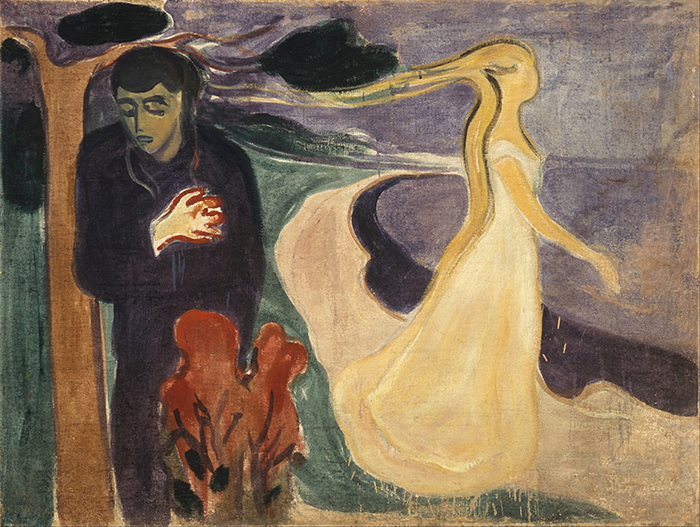
Separation (1896), oil on canvas by Edvard Munch in the Munch Museum, Oslo, Norway (Wikimedia Commons). This unnerving picture was finished the year after George Moore published the bleak stories of Celibates (1895), a book that extended and put some finishing touches on morbid fancies he anatomized in the 1880s. George’s stewing pessimism later resonated with the gloomy dreamscape in Edvard ’s “The Frieze of Life” (of which Separation was part). Both Norwegian artist and Irish novelist embodied tragic themes of love and loss in their work. Is Edvard ’s female figure, as she faced an ominously dark sea, the departing soul of the crazed Kitty Hare? Is she the panicked Agnes Lahens fleeing to a convent shelter after her gross brush with worldliness? Or is she the disconsolate shell of Mildred Lawson, gravitating back to her sterile home in England sans virtue, vocation, and fortune? All three characters and their male counterparts seem to live in Munch‘s picture, though the artist and novelist did not know each other. Still, they observed life from likewise dreary perspectives, wrestled with insoluble problems. and anguished over tensions that fragmented the human condition during the Fin de Siècle.
GMi Worlds and Letters have been on two tracks of development, running parallel from month to month but nowise in sync. These tracks are about to intersect, albeit briefly, before resuming their separate ways.
My curation of Celibates this month brings the digital archive of George’s world-building up to 1895. There are still a few gaps to be filled, but after Celibates George Moore kept mostly out of sight as a world-builder until 1898, when he published Evelyn Innes.
Coincidentally this month, with my curation of George’s correspondence of 1897, my digital letters archive is poised to expand into 1898. Our world-builder and letter-writer are going to converge in October!
I’m not promising revelations from the convergence, since the letter-writer rarely aired the creative process and unresolved concerns of the world-builder. His letters tell us where he was, what he was doing, whom he was with on a given day, but they don’t reveal many particulars of his literary inspiration, research and composition.
I infer from this reticence that the man of the world who wrote letters and the author who wrote novels were two different beings in the same body; Jekyll and Hyde, so to speak. That’s somewhat paradoxical, because the novelist mined his real-world experience for character and plot, all the time!
Much as George expropriated his activities, relationships, and domiciles for use in his fiction, he generally didn’t share details about his writing in letters to his social network. For the most part, he let his creative writing speak for itself.
That may be why family and friends were surprised to find themselves turned into literature. At least in his letters, George didn’t tell his models what to expect in his books and evidently preferred to ask forgiveness rather than permission for his treatment of them.
The Kind of Person
What kind of person was George Moore? I’m not asking about his biography, but the man himself.
As far as I’m aware, this question has not been answered convincingly. We have memoirs of George by those who met him, and researched accounts by those who didn’t. All have this in common: latent subjectivity.
Under a mask of objectivity, they reveal as much about the observers as the person observed. They replace a human being who lived once upon a time with an artifact that didn’t.
Take for example the substantial biographies of George Moore by Joseph Hone and Adrian Frazier, published about sixty years apart. What readers found between the covers were two artifacts rather than a singular person: two scorecards that allow readers to check the conventional boxes of narrative portraiture.
But they didn’t find the vital subject, the man himself.
This is not surprising. There is no “definitive” biography of George Moore (or any great writer); and I doubt there ever will or should be. When it comes to literature and art, the word “definitive” is nonsensical in any case.
All we really have in these and similar biographies are portraits of the artist from points of view that were brought to bear, rather than sprung from the subject itself.
This is obvious in the Iconography of George Moore and uncontroversial. The painters and photographers who rendered George actually produced many different and dissimilar images. Each was self-expressive, none was definitive; nor would anybody want or expect them to be. The absence of certainty and uniformity in the visual portraiture is a strong indication of the subject’s complex and elusive humanity.
With all due respect for “complex and elusive humanity,” to me the question about what kind of person remains crucial. If we somehow get and make use of an answer, it might further activate our understanding and appreciation of George’s phenomenal literary legacy.
It might free his legacy from stodgy and hackneyed opinions that pin him to stultifying intellectual boulders or float him over our heads like a pedagogical piñata.
Because — let’s face this fact together and tediously say it again — George Moore has been underserved by caretakers of his legacy (including me).
His creative achievements are today mostly ignored, his contributions are explained away, his books and articles are generally unread except by curious garbage pickers. The once-vibrant voice of the grand old man is now unheard or marginalized to a fraction of its historic scope and worth.
And that has been true for more than 50 years, at least since the time I started paying attention.
Given George’s seemingly irrevocable obscurity, why did I start GMi (now summing up to nearly 2,000 web pages and rapidly growing)?
As I may have said before, I didn’t do it to shore up the author’s flagging reputation or free him from critical trammels. Those things really don’t matter to me.
I did it, specifically, to empower George to do all of that (and more) for himself!
In his own words and voice (not mine or others), to rejoin conversations that he left many years ago and which continued without him; and to participate in fresh conversations that are just getting started.
Not to ventriloquize George with my picayune theories and discoveries, but to empower him to speak for himself about himself.
That’s a revolutionary agenda with benefits that could spread across the humanities with the aid of advanced technology. Just imagine for any author or artist:
To empower [fill in the blank] to speak for themselves about themselves
Get it? Empowering George Moore is not a destination; its the first leg of an epic curatorial journey.
What Kind of Person?
This brings me back to my initial question, “what kind of person?” The enabling technology of empowerment I mentioned is simulation.
A high-fidelity simulation of George, grounded in GMi, may help to restore his voice and agency. It may wipe the blackboard clean, so to speak, and send Pooh-Bahs packing when the author himself gets his turns to speak.
After all, wouldn’t you rather listen to a fabulous author talking about his life and work than somebody who never even met him? Good, I’m glad we agree about that.
But to simulate George, I’ll need to do more than “check the conventional boxes.” I’ll need to ascertain “the kind of person” he was in real life and will now become in a second life.
That will involve identifying or approximating his personality quirks, body language and facial expressions, the sound of his voice and movement of his hands as he spoke, his eyes when he looked intently into another’s or looked away when his patience famously expired.
Real people pay very close attention to details like these when they’re with somebody and present in the moment. Ironically or necessarily, such quirks and foibles are largely missing from scholarly accounts of historic figures. As if they don’t matter, but they more than matter; they’re crucial.
I have hypothesized that George’s quotidian language and ideas may be reliably inferred from his literature. Why? Because as a writer, he was always self-expressive.
He modulated his prose in a spoken idiom, presumably his own. I speculate that the style of his written language was also the way he talked. I can think of no other explanation for his remarkably fluid prose and penchant for dialogue.
Because George wrote as he spoke, his memoirs seamlessly crossed the line into worldbuilding; his fiction crossed the line into recollection. He was not undisciplined or egotistical, far from it. He was integrative.
I think it will be possible to abstract a high-fidelity simulation of his conversational syntax, cadence, vocabulary and rhetorical finesse from his literary legacy. After the legacy is fully curated, with the help of machine learning and large language models.
His reanimated self in GMi should be able to say pretty much what the living George would have said a hundred years ago, even when discussing subjects that are new to him. And say it in a lifelike manner.
Outlandish? Of course. Technically feasible? You bet. Certain to succeed? Not even close. Worth trying? God yes!
Don’t Touch Me
Writing last month about Celibates: “I vaguely recall that doleful collection of stories as a throwback or piece of unfinished business, a collection of ideas that escaped the wastebasket. But was it?”
Now that I’ve reread the book, I’m sure it is not what I misremembered! You can decide for yourself. The text is live on GMi as an archive of Google Docs, an ebook, and a portfolio of four PDFs that you may upload to AI apps for guided analysis and interpretation.
I have elsewhere written that naming was not a core strength of George Moore, and Celibates was no exception. I won’t speculate how many readers in 1895 would enthusiastically reach for a new book under that title, but probably not many. The implicit subject matter lies somewhere between mundane and repellent!
However that’s not why I object to the title. Instead it’s because the title doesn’t really intimate the subject of the book.
Consider the dictionary definition of a celibate (the noun):
a person who abstains from marriage and sexual relations
Though details were not explicit, Mildred Lawson seems to have had sexual relations with one or two men before accepting the marriage proposal of a third.
Kitty Hare had no objections to sexual relations and accepted the marriage proposal of John Norton. On the other hand, John Norton identified with Peter Abelard (page 451), hardly a paragon of celibacy.
Agnes Lahens was only sixteen years old when she left her parents’s home for a convent, but not to avoid sexual relations or marriage. She was too immature for both.
If Celibates was not really about celibacy per se, then what was its subject?
For Mildred Lawson, the likely answer is this:
For her chastity was her one safeguard, if she were to lose that, she had always felt, and never more strongly than after the Barbizon episode, that there would be no safety for her. She knew that her safety lay in her chastity, others might do without chastity, and come out all right in the end, but she could not: an instinct told her so. (page 247)
Chastity is not a synonym of celibacy. Turning again to the dictionary for help, I find that chastity is:
the state or practice of refraining from extramarital, or especially from all, sexual intercourse
As I understand the word, chastity does not preclude sexual relations and marriage, it merely shelters them in a protective moral shield.
Mildred’s chastity was not a vow of celibacy but a lifestyle choice that ensured her autonomy and agency. She needed independence and freedom; she needed “self-realisation” (page 279); her aversion to sexual relations and marriage was triggered by men who threatened rather than reinforced her legitimate needs.
Kitty Hare was a virgin until her rape, and violence destroyed her, but I don’t think she was crazed by the loss of her virginity per se. Labeling Kitty as a celibate would be a misreading of her character.
Kitty’s fiancée John Norton was the titular celibate in the story, except that egomaniac might be a better description of him. “He was as unfitted to the priesthood as he was for marriage”; neither celibate nor chaste, but a sort of obsessive-compulsive wanker.
As already mentioned, the adolescent Agnes Lahens was not old or self-conscious enough to opt for celibacy. She did not rush back to the convent to preserve her virginity, but to escape the vulgar claptrap of her disgusting parents.
True, she did not like the role of debutante in a first season, but that wasn’t the issue. The issue was her mother trying to pair her with creepy older men with money.
If Not Celibates?
So what was the real subject of Celibates and what might have been a better title?
The subject, I would say, was personhood: the challenges faced by people, especially young women wanting to be themselves in a male-dominated society that has other ideas for them.
I could elaborate, but so can you if you read and ponder the stories from your own perspective. Or ask AI to help.
And a better title? Don’t Touch Me seems more fitting than Celibates. The book is really about why that phrase is spoken by practically every young woman who assumes she will be respected and reinforced as she grows, until she isn’t.
That Question Again
I want to return for a moment to my earlier question: what does Celibates say about the “kind of person” George was?
I think he was one who didn’t think carefully or strategically about the titles of his books. And also one who thought very deeply about their meaning and consequences.
A pretty cool person, to be sure.
Next Up
By now it goes almost without saying that George Moore’s letters of 1898 are going on the workbench in October, along with his novel Evelyn Innes (1898).
George was in middle age, secure in his reputation, at the end of a massive effort to write a novel that seemed beyond his artistic reach and the ability of readers to fathom. We’ll see how that turned out out.
I haven’t forgotten my promise to curate the first edition of A Modern Lover (1883) for GMi, but I don’t own a copy to scan. Every copy that has come up for sale while I was watching was purchased for a relatively insane amount of money, not by me.
However a sympathetic collector is having his copy scanned for GMi, and the results should arrive soon. This will be the first time that the first edition of A Modern Lover has been digitized.
The sun rises over a book in the logo art of Resurgam NFP, a new fundraising organization for projects like George Moore Interactive. Resurgam in Latin means “I shall rise again.” It was the title of the final chapter of Memoirs of My Dead Life (1906) where George pondered his origins and legacy during a visit to Moore Hall. The leaves of the open book are blue, like the rippling waters of Lough Carra where he imagined his funeral (and where he was later buried). The covers of the book are green, like woodland and meadow that surround the lake still. The red sunrise says change is coming. This logo symbolizes the specific aim of Resurgam: to kickstart literary legacies in the digital age.
I was taken aback at the end of Michael Chabon’s essay, “The Midnight World,” in the New York Review of Books (19 December 2024). He wrote:
“It takes a rare kind of mind to care so deeply, for so long, with such discernment, about something whose worth and significance have been so thoroughly neglected, and then to persevere in the piecemeal, painstaking work of ending, at a stroke, that neglect.”
Though Michael was characterizing Glenn Fleishman, the author of How Comics Were Made (2025), he seemed to be talking about me!
Lest you think I’m preening or gloating when I say that, I hasten to add that “a rare kind of mind” may not be a brilliant mind. It could be anything as long as it’s different.
If my own mind is rare (arguable), that’s probably because it is centered, calm, independent, deliberate, and orderly. I believe those are the drivers of my perseverance with George. I make no loftier claims.
Researchers like Glenn Fleishman, who likewise strive to kickstart literary legacies, have minds that are different from each other’s. Each has a unique blend of strengths and weaknesses that make a noble and seemingly Quixotic mission not just feasible, but profoundly satisfying.
I take my hat off to Glenn and everyone like him, or like me. We follow, however obscurely, the footsteps of heroes in that famous Apple commercial. We are not changing the world, but we do think different.
In turn I bow to the occasional applause from folks in what is always a nearly empty theater. The show — the piecemeal, painstaking work — must go on, and it does.
Letters of 1888
Since last month’s newsletter I have published George Moore’s extant letters from 1888. That was a disappointing year for him, though I’m not sure how he felt about it.
The year began with the failure of an experimental novel, A Mere Accident. It ended with the failure of a conventional novel, Spring Days. Yet another futile novel, Mike Fletcher, was emerging on his desk under the working title of Don Juan. George’s publishers so hated the manuscript submission of Don Juan that they parted ways, most likely with hurt feelings.
What the heck was George up to in 1888?
The answer for me is self-actualization. George admitted to a journalist in 1888 that he was a wannabe — an improbable, accidental man of letters. Lacking a liberal education and technical training, spinning like a pinball between English and French language and aesthetics, his writing looks like a chockablock process of stymied heuristics.
Intrinsically motivated as he was, almost selfless in his dedication to modern art and literature, he was nonetheless a dyed-in-the-wool contrarian — a “righteous apostate” — from tip to toe and morning to night, almost entirely lacking in what contemporaries would have called genius and purpose.
Yet somehow he bumbled into self-actualization in his memoirs of this period. It seems almost laughable now, that a Nobody like George in his mid 30s should publish any memoirs at all, and yet he did, twice. Parnell and His Island in 1887 was followed by Confessions of a Young Man in 1888, the latter somehow achieving the rank of untoward masterpiece. (Both books are digitally published by GMi.)
In 1888 George the budding novelist hit his stride most improbably, not by writing career-advancing fiction, but by reinventing himself as a “man of wax” and reporting out the results. He self-actualized like a genie springing impulsively from a bottle that nobody had bothered to rub.
For readers like myself who find his surprising behavior oddly charming, his novelistic failures are no less fascinating than his autobiographical successes. They all have the charisma of eggs in a nest about ready to hatch. They just didn’t hatch as planned.
Near the end of 1888, a reviewer in a prestigious London newspaper wrote that Spring Days was the worst novel he had ever read. George calmly noted that appraisal, filed it, and carried on.
My AI Buddy
I have talked about reanimating George Moore with generative artificial intelligence. During the past couple of years since launching GMi, those aspirations have turned into pragmatic intentions, but not because of anything I did.
AI is now so accessible, powerful, capable and adept that the technical challenge of reanimating George is low-hanging fruit. The groundbreaking stuff still to accomplish — digital curation, integration and preservation of George’s lapsed literary legacy — is where the action is today.
That’s not to say that I’ve set AI aside while I perform mundane editorial tasks. Indeed I am performing the mundane tasks with the help of AI.
Take for example the logo art of Resurgam pictured at the top of his post. Not too shabby? I am not a graphic designer, yet I designed that logo in a few minutes, and the results speak for themselves.
How did I manage that?
I did it with my first AI buddy, ChatGPT. As mentioned two months ago, after pondering the meaning of the word resurgam — wondering what sort of tangible, visible object would connote the behavior of “rising again,” I settled on the sun as my metaphor. The sun rises everyday for everybody and makes life possible. Good choice!
But how to associate a rising sun with the notion of literary legacy? I asked ChatGPT to work that problem. I prompted it to design a logo for Resurgam that combined a sunrise with a book (a literary artifact). Very basic direction. Mere seconds later, voilà. The sun rises from the leaves of an open book and it looks just fine to me.
Staring at the bitmap, much impressed, I asked ChatGPT if I must pay a fee to use it? Does the copyright of the logo belong to somebody or something? Mere seconds later, the answer: Bob Becker owns the copyright. The logo is my intellectual property. I am gobsmacked.
Picking myself up off the floor, I then asked ChatGPT for a vector of the bitmap it had made for me. I wanted to be able to scale and manipulate the art, not just publish it. Mere seconds later, ChatGPT delivered an EPS file of the logo, along with its original PNG, that I can scale and manipulate to my heart’s content.
The final step of logo creation was to color the monochrome design that ChatGPT generated. I did this in Adobe Illustrator and Photoshop, completing the metaphor that is described at the top of this post.
I pause now to reflect.
None of this creativity would have been possible for me on my own. Based on my experience, it wouldn’t have been possible if I had engaged an artist to make a logo, but I would have spent a lot of time and money finding that out.
All of this was possible because AI is available to extend my thinking capabilities into areas formerly off limits: designing, drawing and painting.
Other Uses
Profoundly impressed by ChatGPT, I decided to test whether I had benefitted from beginner’s luck. I created three more logos for different brands on my LinkedIn profile, following the same steps as before: think, prompt, refine prompt, edit. In every case, I produced good results (IMHO), fast and free.
I was again on the floor, picking myself up and wondering, what’s next? I have all the logos I need for now.
I turned to the bylaws of Resurgam. Bylaws are needed after registering a not-for-profit corporation in the State of Illinois, before qualifying for tax exemption at federal and state levels. Because of legal PTSD, I had been dreading the prospect of engaging an attorney to draft the bylaws.
Instead a got back with my AI buddy and prompted it, first for general guidance and templates, then zooming into particular questions, all related to composing bylaws of a not-for-profit Illinois corporation that is compliant with IRC regulations for a 501(c)(3) tax-exempt corporation.
Two dozen prompts later (each followed by mere seconds of artifical cogitation), I had all my answers.
The answer to each prompt was followed by my own writing and editing. I customized my text to the specific needs of Resurgam.
When all of my human writing was done, and a complete draft of bylaws was on my desktop, I took one more cautious step before sharing the bylaws with Resurgam’s board of directors.
I uploaded my entire draft to ChatGPT and requested a quality check. Mere seconds later, I received a few tweaks to my 14-page draft along with solid confirmation that everything I had composed should fly with the Internal Revenue Service when I apply for tax exemption.
Yay!
As with designing logo art, drafting corporate bylaws was rapid, easy, downright enjoyable and free, with good results and with assurances that what I created in this step of corporate formation is a strong foundation for the next step.
Gemini
I’m tempted to admit that ChatGPT and I are now a thing. We’re going steady, man. Only I have strayed a little from the straight and narrow and started a ménage à trois.
The other day, in order to access some amazing and needed features in Google Meet, I upgraded my Google Workspace for GMi. Google Workspace is one of my main toolsets for curating and writing content in the cloud.
In addition to gaining those nifty features in Google Meet, my upgrade brought the Google Gemini large language model into all of my Workspace apps.
Now with a click or a tap, I can do the kinds of things I did with ChatGPT, but within Google apps. Integration! I have not even scratched the surface of these AI capabilities, but who knows, when I do, I may be able ask an AI buddy to write my newsletters for me.
Nah, that would be weird. It’s one thing to make an artist or an attorney redundant, but a human still needs to be here. To persevere.
Coming Soon
Claudette Walsh in Ireland has looked at a sample transcript of my scan of Terre d’Irlande. As I feared, my transcript is unusable.
In order to create the first unexpurgated edition of Parnell and His Island in English (and the first-ever e-book of the original French text), I must go back to square one.
The problem here is that my OCR of the scanned pages is crappy, making my transcript useless. I will have to rescan the physical book with different scan settings, to improve the OCR somehow. One way or another, Claudette and I shall persevere. Stay tuned!
Also coming soon, the letters of 1889 are being prepared for publication on GMi. My speed is increasing lately despite temporarily impaired eyesight, so hopefully I will be able to stay ahead of Claudette.
As you may recall, she is correcting George Moore’s very sloppy French letters, so that they are as readable and meaningful today as they were to his original correspondents.
Finally, by this time next month I may be on the cusp of filing Resurgam’s application for tax exemption. I am not nearly there at present, and I don’t know what I don’t know, but what I have seen so far is not frightening. “I think I can, I think I can.”
I’m not an artist; I’m not an attorney; I’m not an accountant; but somehow, according to me, where there’s a will there’s a way.