
←Menu of Pictures of George Moore
Who is Walter Richard Sickert?
Boiled Ghost
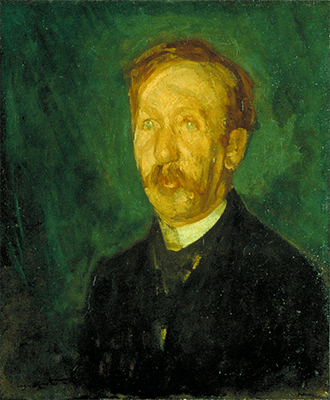
Signed Sickert bottom left; inscribed George Moore on the back of the stretcher. George Moore half-length. This eerie treatment of Moore has been compared to a “boiled ghost.”
In The Speaker (20 February 1892), Moore noted that he sat only twice for the portrait. It belonged to the painter Philip Wilson Steer, who gave it to the present owner via the Contemporary Art Society.
Provenance and exhibition history on the owner’s page. Owned by the Tate, London, England.
Original Playwright

Inscribed George Moore. Feb 16 1893 in an unknown hand. Signed: Sickert. George Moore head and shoulders turned slightly to his left.
Published in the Pall Mall Budget, 23 February 1893, illustrating an unsigned interview. Present whereabouts unknown.
The Striker of Arlingford
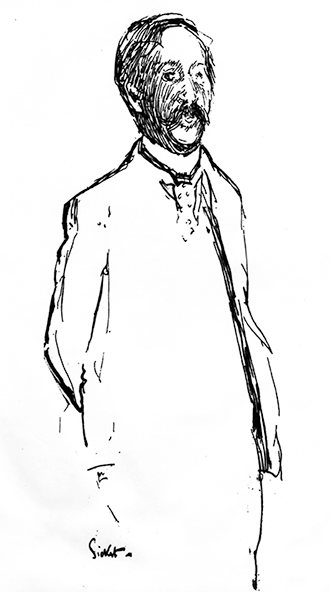
28 February1893, aet. 41
Ink on paper?
Captioned The Striker of Arlingford — As He Should Be. Signed Sickert. George Moore three-quarter length half-turned to his left, hands behind his back.
The title refers to Moore’s play The Strike at Arlingford, presented on 21 February 1893 by the Independent Theatre Society, London.
Published in the Cambridge Observer, 28 February 1893, a newspaper edited by the artist’s brother Robert Oswald Sickert. Present whereabouts unknown.
Man of the Day
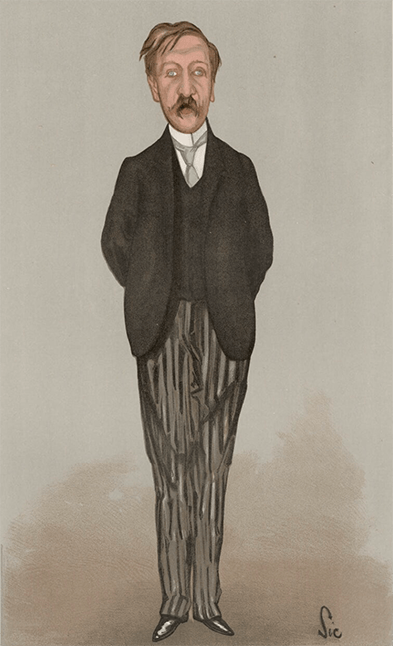
Signed Sic. George Moore full-length, hands behind his back, remarkable eyes.
Captioned ”Esther Waters” Men of the Day. No. 670. Mr. George Moore. A disciple (far away) of Emile Zola, he began his literary career by setting Messrs. Smith and Mudie against him; for he was a realist of the kind that respects not the feelings of the public. But he has improved, or else he has learned wisdom; and, having purified himself, he has shown that he is not without ability. From A Mummer’s Wife to Esther Waters is a far cry: but he has achieved the distance; and though he has been much abused he is read. He has been guilty of much work; of which some is good. His enemies (who are many) find in him faults of all kinds: his friends (who are fewer) cannot find words to praise him. Therefore it is that by his work he shall stand – or fall. He thinks that he killed the three-volume novel; but he is supposed to disapprove of dueling.
The caption is printed on a separate page. Moore had been introduced to Zola by Edouard Manet in 1879 and was described by Zola in 1894 (the year Esther Waters was published) as his chief disciple in England. The circulating libraries of W.H. Smith and Charles Mudie banned all of Moore’s books until after 1900. Moore and publisher Henry Vizetelly circumvented the ban by publishing in a single-volume six shilling format. Ten years separated the publications of A Mummer’s Wife and Esther Waters. Moore insisted that the latter was not a naturalistic (Zolaesque) novel. In 1895 the painter James McNeil Whistler challenged Moore to a duel, during a legal entanglement with Moore’s friend Sir William Eden. Moore ignored the challenge.
Published in Vanity Fair (London, 21 January 1897). Present whereabouts unknown.
Reading a Newspaper
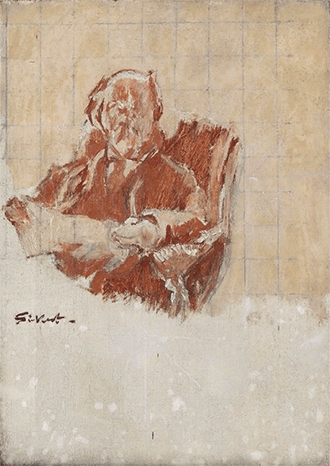
Signed: Sickert. Half-length in an upholstered armchair turned slightly to his right, elbows on the armrests, holding a newspaper, looking up.
Present whereabouts unknown.


Leave a comment