
“In 1783 (the Penal Code in Ireland being then somewhat relaxed), George Moore of Alicante purchased from Farragh McDonnell of Mucklon, the property now known as the Moorehall estate, situate on the northern shore of an arm of Lough Carra, County Mayo; and in the same year he succeeded to the Ashbrook property on the death, unmarried, of his elder brother, Robert Moore. George Moore of Alicante, about this period, returned from Spain and took up his residence in Ireland, first at Ashbrook, and afterwards at the present existing mansion house of Moorehall, which he built himself and completed in 1796.” — Martin J. Blake, “Sir Thomas More: His Descendants in the Male Line,” Journal of the Royal Society of Antiquaries of Ireland for the Year 1906, page 228.
For an excellent photo essay on Moore Hall, see David Hicks, Irish Country Houses: Portraits & Painters (Cork: Collins Press, 2014); and also his blog.
Atop Muckloon
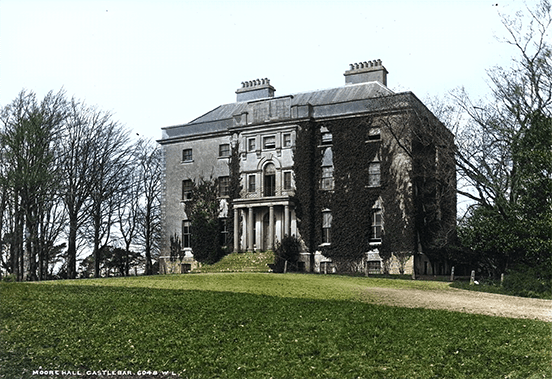
1898
Monochrome photograph, colorized
Inscribed on the negative: Moore Hall, Castlebar, 6048 WL. The big house as George Moore knew it, on Muckloon Hill overlooking Lough Carra in County Mayo, Ireland. He was born and raised here until adolescence and boarding school in England. Designed by architect John Roberts circa 1795 for George’s great grandfather (also named George), the house and its contents were burned by terrorists in 1923. The following year George Moore dubbed it “my dreaming house” in Chapter 19 of Conversations in Ebury Street.
Photograph by Robert French (1841-1917). Glass negative in the National Library of Ireland, Lawrence Photograph Collections. Another image of Moore Hall from the same shoot was published as the frontispiece in Joseph Hone, The Moores of Moore Hall (1939).
Owner: National Library of Ireland.
View from the Carra Shore
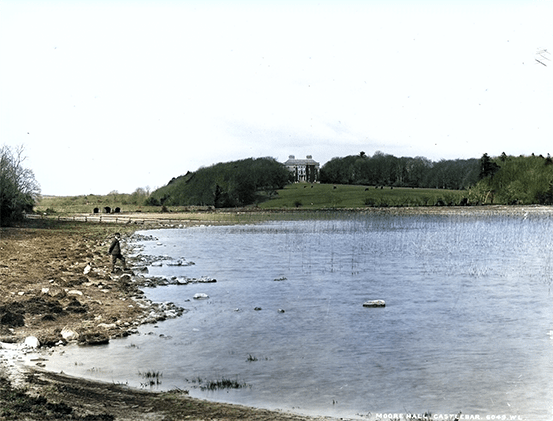
Undated (1865-1914)
Monochrome photograph colorized
Inscribed on the negative: Moore Hall, Castlebar, 6049 WL. I don’t know the exact location of the camera, but the view it provides is at least similar to the view of the big house from Castle Island, where ancient Welsh conquerers of the area built a fortress and, centuries later, the writer George Moore imagined his own funeral taking place; he later was buried on Castle Island.
Photograph by Robert French (1841-1917). Glass negative in the National Library of Ireland, Lawrence Photograph Collections.
Owner: National Library of Ireland.
Gone Fishing
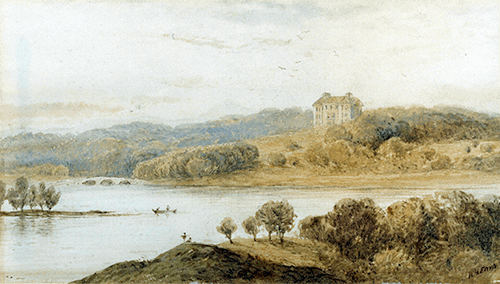
Circa 1820
9.84 x 5.31 in; 25 x 13.5 cm
Watercolor on paper
Signed by the artist in the lower left corner: W.H. Earle. Two figures are in a rowboat, one standing with a pole, slightly left of center; two more figures are looking towards the boat from the shore below. George Moore recalled visiting the house upon his return from Paris, in Chapter 6 of Parnell and His Island (1887)
This painting of Moore Hall was the basis for an engraving.
Owner: Mr. Charles Deane, Auckland, NZ
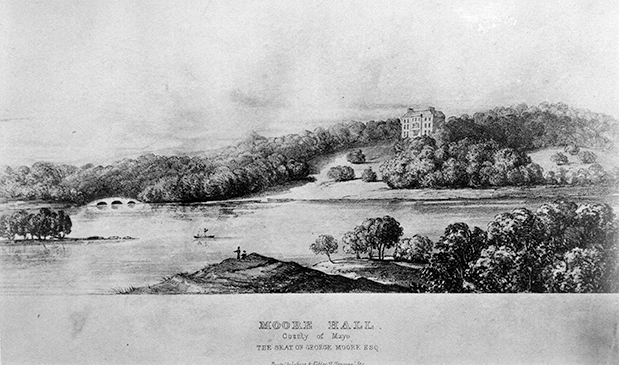
Printed by Lithographic Press, 5 Bond Court, Walbrook, London, circa 1822; National Library of Ireland. Also printed by Lefevre & Kohler, 52 Newman Street, London, 1836; National Library of Ireland. A version of this was published in Maurice George Moore, An Irish Gentleman (London: T. Werner Laurie, 1913), facing page 6.

Leave a comment