
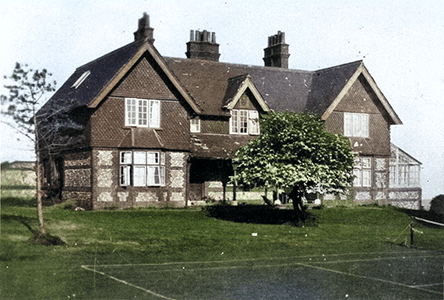
Perched high atop Truleigh Hill (altitude 720′) overlooking the sea and the soft, round South Downs of England, surrounded at a distance by a ten-foot high wrought iron fence that enclosed dense acreage of colorful heather, this small two story brick house was built in 1887 by Colvill Bridger, who set himself up there as a rabbit farmer. According to GM (Ave, Chapter 13) Colvill’s idea for the farm originated in 1883, when he brought home two Belgian hares and from them, during the next four years, bred a flock of over 400. Truleigh Hill formed, he believed, a perfect warren; so at considerable expense he enclosed it and went to live in the rather isolated (in winter desolate) Freshcombe Lodge.
GM lived there with him as a friend and partner from late 1887 until late 1888. The farm failed to earn sufficient income and within two years Colvill faced the consequences of his miscalculations: the rabbits would not provide the capital with which to recoup his investment; the farm rapidly lost money. For a while Colvill entertained the fantasy of stripping the hill and covering it with fruit trees, but by 1900 Freshcombe Lodge was abandoned. After a few years of dereliction it was restored and has been occupied ever since.
The house and character of Colvill Bridger were transformed into literature in Edward Martyn’s play The Heather Field (1899).
The house may have inspired George Moore’s story “In Sight of Death” (1892) aka “A Flood.” When I visited the owner in the late 1970s, she related a recurring nightmare she had since moving there. It was about the sea level rising and swamping the lonely house on the hilltop.
