- The Neglected Innovator
- Innovator or Heretic?
- La Terreur de la Terre
- Starting the Next Decade
- “I Shall Rise Again”
- Next in the Shop
The Neglected Innovator
May I have your attention please? The James Joyce Tower & Museum is about to host a spring lecture in Dun Laoghaire, Ireland. If you’re in, or somewhere near Dublin on 6 March 2025, go to the architectural gem known as DLR Lexicon Library for the event entitled George Moore — A Neglected Innovator. The event is organized by Michael O’Shea and presented by George’s esteemed biographer, Dr. Adrian Frazier.
Rather than showing up unexpected, you may reserve a seat online at the James Joyce Tower and Museum. That way you won’t have to stand at the back of the Studio, wishing life were more fair.
Since one ocean and half a continent separate me from this rare event, I cannot join you there. However as an academically trained snob of sorts, it may be my professional duty to quibble with something, anything, lest I seem uncritical and therefore unthinking.
So I’ll quibble with that adjective, “neglected.” Clayton Christensen’s book, The Innovator’s Dilemma (1997), taught me long ago that all innovators are not just neglected, but also opposed, by incumbents who have invested in the status quo and by a conservative public that resists change.
To call George a neglected innovator is therefore, how shall I say, redundant, since all literary innovators (Joyce included) were neglected (or worse) until they were not (usually postmortem).
George is obviously postmortem, though probably not forever. As you know, GMi is trying to bring him back to life, reanimating him, returning him to conversations he began but didn’t finish, adding him to others he never had, at least to my knowledge. In all things, letting George speak for himself!
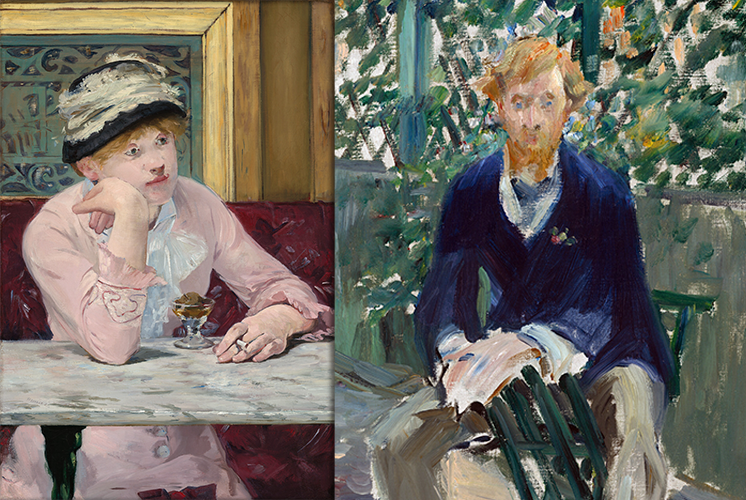
Today as in many years past, readers neglect and even oppose George Moore because they must. Like early viewers of Impressionist art, ordinary readers have been led elsewhere, on golden leashes by incumbents in ivory towers.
And unlike Fagin in his cinematic slum, when it comes to George Moore readers rarely or willingly avow, “I think I’d better think it out again.”
And that is fitting. When George is no longer neglected, he will no longer be innovative. He will instead be canonical. That apotheosis is inevitable, alas, but for now you can attend Adrian’s lecture in hopes of having a (potentially) risky, disruptive, unheard of, unsettling epiphany by the time it’s over.
Adrian’s may be comparable to a lecture about the heretic Jimmy Joyce before his legacy became fodder for conformists and pedagogues. Go there, don’t be square, and find out for yourself!
Innovator or Heretic?
I shouldn’t mention Clayton Christensen without also hailing Art Kleiner, author of The Age of Heretics (1996). Both men were public intellectuals — so-called thought leaders — not long after I left my job as a dorky English professor for a hectic career in educational technology.
This was the era of the New Economy when designers, makers and users strove for game-changing innovation in everything (including learning).
Steve Jobs became the poster child of that era — you may remember his 2005 commencement address at Stanford — but he was not alone. I remember my surprise at the intellectual vigor and rigor I found beyond the ivory tower, so much more enlightened and pragmatic than what I experienced in it.
The Age of Heretics made a thrilling case for contemporary innovation by tracing its roots to heretics who, against all odds, refused to conform. One such was Pierre Abelard, also the endearing subject of George Moore’s novel Héloïse and Abélard (1921).
I think it helps to understand George Moore as a heretic, rather more than as an innovator. Heresy involves rocking foundational assumptions, beliefs and aspirations, and that is what George strove to do again and again in his writing and aesthetic activism.
In contrast, innovation is usually more about praxis, about changing the way things are done versus how they are understood and desired.
George Moore was an accomplished innovator in Victorian, Edwardian and Georgian England — he never stopped rocking the boat! And he somewhat relentlessly set aside his commercial interests for the sake of undermining or sabotaging authority and paradigms that triggered him.
For example, soon after finishing Parnell and His Island, his London publisher (who had preemptively expurgated the manuscript) called George out for being self-defeating instead of building his base.
Was George chastened? He was not.
Intead he parted ways with his publisher William Swan Sonneschein, insisting that he would remain true to himself regardless of consequences. The consequences were commercially and critically disastrous.
Yes, of course, George committed these mistakes as an innovator, as an unconventional writer, but even more he did it as a heretic, a disruptive thinker, and perhaps for that reason he shall (as he predicted) rise again.
La Terreur de la Terre
Last month I admitted my failure to scan the French text of Terre d’Irlande. Scanning is the first step of transcription, but it went nowhere. Complicating factors were:
- The frail, 138 year-old binding of my physical copy.
- Typography on printed pages that tricked my OCR.
- Mellifluous French letterforms that defy Gertrude Stein.
- Printer’s errors in pagination that were unacknowledged.
It was Gertrude in Paris who wrote that “Rose is a rose is a rose is a rose.” Okay fine, but in French the letter a is an a is an à is an á is an â is an ä etc. etc. and so forth. Enough to cross the eyes of an English-only reader and his trusty machine sidekick.
It would not surprise me to learn that my copy of Terre hadn’t been opened since publication. It was as stiff and reluctant as yours truly after spending hours making transcriptions that nobody may ever read or care about.
I take that back: at least one person must read and care: the angelic Claudette Walsh, native French editor (in Ireland) who is line-editing my transcripts.
Anyway, before Claudette could edit George’s lines, I had to provide lines that were as visually readable to her as a printed book.
It took a while, and the experience taught me this: that not all OCR is created equal! Before Terre, I had been scanning to pdf, figuring that the OCR in Adobe Acrobat was best in class. It is not.
My breakthrough came when I scanned not to pdf but to docx, the format of Microsoft Word. This was not intuitive to me because I’m a Mac and I hate MS Word; I can’t stand its preposterous ribbons full of icons that make me feel I’m looking at my document through a kaleidoscope!
But MS Word was the key! Using my magical CZUR overhead scanner to create bitmaps of page spreads, I converted those images to single pages of machine and human readable Word docs, one doc per chapter (each chapter around 3,000 words).
The results were impressive! The OCR software recognized that a rose is not necessarily a rose, and I was able to develop transcriptions in Google Docs that are close enough to perfect to enable Claudette to wave her wand over the French text. A final sprinkle of pixie dust!
The results of my 40-hour terreur with the Terre are now live on GMi. All twelve chapters, plus the Preface, plus the Conclusion. When Claudette finishes her French review, I will also publish an ebook using Walter Osborne’s lovely painting of a bookseller as the cover art.
Will anybody actually read Terre d’Irlande? I don’t care, and that’s not the important question for me. What matters is, for the first time in 138 years:
- Terre d’Irlande will be accessible and readable to anybody who wants it.
- Lettres Sur Irlande de George Moore in Le Figaro will be viewable side by side with the pages of Terre that came later.
- Expurgations of Parnell and His Island will be detectable by comparing the French text and the English that came later.
- A talented writer (Colm Tóibín?) who is looking for a cool project may restore the expurgated text and reverse the censorship.
By this time next month, the ebook of Terre d’Irlande will be in the GMi Shop. And I’ll have moved on to other things.
Starting the Next Decade
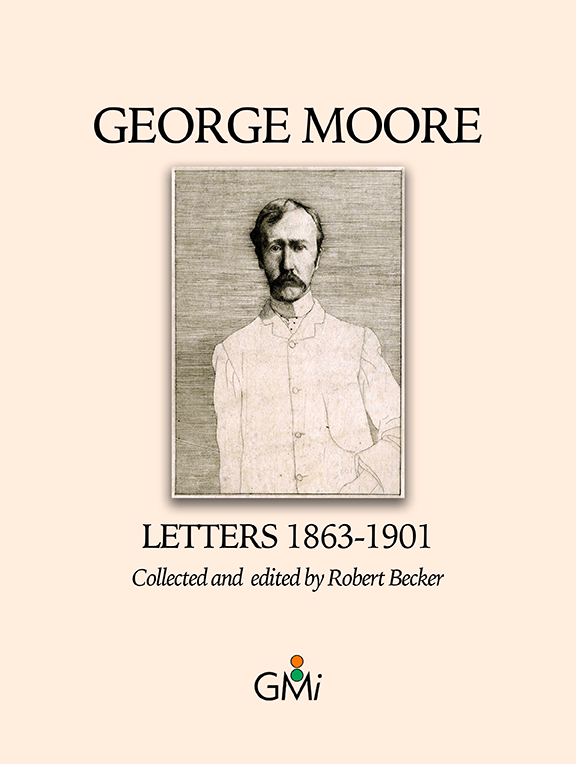
Letters of George Moore on GMi now run from 1863 through 1889. Thanks to Claudette, George’s sloppy French is now as readable as his sloppy English (we both corrected paragraph breaks, spelling, punctuation and capitalization).
The 1880s were a thrilling and depressing decade for the young writer. After his juvenile (but proficient) forays in shock-poetry, he came out as a debut novelist with A Modern Lover, but it failed to sell.
Then unexpectedly (even to himself) he scored a bestseller with A Mummer’s Wife. It signaled that a formidable author had emerged from his false starts. But the rest of the decade dimmed that signal, with books that few people bought, and that caused many people to dislike the author peremptorily.
If one word comes most to mind when I look back on letters of the 1880s, it is resilience. George Moore’s response to being repeatedly knocked down was to pick himself up, dust himself off, and try again harder.
As Bernard Shaw (who turns up in letters of this decade) later noted, no writer ever worked harder, with fewer extrinsic rewards, than George Moore. Yet through it all, he stayed calm and carried on, believing in the right and responsibility of the artist to observe truth in beauty, in his own way.
George was a self-conscious innovator, a proud and stubborn heretic, whose intense aspirations seemed to be fortified by failure. After A Mummer’s Wife in 1885, his next commercial success was not in fiction but memoir.
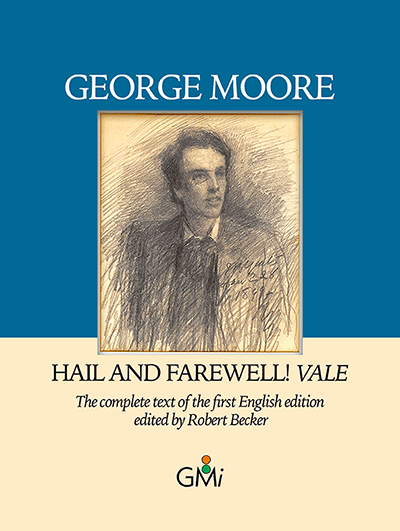
Confessions of a Young Man once again signaled the presence of a formidable author. It pointed towards a future that would someday include Hail and Farewell! That sublime Irish trilogy quietly resonates with the gritty heresies of Terre d’Irlande. Now you know.
George’s letters of 1890 are on my workbench; publication on GMi shall be completed by this time next month!
“I Shall Rise Again”
During the past month, Resurgam added a fifth member to its board of directors, fashioned and refashioned its bylaws, engaged and parted ways with a fundraiser, appointed a treasurer, retained a CPA, and drafted our application to the United States Internal Revenue Service for certification as a 501(c)(3).
A busy month, full of progress, very little inertia and disappointment, all for the sake of Resurgam’s educational, literary and scientific purposes.
The angels who donated to my Gofundme Campaign for travel to the British Library can rest assured: my travel has been delayed but it shall occur! Among myriad other priorities, Resurgam will try to cover expenses that GoFundme couldn’t cover because not enough donations came in.
The Gofundme Campaign is still open and ready to receive your donation, should you decide to jump off the fence. You too can have a hand in exhuming an invaluable portion of George Moore’s literary legacy from the subterranean analog stacks of the British Library, making it freely accessible and useful forever to people everywhere.
But apart from financial support, you can also volunteer your time and skills in meaningful ways, a little or a lot, to advance the bold mission.
For example, I would be delighted to meet an engineer of machine learning who can advise Resurgam on ways to cross the chasm that divides digital publishing from expert systems.
That chasm is already coming into view. Our team needs to prepare for getting to the other side.
Next in the Shop
I long to publish The Brook Kerith on GMi, not because readers are asking for it, but because I only faintly remember it.
My faint memory suggests that The Brook Kerith is a novel whose time has come. In a world where oligarchs, criminals and charlatans are hurting people in the name of Jesus Christ, it is time for a “real” Jesus to get up and knock them down (as he does in The Brook Kerith).
That said, after I add Terre d’Irlande to the GMi Shop, I’m going to stay in the nineteenth century for my next mini project. Having finished work on George’s Irish essays, a next milestone may be A Drama in Muslin (1886).
This was an Irish story written in the afterglow of A Mummer’s Wife, when George was on the cusp of commercial success as a novelist. Alas, he would dangle there for another ten years.