- Roundup of Outliers
- Can’t Go Yet
- Where Angels Fear to Tread
- Ireland Redux
- Confessions of an Irishman
- Agon of the Agora
- Responsive Web Pages
- Letters 1863-1901
Roundup of Outliers
The Aesthetics pillar of George Moore Interactive has bulked up nicely.
It now contains 227 essays of art criticism and 215 essays of literary criticism originally published in periodicals and books during the author’s lifetime. That’s a total of 442 essays — but not a grand total.
I have yet to acquire 90 outliers: 22 essays of art criticism and 68 essays of literary criticism squirreled away in periodicals that have not been scanned or stored in a conveniently located library. Convenient to me, that is; I’m situated in Chicago.
To acquire these 90 outliers, I must leave my virtual tower and travel to the British Library in London. Once ensconced in the Reading Room, I shall order up the periodicals, one at a time, so that I can locate, transcribe and edit the essays I need, and use them to complete the Aesthetics pillar.
At that momentous milestone, there will be 532 critical essays — the whole shebang — live on George Moore Interactive. As always, they will be freely accessible to readers (human and machine) all over the world.
I know, know, it’s about time.
Assuming that the 90 outliers are similar in length to essays already acquired, I estimate that each contains an average of 2,000 words. That being the case, the completed Aesthetics of George Moore will contain 487,191 words of art criticism and 732,924 words of literary criticism for a grand total of 1,220,115 words.
That is obviously more than most people will ever get around to reading or even skimming. However it should take just a few minutes for machine learners to suck all 1,220,115 words into a large language model.
Not long after that, a reanimated George Moore will resume speaking for himself in response to questions about the art and literature of his time, and of ours. Pretty cool!
Can’t Go Yet
I’m fully prepared to go after the needed 90, but the British Library is not ready to host my visit. You may have heard that cyber criminals kidnapped the Library late in 2023 and held it for ransom. Their dastardly behavior is described here and here.
I pause to ask myself: who would want to attack a library, any library, for money? What lowlife would choose to attack the British Library, of all libraries, a pinnacle of western civilization?
I don’t have any answers, but I’m generally aware that some of our fellow citizens rarely hesitate to do any awful thing that lines their pockets and strokes their egos. A library today. The planet tomorrow.
The ransom wasn’t paid, thank heavens, but the cyber criminals didn’t undo the damage they caused; instead they wound up damaging the British Library for free.
The Library has been in recovery mode ever since, rebuilding their legacy information technology so that even the remote collections I want to browse can be accessed once more.
There is light at the end of the tunnel, though I don’t know how far off it is. My plan is to visit London in the spring of 2025 when, hopefully, all Library systems will be go.
Where Angels Fear to Tread
My trip to the British Library will not be nostalgic.
In the 1970s I spent five years under the luminous dome of the old Reading Room, that hallowed Victorian temple of the human spirit. Back then I was a graduate student from the University of Reading in Berkshire, trundling down to Bloomsbury and over to Colindale on my motorcycle, rain or shine, from my quaint mews house in Hampstead.
Though the luminous dome is still attached to the Museum in Bloomsbury, the Library long ago moved to a modern campus headquartered in St. Pancras. That’s my new destination, half a century after my innumerable visits to the original.
Based on the average time that orders take to reach readers in today’s British Library, and the limit on how many orders may be submitted in one day, I have planned a stay of two full weeks to acquire the outliers.
Even as an American citizen, my use of the British Library is to be free of charge; but airfare, hotel accommodation, meals, and ground transportation are not. And by the way, London is not the cheapest town to dally in.
Hence my wish for an angel investor to help cover the travel expenses. What is an angel investor? Somebody who proffers a small amount of capital for a short time, say three years, in order to make 10x return on that investment. Doesn’t sound very angelic, does it? More like usurious, but I didn’t invent the moniker.
Unable to promise 10x or even 1x to a so-called angel, I’ll instead create a crowdfunding campaign to cover the travel expenses. What is crowdfunding? That’s when individuals (and maybe institutions) pledge small donations to kickstart an untested venture, and in return donors receive a tangible thing of value.
My crowdfunding campaign will most likely offer donors a collectible: for example, a signed, maybe illustrated hardcover of select, uncollected essays of George Moore. A fine limited edition that could retail for more than $50 and over time appreciate to multiples of that.
Collectors of George Moore and his period may covet a copy of the book for their physical shelves. My goal is to raise enough small donations to cover all or most of my travel expenses and costs of manufacturing the book.
My crowdfunding campaign will make clear that donations help complete the Aesthetics pillar of GMi; and more importantly move the project closer to its noble goal of kickstarting literary legacies in the digital age.
The limited edition will not be a commercial product, but a token of appreciation to folks who volunteer their support.
Ireland Redux
Spending two weeks from morning to night, head-down in the British Library, eating takeout tandoori when I return to my rented garret, must be balanced by a personal reward of some sort; otherwise my sparkle may dim.
The reward I have in mind is a visit to Ireland, my first in about 20 years. My daughter Elayne may join me to celebrate completion of her third novel (you should read or listen to the first two, they’re great).
In Dublin I may meet Michael O’Shea at Joyce’s Martello Tower for a chilly spring skinny-dip. I may drive around both Irelands as I did more than once upon a time, admiring the beauties and puzzling over the personalities.
Confessions of an Irishman
The other day Michael managed to find a copy of Terre d’Irlande (1887), a cornerstone of any rare book collection of George Moore. I was just then finishing my edit of Confessions of a Young Man (1888) for GMi and still undecided about what to slate next for the Worlds pillar.
My memory of the English translation of Terre d’Irlande, entitled Parnell and His Island, was admittedly poor and not very positive. I had a vague feeling that it was a nasty little rag about a beloved emerald island.
But is it? I decided to check.
Fast forward to now: all sixteen chapters of Parnell and His Island are published in the Worlds pillar of GMi. And I do declare, they are fine: thoughtful, beautifully written, not nasty though occasionally arch. They cover more than a dozen thematic aspects of mid-nineteenth century Irish culture from a biased, Anglo-Irish, eyewitness perspective. I love them all.
Moreover I think Parnell and His Island is intriguing when juxtaposed with Confessions of a Young Man. Both are nonlinear collections of essays that appeared one after the other and were probably written at the same time.
Parnell is all worldbuilding, Confessions is half worldbuilding, half criticism. Together the volumes reflect the perspicuity and sensibility of an emergent author testing his elastic limits.
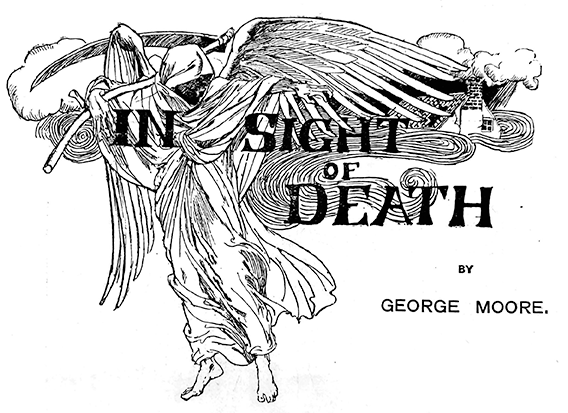
Next up in Worlds: “In Sight of Death” (1892), later called “A Flood” (1911); the earlier text courtesy of the collection of Kathi Griffin.
Agon of the Agora
Having uploaded first edition texts of Parnell and His Island and Confessions of a Young Man to George Moore Interactive, I’m now wondering if I should also publish them as Kindle editions.
I already have four Kindle editions in the GMi Shop, so I’ve had enough experience of that marketplace to form personal opinions. So far they include:
- Kindle Create is lame desktop publishing software
- Kindle Direct Publishing is slow and time-consuming
- The Kindle Store is a big box rather than a boutique
I’m not sure how much time I have wasted making Kindle editions, but it’s beginning to add up. What’s worse, it’s been neither fun nor profitable for me.
Is there a better way? I have decided to explore other options for ebook and audiobook creation, production and sales.
If I learn it’s possible to increase the quality of GMi editions in any of those three categories by changing platforms, I will. That will mean moving my wares from the big box to a boutique, but I think that will be okay. More my style anyway.
Responsive Web Pages
A quick technical note about embedded Google Docs on the GMi website.
There are now nearly 1,000 live GMi web pages, most of them containing embedded Google Docs of what scholars call primary source material. The embedded docs display in a white box on this standard dark background.
I have discovered that embedded Google Docs display perfectly on computers and mobile devices held in landscape orientation. All good.
However due to technology that I don’t control, embedded Google Docs do not display properly on mobile devices held in portrait orientation.
One fix for this is to spend boatloads of money to write custom code. Another is for people visiting the GMi site on a phone to hold the device sideways, in landscape orientation, to view the embedded content.
For obvious reasons I opt for the second solution. However if a skillful code developer with a literary bent wishes to volunteer to write that custom code, the job can be theirs. If they succeed they can license the code to WordPress or Google, who could sure use it!
BREAKING NEWS 2024-07-26. The technical issue described above was solved by code developer Onur Demir through Codeable. GMi pages with embedded Google Docs now display properly on mobile devices held in portrait or landscape orientation.
Letters 1863-1901
My unpublished PhD dissertation The Letters of George Moore, 1863-1901 contains about 1,000 annotated letters with other scholarly stuff.
The time has come for me to have it scanned as a first step toward integration in the GMi project. I may also produce an ebook of its massive content, since I don’t plan to put “stuff” on this website.
My preferred book scanner in Missouri seems to be AWOL. I can’t seem to get his attention. As soon as I qualify a new vendor for scanning, Letters production will proceed.
Three heavy oversize volumes are not the easiest things to mount on a book scanner, so my choice of a new vendor must be cautious.