
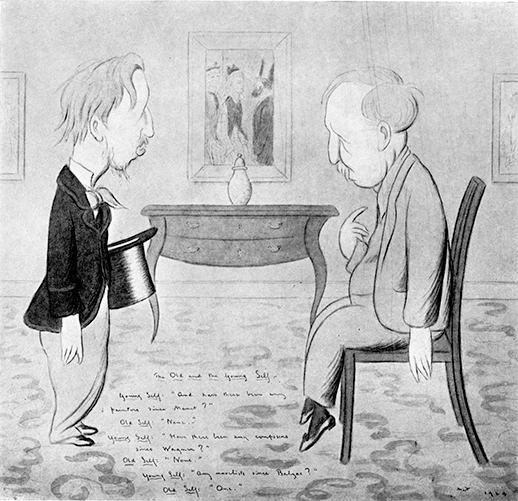
Mr. George Moore — The Old and the Young Self (1924)
YOUNG SELF: “And have there been any painters since Manet?”
OLD SELF: “None.”
YOUNG SELF: “Have there been any composers since Wagner?”
OLD SELF: “None.”
YOUNG SELF: “Any novelists since Balzac?”
OLD SELF: ” One.”
This is number 15 of 19 Old and Young Self caricatures in the book Observations (London: William Heinemann Ltd., 1925) by Max Beerbohm. Moore appears in a second time-warp in this book: Some Persons of “the Nineties” little imagining, despite their Proper Pride and Ornamental Aspect, how much they will interest Mr. Holbrook Jackson and Mr. Osbert Burdett.
Max drew at least 33 caricatures of his friend George Moore and published a touching memoir in the Atlantic Monthly (Boston, December 1950). The pencil and watercolour of this Old and Young Self is now in the London Library; it was published in color in The Sketch (London, May 20, 1925), in an issue that is now strangely missing from the British Newspaper Archive. When I obtain a color photograph of the original artwork, I will put it on this page.
Hi Reader! Art may be imbued with transcendent idealism, but life and work? Not so much. Understanding the thoughts, feelings, behavior and experience, even of a lofty man of letters like George Moore, often comes down to ascertaining precisely what happened, when, to whom, and to what effect. Evidence of that mundane sort is the remit of Chronology, one of the six pillars of George Moore Interactive.
Chronology is implicit in George Moore’s autobiographies, letters, articles, biographies, bibliographies, iconography and critical heritage. Readers can extrapolate what happened etc. but rarely with much depth or certainty.
That’s because authors and critics who write what we study tend to filter what-when-who-where data to suit themselves, typically producing partial and inconsistent records of activities and outcomes; also because the structure and language of research literature is often bewildering (if not mind-numbing), impeding rather than facilitating an ordinary reader’s curiosity; also because PRINT — de facto medium of scholarly publication — is not interactive, so gaps and errors that find their way into text are not self correcting. Authors depend on editors, critics depend on peers, students depend on teachers to correct their mistakes. The system is not fail-safe.
Would it be more efficient (and fun) for readers to depend on the evidence itself for understanding, rather than on people who may have a literary or academic ax to grind with the primary sources? Would it be empowering for ordinary readers to interrogate accessible texts and images, nudging objects to reveal much of what one wants to know? That way readers themselves could spot gaps and errors in their understanding, and replace them with insight about what happened, when, to whom, and to what effect. Chronology enables that kind of empowerment.
I am modeling the Chronology of George Moore Interactive on The New York Public Library Book of Chronologies (New York: Simon and Schuster, 1990) by Bruce Wetterau. This magnum opus is divided into 14 chapters of broad subject matter. Each chapter contains core chronologies of narrower topics that fit under the overarching title. Core chronologies are interspersed with mini chronologies of outstanding subtopics.
A total of 250 core chronologies fill the book. Readers open a chapter on a subject of interest; then they find the pertinent chronologies; then they read entries listed in chronological order. Each entry contains:
- YYYY Year
- Pea-sized description of a behavior, event, person, thing etc.
- MM/DD dates (if known) of key particulars in the description
These entries reveal both granular specificity and thematic patterns. It’s remarkably cool (though it may sound convoluted in my telling).
Another way to navigate entries in the Book of Chronologies is with a comprehensive name index. For example, the name George Moore in the index references:
- Chapter: The Arts
- Core Chronology: Novelists, Poets, and Essayists
- Citation: George Moore on page 249
- Entry: 1852-1933 George Moore… (description of life and work)
This diagram shows the basic structure of the data. All of the content is in the entries; the other boxes are mere containers.
Like George Moore Interactive, The New York Public Library Book of Chronologies is for general readers: people who are there to be amused and edified (not pay the rent). That makes it a worthy model for my project.
Following the model, I defined the broad subjects (i.e. “chapters”) of the George Moore Chronology as follows:
- Moore Hall: The ancestral home and lineage it represents.
- Life: Notable experiences of George Moore (1852-1933).
- Friends & Family: Notable experiences of people Moore knew.
- Work: George Moore’s publications and events.
Each of these broad subjects is supported with a few core chronologies. Within each core there are mini chronologies. For example, within the broad subject of Work, there is a core chronology named Bibliography. Within Bibliography there are mini chronologies named Books and Pamphlets, Contributions, Periodical Appearances, and Translations — dovetailing with Edwin Gilcher’s organization of the same data.
Now you might wonder about this example: why bother? Doesn’t the Bibliography pillar of George Moore Interactive give dates of publications? Yes it does! The difference is that Bibliography groups most things by title and Chronology groups them by date. When you consider how large and convoluted Moore’s publishing (and other work) history is, you see how Chronology does what Bibliography can’t. It supports a coherent timeline.
The same kinds of benefits enhance biographies, collected letters, and the critical heritage. The Chronology of George Moore Interactive enhances all of these data sets for the benefit of naive readers trying to figure things out on their own. They are the people I care most about.
Be Notified of the Next Post
You’ll receive a confirmation email after entering your address and tapping Subscribe. Your subscription to this blog becomes active after you confirm. Cancel any time.
You Are Invited
The Oak Park Public Library is going to host a brief discussion of George Moore Interactive a few days after George Moore’s birthday on Saturday, February 25, 2023 at 12:30 PM Central Time (6:30 PM GMT). You may remotely attend on Zoom or in person. Here is an announcement that will soon appear on the Library’s free registration page.
The brilliant iconoclast George Moore (1852-1933) helped put modernism in the vanguard of Western literature and art; afterwards he was eclipsed by friends such as Oscar Wilde, William Butler Yeats, George Bernard Shaw and James Joyce. What is the value of Moore’s legacy today? Dr. Becker is proposing an answer in the form of George Moore Interactive, a project that makes it easier for people to access, enjoy, understand, and use the art and literature they experience. The technology can be applied to other modernist creatives including Ernest Hemingway and Frank Lloyd Wright.
Oak Park is where Ernest Hemingway (fan of Moore) was born and raised; where Frank Lloyd Wright founded and grew his architecture practice; and where I live and work in my own home studio. The Oak Park Public Library is a pillar of the community; Special Collections librarians Kathleen Spale and Kheir Fakhreldin make projects like mine not just doable, but joyful.
