
←Menu of Pictures of George Moore
Sir Rupert Hart-Davis wrote of Max Beerbohm’s media: “Every drawing that I have seen is executed in pen or pencil, or a combination of the two. The great majority have some added water-colour.”
Max usually worked with color but almost all of his published drawings are printed in grayscale.
- Will Rothenstein laying down the law
- Making a Point
- Wide-Eyed Surprise
- Pat and Sandy
- Appeal May Be Made
- The Celtic Renaissance
- Butterfly Tie
- To the Queen of the Fairies
- William Archer Really Conversing
- Preacher to Lord Howard de Walden
- An Influential Deputation
- Reappearance in Chelsea
- Study for Reappearance in Chelsea
- Beyond a Joke
- In Case I Am Not Spared to See Them
- Influence of the Boer War
- How They Might Undo Me
- A Survivor of the Nouvelle Athénes
- I will be a Mexican
- Salve
- In the Mirror of the Past
- Elegy on Any Lady
- Study for Elegy on Any Lady
- The Birthday Surprise
- Gaffer George
- An Unusual Case
- A Lacuna
- Edwardian Parade
- Sketch for Edwardian Parade
- That Eternal Invalid
- The Old and the Young Self
- Some Persons of “the Nineties”
- Vagrom Memories of Sloping Shoulders
- Max’s Last Drawing
- In a Picture Gallery
- With a Lady
- Astrakhan and Bowler
- In a Sculpture Gallery
Will Rothenstein laying down the law
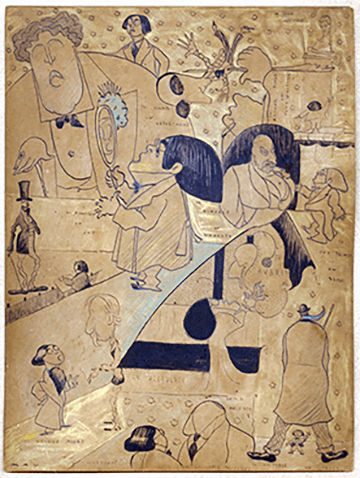
Circa 1895, aet 43
Ink, chalk and watercolor on paper
Captioned in the lower left George Moore on Caution. George Moore full-length in profile, turned to his right, facing the artist Will Rothenstein who instructs him. Rothenstein also instructs Aubrey Beardsley (on Decadence), Max Beerbohm (on Modesty), Lord Coleridge (on Law), Charles Furse (on Folly), Arthur Pinero (on Playwriting), Lord Rosebery (on La Haute Politique), Eugene Stratton (on Art), the Prince of Wales (on Dress) and Oscar Wilde (on Deportment).
Provenance, exhibition and publication history in Rupert Hart-Davis, A Catalogue of the Caricatures of Max Beerbohm (1972), number 1307.
The owner updated publication history: Max and Will: Max Beerbohm and William Rothenstein, Their Friendship and Correspondence, 1893-1945, ed. Mary M. Lago and Karl Beckson (1975), between pages 42-43; Mark Samuels Lasner, The English ‘Nineties: A Selection from the Library of Mark Samuels Lasner (1992), frontispiece; Margaret D. Stetz and Mark Samuels Lasner, The Yellow Book: A Centenary Exhibition (1994), page 41; Margaret D. Stetz, Facing the Late Victorians: Portraits of Writers and Artists form the Mark Samuels Lasner Collection (2007), page 101; Margaret D. Stetz, Aubrey Beardsley, 150 Years Young (2022) page 54.
The owner updated exhibition history: “Max in Retrospect,” Leicester Galleries, London (1952); “William Rothenstein,” Max Rutherston, London (1990); “The English ‘Nineties: A Selection from the Library of Mark Samuels Lasner,” Grolier Club (1992); “The Yellow Book: A Centenary Exhibition,” Houghton Library, Harvard University (1994); “Beyond Oscar Wilde: Portraits of Late-Victorian Writers and Artists from the Mark Samuels Lasner Collection, University Gallery, University of Delaware (2002); “The Power of Conversation: Jewish Women and their Salons,” Jewish Museum, New York, and McMullen Museum, Boston College (2005); “Facing the Late Victorians: Portraits of Writers and Artists from the Mark Samuels Lasner Collection,” Grolier Club (2008); “Aubrey Beardsley, 150 Years Young,” Grolier Club (2022).
Owned by the Mark Samuels Lasner Collection, University of Delaware Library, Newark, USA.
Making a Point
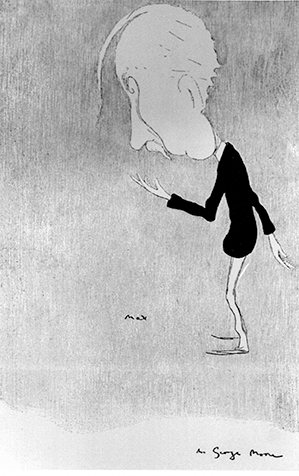
1896, aet 44
Ink, graphite and watercolor on paper
Captioned Mr George Moore. Signed Max. George Moore full length in profile, turned to his right, left arm raised with an open hand, his right arm extended behind; leaning in with an intense expression as if making a point.
Provenance, exhibition and publication history in Rupert Hart-Davis, A Catalogue of the Caricatures of Max Beerbohm (1972), number 1044. Present whereabouts unknown.
Wide-Eyed Surprise
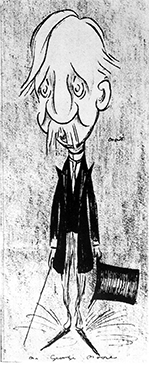
1898, aet 46
Ink, graphite and watercolor on paper
Captioned Mr. George Moore. Signed Max. George Moore full length looking slightly to his right, facial expression of wide-eyed surprise; holding a stick in his right hand and a top hat in his left hand.
Provenance, exhibition and publication history in Rupert Hart-Davis, A Catalogue of the Caricatures of Max Beerbohm (1972), number 1045. Present whereabouts unknown.
Pat and Sandy

1899, aet 47
Ink, graphite and watercolor on paper
Signed Max. Captioned By Max Beerbohm. George Moore full-length on the left side of the picture, dressed in traditional Irish clothing, a shillelagh in his raised left hand, a coat trailing from his right hand. He brawls with theater critic William Archer on the right side of the picture, dressed in traditional Highland attire and pointing to his foot on Moore’s coat.
The two were engaged in an argument provoked by Archer’s harsh review of Edward Martyn’s The Heather Field, a play which Moore promoted and had a hand in writing. The title is taken from a drawing by Jack Yeats on the same subject.
Provenance, exhibition and publication history in Rupert Hart-Davis, A Catalogue of the Caricatures of Max Beerbohm (1972), number 24. Present whereabouts unknown.
Appeal May Be Made
1899, aet 47
8 x 11 inches; 20.32 x 27.94 cm
Watercolor on first two leaves of a copy of Edward Martyn’s The Heather Field and Maeve, (1899)
(Image forthcoming)
Captioned Appeal may be made to the vanity of the actor-manager and his wife. Inscribed For Will [Rothenstein] from Max. George Moore seated, entertaining Mr. and Mrs. George Alexander to dinner.
ln Moore’s Introduction to Martyn’s play, he recounted how he asked George Alexander to produce The Heather Field. The play was accepted but not performed. Bemoaning the unpopularity of literary drama in the modem English theatre, Moore theorized that serious dramatists might yet have their plays produced through personal appeal to actor-managers. “Appeal may be made to the vanity of the actor-manager and his wife; the vanity of the actor and actress is a gleam of hope in a dark outlook, a fugitive gleam” (p. xi).
Purportedly published in Catalogue 137, September 1954, P.H. Muir (for Elkin Mathews Ltd.). Not found in the Elkin Mathews archive at Indiana University.
My detailed notes indicate that I’ve seen this picture but I can’t find it. Present whereabouts unknown.
The Celtic Renaissance
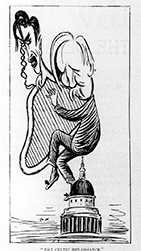
1900, aet 48
6 x 11.5 inches; 15.24 x 29.21 cm
Ink and graphite on paper
Captioned by the publisher The Celtic Renaissance. Signed Max. George Moore full-length turned to his right, seated on the spire of a domed building (Custom House, Dublin), strumming a harp surmounted with the head of William Butler Yeats. Both faces look towards the lower left corner of the picture.
Provenance, exhibition and publication history in Rupert Hart-Davis, A Catalogue of the Caricatures of Max Beerbohm (1972), number 1046. Owned by the William Andrews Clark Memorial Library, University of California, Los Angeles, USA.
Butterfly Tie
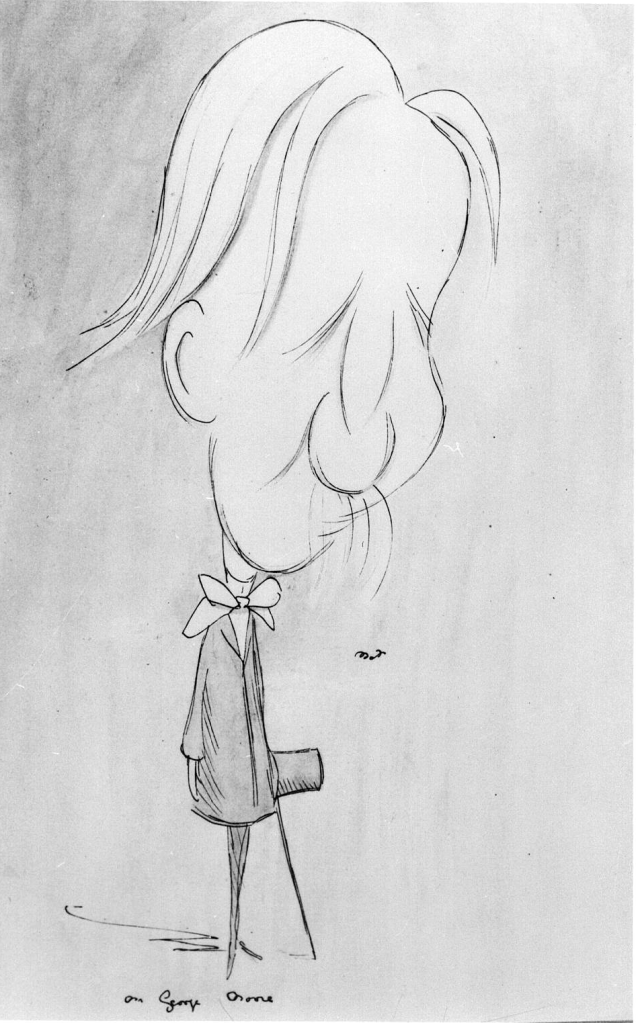
1901, aet 49
6 x 10.5 inches; 15.24 x 26.67 cm
Graphite and watercolor on paper
Captioned Mr George Moore. Signed Max. Geroge Moore full length, half-turned to his left, wearing a large bow tie, holding a top hat and stick in his left hand.
Provenance, exhibition and publication history in Rupert Hart-Davis, A Catalogue of the Caricatures of Max Beerbohm (1972), number 1047. Owned by the Harry Ransom Center, University of Texas at Austin, USA.
To the Queen of the Fairies
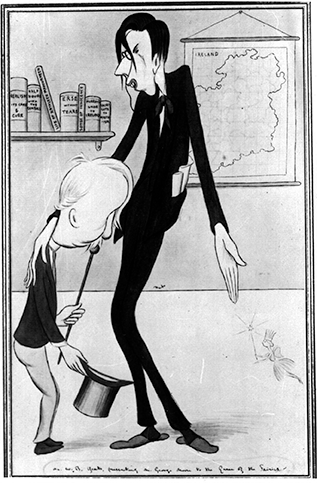
1904, aet. 52
12.5 x 7.5 in; 31.75 x 19.05 cm
Ink and watercolor on paper
Captioned Mr. W .B. Yeats presenting George Moore to the Queen of the Fairies. Signed Max. George Moore on the left side of the picture, full-length in profile turned to his left, a top hat in his right hand, a stick raised to his chin in his left hand. He faces the Queen on the right side of the picture. A willowy Yeats full-length is centered between the other two, his right hand draped over Moore’s right shoulder, his left gesturing towards the Queen. Background includes a map of Ireland and a shelf of humorously titled books: Realism, Its Cause & Cure; Half Hour with the Symbols; Life of Kathleen Mavourneen; Erse Without Tears; Songs of Innocence; Murray Guide to Ireland; Short Cuts to Mysticism.
Provenance, exhibition and publication history in Rupert Hart-Davis, A Catalogue of the Caricatures of Max Beerbohm (1972), number 1827. Owned by the Hugh Lane Gallery, Dublin, Ireland.
William Archer Really Conversing
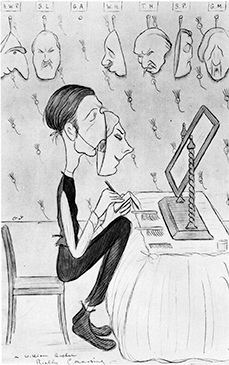
1904, aet. 52
16 x 8 in; 40.64 x 20.32 cm
Ink, graphite and watercolor on paper
Captioned Mr William Archer Really Conversing. Archer full-length at center-left, in profile turned to his left, seated and taking notes before a mirror and wearing a mask of George Alexander. The background includes a mask of George Moore in the upper right corner of the picture, and masks (from left to right) of Arthur Pinero, Sidney Lee, William Heinemann, Thomas Hardy, and Stephen Phillips. All were interviewed by Archer in Real Conversations (1904). Moore’s interview was recorded in 1901, at the end of the argument referenced in Pat and Sandy.
Provenance, exhibition and publication history in Rupert Hart-Davis, A Catalogue of the Caricatures of Max Beerbohm (1972), number 27. Owned by the Harry Ransom Center, University of Texas at Austin, USA.
Preacher to Lord Howard de Walden
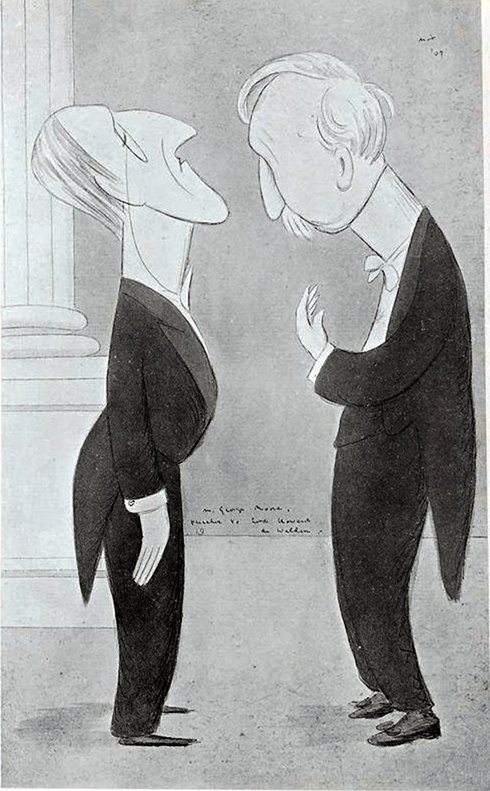
1907, aet. 55
Ink, graphite and watercolor on paper
Captioned Mr. George Moore, preacher to Lord Howard de Walden. Signed Max ’07. Both men full-length in profile facing each other in evening dress. Moore on the right side of the picture, his left hand raised as though expounding, looks at Lord Howard de Walden’s upturned chin. An architectural column at left in the background.
Moore was Lord Howard de Walden’s artistic adviser in the early 1900s.
Provenance, exhibition and publication history in Rupert Hart-Davis, A Catalogue of the Caricatures of Max Beerbohm (1972), number 1049. Also published in Thomas Seymour, A Boon Companion (2021). Present whereabouts unknown.
An Influential Deputation
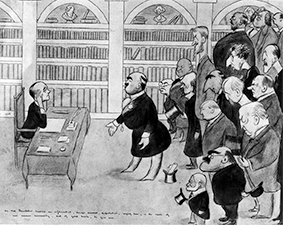
1908, aet. 56
12.63 x 16 in; 32.07 x 40.64 cm
Ink, graphite and watercolor on paper
Captioned Mr Max Beerbohm receives an influential, though biassed, deputation, urging him, in the cause of our common humanity, and of good taste, to give over. Max seated in a library facing his frequent pictorial subjects including George Moore center right, Lord Burnham, Hall Caine, Edward Carson, G.K. Chesterton, Viscount Haldane, Henry James, Rudyard Kipling, Lord Northcliffe, Arthur Pinero, William Rothenstein, William Sargent, G.B. Shaw, Marquis Luis de Soveral, P.W. Steer, Paolo Tosti, and Israel Zangwill.
Provenance, exhibition and publication history in Rupert Hart-Davis, A Catalogue of the Caricatures of Max Beerbohm (1972), number 1423. Owned by the Art Institute of Chicago, USA.
Reappearance in Chelsea
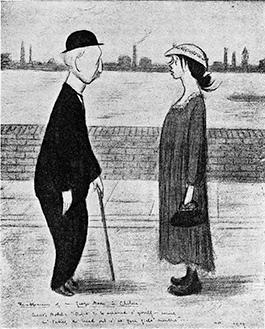
1909, aet. 57
22 x 18 in; 55.88 x 45.72 cm
Ink, graphite and watercolor on paper
Captioned Reappearance of Mr George Moore in Chelsea. Inscribed Artist’s Model: “Ought to be ashamed o’ yerself — coming an’ taking the bread out o’ us pore girls’ mouths…” Moore full-length on the left side of the picture, in profile turned to his left, wearing a bowler hat, a stick in his left hand, facing a female model on the right side of the picture who addresses him. View of the London Embankment in the background.
E.V. Lucas’ play His Fatal Beauty: or, The Moore of Chelsea (1917) likewise satirized Moore’s frequent sittings for portraits.
Provenance, exhibition and publication history in Rupert Hart-Davis, A Catalogue of the Caricatures of Max Beerbohm (1972), number 1050. Owned by the Charterhouse School, Godalming, Surrey, England.
Study for Reappearance in Chelsea
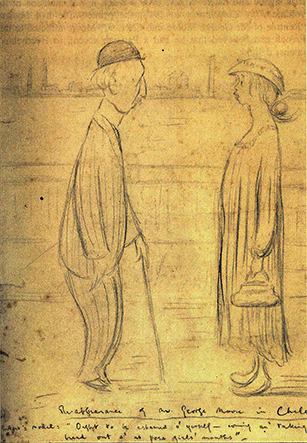
1909, aet. 57
12.6 x 10.63 in; 32 x 27 cm
Graphite on paper
Signed Max 1909. Captioned: Reappearance of Mr George Moore in Chelsea. Inscribed Artist’s Model: “Ought to be ashamed o’ yerself — coming an’ taking the bread out o’ us pore girls’ mouths…” Moore on the left side of the picture is full-length in profile turned to his left, wearing a bowler hat, stick in his left hand, facing a female artist’s model who addresses him. The London Embankment is in the background.
Exhibited in “Max in Retrospect,” Leicester Galleries, London (1952); “England in the 1890s: Literary Publishing at the Bodley Head,” Georgetown University Library (1989-1990); “The Power of Conversation: Jewish Women and their Salons, Jewish Museum, New York, and McMullen Museum, Boston College (2005).
Published in Margaret D. Stetz and Mark Samuels Lasner, England in the 1890s: Literary Publishing at the Bodley Head (1990), page 101; Marie-Claire Hamand, “Max the caricaturist and Moore: Crossing the Boundaries of Friendship,” in Christine Huguet and Fabienne Darrigeon-Garcier, , George Moore: Across Borders (2013), page 77.
Owned by the Mark Samuels Lasner Collection, University of Delaware Library, Newark, USA.
Beyond a Joke

Circa 1909, aet. 57
Ink on paper
Inscribed Here is George Moore. I saw him last night — had not met him for more than a year; and his appearance really is beyond a joke now. Max Beerbohm. Head and shoulders of a feeble and exhausted George Moore, looking to his right.
Published in Catalogue 162 (1969) of Bertram Rota Booksellers, featuring 28 autograph signed letters of Max Beerbohm incorporating two caricatures and a sketch map, 1903-10 (with undated letters of the same period) to Mrs Hugh Hammersley with one to Hugh Hammersley, 20th March, 1909. Sold in 1969 to Seven Gables Bookshop in New York City. Actually Mrs Hugh Hammersley died in 1902.
Owned by the Mark Samuels Lasner Collection, University of Delaware Library, Newark, USA.
In Case I Am Not Spared to See Them
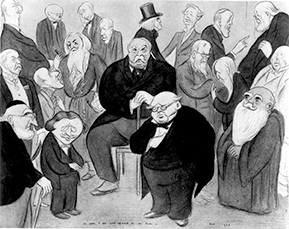
1910, aet. 58
13 x 16 in; 33.02 x 40.64 cm
Ink, graphite and watercolor on paper
Frequent subjects of Max’s artistic gaze are depicted in extreme old age. They include George Moore with long hair and beard, center-right side of the picture, Arthur Balfour, Haddon Chambers, Winston Churchill, L.V. Harcourt, Lord Howard de Walden, H.B. Irving, Augustus John, Lord Kitchener, A.E.W. Mason, Arthur Pinero, Soveral, F.E. Smith, G.S. Street, Alfred Sutro, the Duke of Westminster, Charles Wyndham, and George Wyndham.
Provenance, exhibition and publication history in Rupert Hart-Davis, A Catalogue of the Caricatures of Max Beerbohm (1972), number 335. Owned in 1972 by Stephen Pilkington, son (?) of Piccadilly Gallery cofounder Godfrey Pilkington. Present whereabouts unknown.
Influence of the Boer War
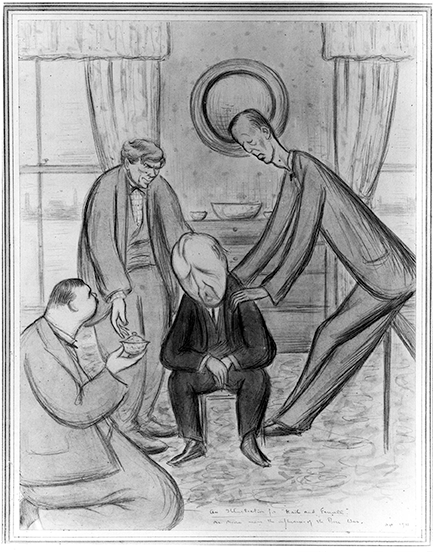
1911, aet. 59
15.75 x 12 3/8 in; 40.01 x 31.43 cm
Graphite and watercolor on paper
Captioned An illustration for ‘Hail and Farewell’. Mr Moore under the influence of the Boer War. See Hail and Farewell – Ave, Chapter 12. George Moore full-length, his morose head drooping to his right, hands folded in his lap, seated in the center of a nicely furnished room, surrounded by his consoling artist-friends Philip Wilson Steer, Walter Sickert, and Henry Tonks.
Provenance, exhibition and publication history in Rupert Hart-Davis, A Catalogue of the Caricatures of Max Beerbohm (1972), number 1054. Owned by the Ashmolean Museum, Oxford University, England.
How They Might Undo Me
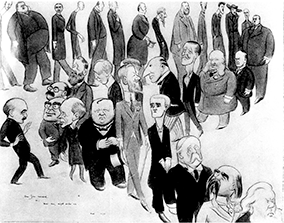
1911, aet. 59
Ink, graphite and watercolor on paper
Captioned One fine morning, or, How they might undo me. Signed Max 1911. Max is taken aback by a line of altered figures including George Moore center-left without mustache, Asquith, Arthur Balfour, Arnold Bennett, Lord Burnham, Hall Caine, Rev. R.J. Campbell, G.K. Chesterton, W.C. Courtney, Lord Curzon, Viscount Haldane, L.V. Harcourt, Rudyard Kipling, Lord Kitchener, Andrew Lang, W.]. Locke, Arthur Pinero, Lord Ribblesdale, Lord Rosebery, William Rothenstein, William Sargent, G.B. Shaw, F.E. Smith, Soveral, Lord Spencer, P.W. Steer, Alfred Sutro, Henry Tonks, A.B. Walkley, and Israel Zangwill.
Provenance, exhibition and publication history in Rupert Hart-Davis, A Catalogue of the Caricatures of Max Beerbohm (1972), number 1443. Owned by actress Elizabeth Montgomery of Beverly Hills, California in 1972. Present whereabouts unknown.
A Survivor of the Nouvelle Athénes
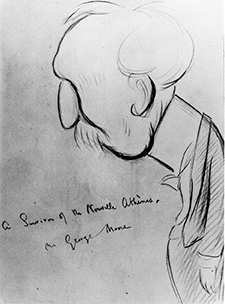
Circa 1912, aet. 60
10.75 x 8.4 in; 27.31 x 21.34 cm
Pencil on paper
Captioned A Survivor of the Nouvelle Athènes – Mr George Moore. George Moore three-quarter length in profile, turned to his right.
Moore wrote in Chapter 15 of Hail and Farewell, Salve (1912): “I am an Objectivist, reared among the Parnassians, an exile from the Nouvelle Athènes….”
Provenance, exhibition and publication history in Rupert Hart-Davis, A Catalogue of the Caricatures of Max Beerbohm (1972), number 1061. Owned by the Harry Ransom Center, University of Texas at Austin, USA.
I will be a Mexican
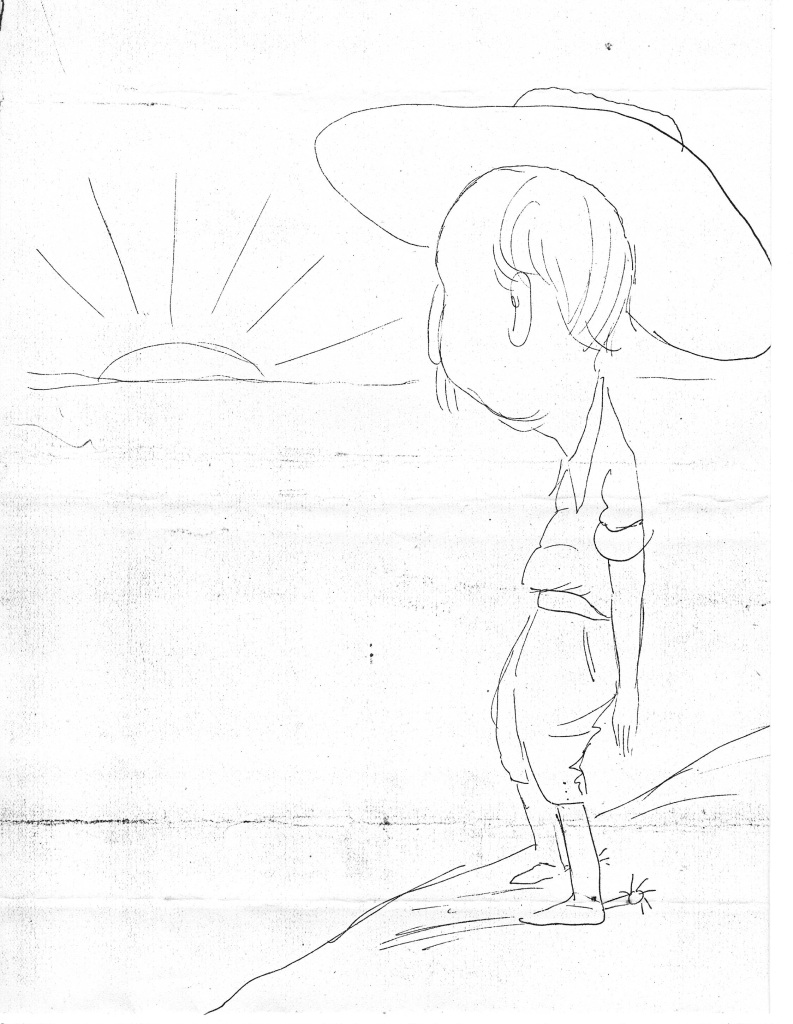
1912, aet. 60
8 x 12.5 in; 20.32 x 31.75 cm
Pencil on verso on page 6 of Max’s manuscript Dickens, by G–rge M–re
Full length in profile turned to his right, looking back at a sunrise or sunset, dressed as a cowboy.
“Deep down in my heart a sudden voice whispers me that there is only one land wherein art may reveal herself once more. Of what avail to await her anywhere else than in Mexico? Only there can the apocalypse happen. I will take a ticket for Mexico, I will buy a Mexican grammar, I will be a Mexican…. On a hillside, or beside some grey pool, gazing out across those plains poor and arid, I will await the first pale showings of the new dawn….” Dickens, by G–rge M–re in Max Beerbohm, A Christmas Garland (London: William Heinemann, 1912), page 185.
Owned by the Robert H. Taylor Collection of Princeton University Library, New Jersey, USA.
Salve

1912, aet. 60
Graphite on the title page of Hail and Farewell! Salve (1912)
George Moore head and shoulders.
Not in Rupert Hart-Davis, A Catalogue of the Caricatures of Max Beerbohm (1972). Photocopy found among my archived correspondence with Edwin Gilcher. Present whereabouts unknown.
In the Mirror of the Past
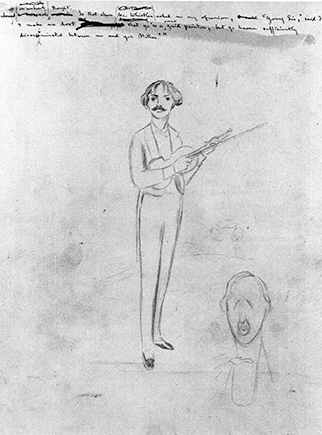
Circa 1913, aet. 61
8 x 13 in; 20.32 x 33.02 cm
Graphite on verso of page 56 of Max’s manuscript The Mirror of the Past
Captioned George Moore and Pable de Sarasate. George Moore half-length in the lower right corner of the picture, below a full-length drawing of Pablo de Sarasate in the center and a holograph anecdote about Thomas Carlyle at the top.
Published in Lawrence Danson, “Max Beerbohm and ‘The Mirror of the Past’,” (Princeton University Library Chronicle , Vol. 43, No. 2 (Winter 1982). Owned by the Robert H. Taylor Collection of Princeton University Library, New Jersey, USA.
Elegy on Any Lady
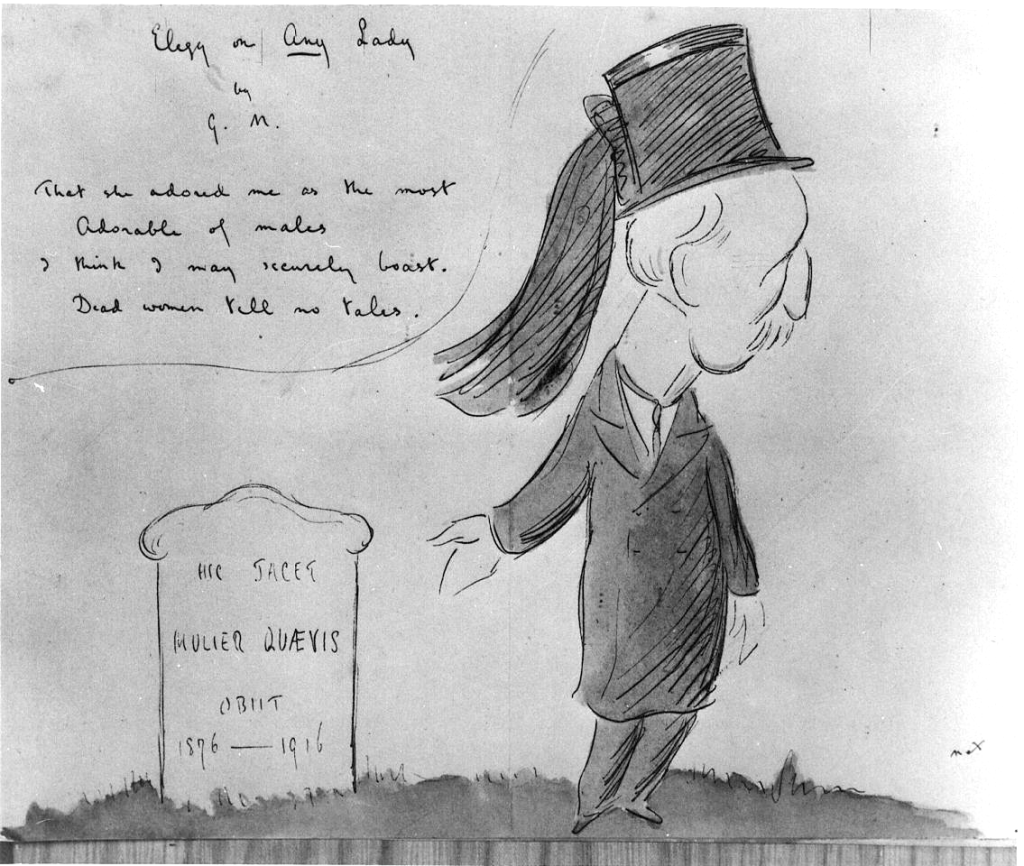
1916, aet. 64
12.38 x 7 in; 31.43 x 17.78 cm
Ink and watercolor on paper
Captioned Elegy on Any Lady by G.M. Inscribed That she adored me as the most Adorable of males I think I may securely boast. Dead women tell no tales. Signed Max. George Moore full-length looking to his left, in mourning, his right hand gesturing towards a tombstone which is carved: HIC JACET MULIER QUAEVIS OBIT 1876-1916.
Provenance, exhibition and publication history in Rupert Hart-Davis, A Catalogue of the Caricatures of Max Beerbohm (1972), number 1055. Owned by Jennifer Gosse of Cold Ash, Berkshire, England in 1972. Present whereabouts unknown.
Study for Elegy on Any Lady
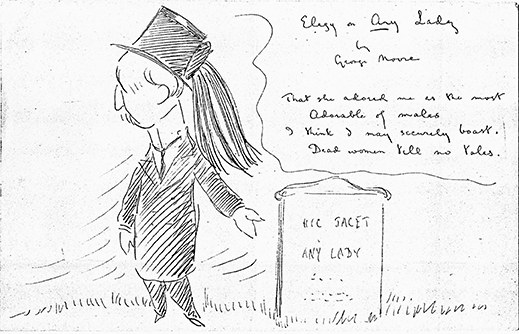
1916, aet. 64
7.25 x 4 in; 18.42 x 10.16 cm
Ink on paper
Captioned Elegy on Any Lady by George Moore. Inscribed That she adored me as the most Adorable of males I think I may securely boast. Dead women tell no tales. Moore full-length looking to his right, in mourning, his left hand gesturing towards a tombstone which is carved: HIC JACET ANY LADY.
Provenance, exhibition and publication history in Rupert Hart-Davis, A Catalogue of the Caricatures of Max Beerbohm (1972), number 1055a. Owned by the Robert H. Taylor Collection of Princeton University Library, New Jersey, USA.
The Birthday Surprise
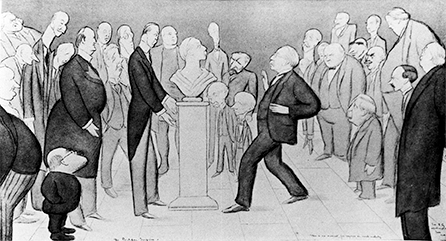
1919, aet. 67
Ink, graphite and watercolor on paper
Captioned The Birthday Surprise. Inscribed “This is no moment for coyness or mock-modesty.” Signed For E.G. affectionately from Max. Edmund Gosse presented with a bust of himself. The bust was unveiled 9 November 1920, a little over a year after he received a congratulatory address marking his seventieth birthday. The signatories of the address in this picture include George Moore third from left side of picture, William Archer, Arthur Balfour, Maurice Baring, Arnold Bennett, Lord Beauchamp, the Archbishop of Canterbury, Evan Charteris, G.K. Chesterton, Joseph Conrad, Lord Crewe, Lord Curzon, Austin Dobson, Lord Haldane, L.V. Harcourt, Thomas Hardy, Maurice Hewlett, Lord Howard de Walden, Rudyard Kipling, Ray Lankester, Lord Londonderry, John Morley, Arthur Pinero, Mr. Ryman, Logan Pearsall Smith, Lord Spencer, Sir Frank Swettenham.
Provenance, exhibition and publication history in Rupert Hart-Davis, A Catalogue of the Caricatures of Max Beerbohm (1972), number 612.
Owned by the Savile Club, London.
Gaffer George
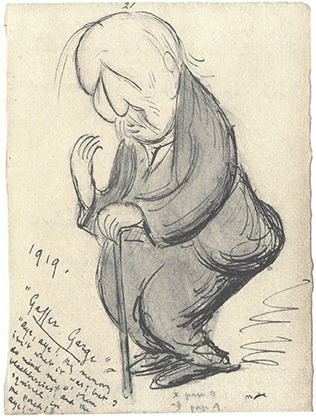
1919, aet. 67
Ink and watercolor on paper
Signed Max 1919. Inscribed “Gaffer George” “Aye, aye! My memory isn’t what it was; but I do mind me o’ them blackberries, and the squirrel in me porch! Aye! George Moore full-length stooping, half-turned to his right, his right hand raised as though expounding, his left hand resting on a stick.
Paired with an undated manuscript letter from Max Beerbohm: My dear little Miss Nancy. “You have not” [see page 2 of your volume] “arrived at the age when such thoughts assail you”. Nevertheless, the fact remains that “when you” [see page 2 again] “are a beautiful young woman in society” our friend George Moore will be “a very old man”. And it is well to look facts in the face. It is well to let Moore’s thoughts assail us, young though we be. Let us not be cowards — you and I. Let us steadfastly, hand in hand, envisage Moore as “a very old man”. Yours ever Max Beerbohm
Published in Christine Huguet and Fabienne Dabrigeon-Garcier, George Moore: Across Borders (2013). Owned by the Mark Samuels Lasner Collection, University of Delaware Library, Newark, USA.
An Unusual Case
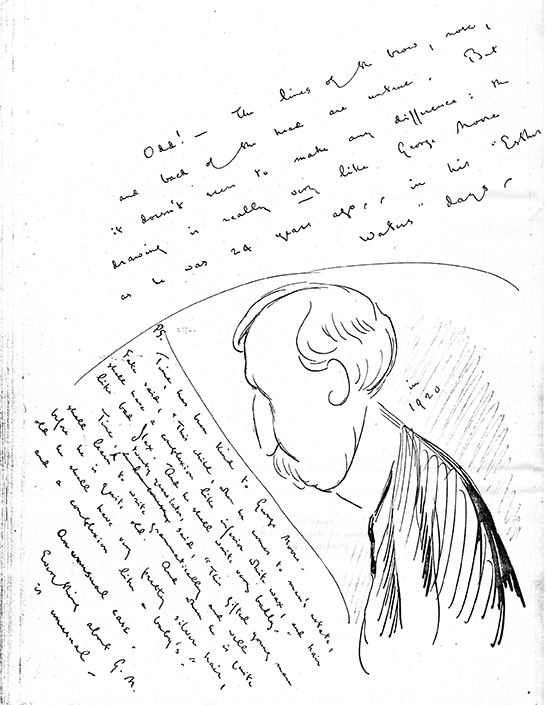
1920, aet. 68
Ink and graphite on a leaf of Max Beerbohm, Twenty-Five Gentlemen (1896)
Captioned in 1920. Inscribed (in 1903, 1909 and 1920) Odd! -The lines of the brow, nose, and back of the head are untrue. But it doesn’t seem to make any difference: the drawing is really very like George Moore as he was 24 years ago… in his Esther Waters days. PS. Time has been kind to George Moore. Fate said, “This child, when he comes to man’s estate, shall have a complexion like inferior white wax, and hair like bad flax. And he shall write very badly.” Time, twenty years later, said, “This gifted young man shall learn to write grammatically and well before he is quite old. And when he is quite old he shall have very pretty silver hair, and a complexion like a baby’s.” An unusual case. Everything about G.M. is unusual. George Moore half-length in profile, turned to his right.
Owned by the Robert H. Taylor Collection of Princeton University Library, New Jersey, USA.
A Lacuna
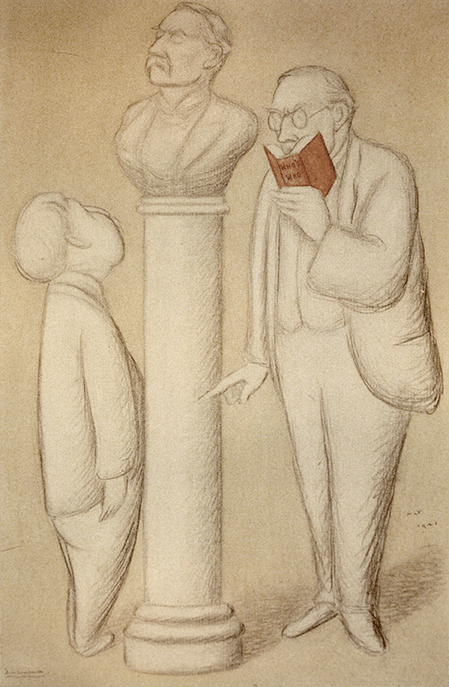
1921, aet. 69
13 x 8.25 in; 33.02 x 20.96 cm
Graphite and watercolor on paper
A diminutive George Moore gazes up at a bust of Edmund Gosse. Gosse himself consults Who’s Who, remarking “But, my dear Moore, of course you will – of course they shall! Only, you don’t tell us when your seventieth birthday is!” GM turned 70 on 24 February 1922.
Provenance, exhibition and publication history in Rupert Hart-Davis, A Catalogue of the Caricatures of Max Beerbohm (1972), number 613. Owned by Harvard College Library of Harvard University, Cambridge, Massachusetts, USA.
Edwardian Parade
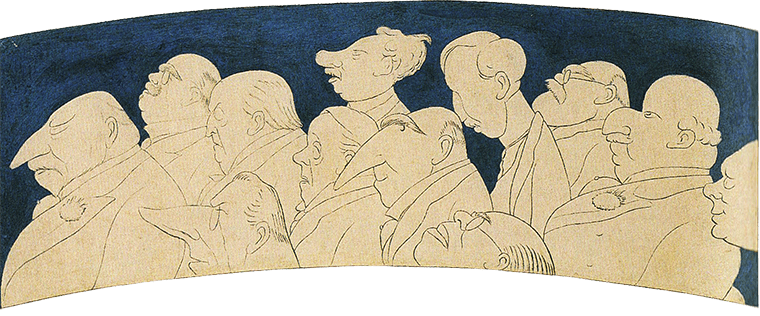
Circa 1900-1910, aet. 50s
20.5 x 48.75 in; 52.07 x 123.83 cm
Oil on canvas laid on board
A mural, formerly in the bedroom of the artist’s home in Rapallo, Italy, including profiles of subjects turned to their right. George Moore is center- right; others are Lord Burnham, Joseph Chamberlain, Winston Churchill, Edward VII, Henry James, Rudyard Kipling, Arthur Pinero, Lord Rosebery, William Rothenstein, Soveral, Reggie Turner.
Published in N. John Hall, Max Beerbohm, A Kind of Life (2002). The title follows the owner’s catalogue. Numbered 514 in Rupert Hart-Davis, A Catalogue of the Caricatures of Max Beerbohm (1972) where it is dated 1922. Owned by the Harry Ransom Center, University of Texas at Austin, USA.
Sketch for Edwardian Parade
Circa 1900-1910
16 x 13 in; 40.64 x 33.02 cm
Pencil and pastel crayon on paper
(Image forthcoming)
Inscribed Sketch for a fresco, which has since been executed by me, quite seriously, on a ladder, in the Villino Chiaro. The faces are the faces that have always come easiest to me — lines of least resistance to the budding frescoist. Offered to the Phillipsian Album. The sketch includes George Moore, Rudyard Kipling, Arthur Pinero, William Rothenstein, and Reggie Turner.
Provenance, exhibition and publication history in Rupert Hart-Davis, A Catalogue of the Caricatures of Max Beerbohm (1972), number 515. Owned by the William Andrews Clark Memorial Library, University of California at Los Angeles, USA.
That Eternal Invalid

1923, aet. 71
14.5 x 12 in; 36.83 x 30.48 cm
Ink, graphite and watercolor on paper
Captioned The British Drama (that eternal invalid). Inscribed Mr. Granville-Barker: “And how are we today?… Yes, yes. The old complaint. Cerebral anaemia. And complicated by acute cinematitis … Municipal pillules are the only hope.” Signed: Max 1923. Harley Granville-Barker at the bedside of a female personification. In the background several figures comment on her condition including George Moore upper-right, turned to his left in profile and captioned I was her lover. Also William Archer, Arnold Bennett, Gordon Craig, St. John Ervine, Lord Howard de Walden, H.A. Jones, John Masefield, G.B. Shaw, and A.B. Walkley.
Moore, a founder of the Independent Theatre and the Irish Literary Theatre, had published arguments for theatre reform since 1885.
Provenance, exhibition and publication history in Rupert Hart-Davis, A Catalogue of the Caricatures of Max Beerbohm (1972), number 95. Owned by the William Andrews Clark Memorial Library, University of California at Los Angeles, USA.
The Old and the Young Self
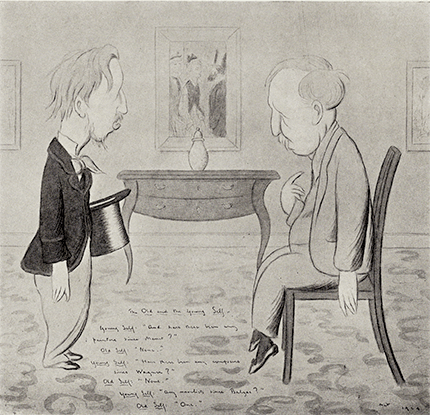
1924, aet. 72
12.75 x 12 in; 32.39 x 30.48 cm
Crayon and pencil on paper
Captioned The Old and the Young Self. Inscribed Young Self: “And have there been any painters since Manet?” Old Self: “None.” Young Self: “Have there been any composers since Wagner?” Old Self: “None.” Young Self: “Any novelists since Balzac?” Old Self: “One.” A young George Moore full-length in profile stands in the left side of the picture, top hat in his left hand, facing an old George Moore full-length, seated on a chair in the right side of the picture, pointing with his right hand to himself. A framed painting hangs on the wall in the background.
Provenance, exhibition and publication history in Rupert Hart-Davis, A Catalogue of the Caricatures of Max Beerbohm (1972), number 1056. Owned by The London Library.
Some Persons of “the Nineties”
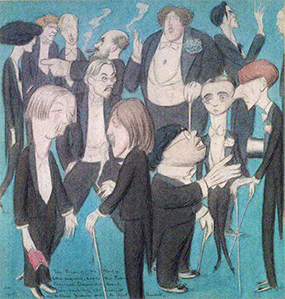
1925, aet. 73
13.67 x 13 in; 34.71 x 33.02 cm
Ink graphite and watercolor on paper
Captioned Some Persons of “the Nineties” little imagining, despite their Proper Pride and Ornamental Aspect, how much they will interest Mr. Holbrook Jackson and Mr. Osbert Burdett. George Moore is three-quarter length in the upper left part of the picture, head tilted to his right. Others are Aubrey Beardsley, Max Beerbohm, Charles Conder, John Davidson, Henry Harland, Richard Le Gallienne, William Rothenstein, Walter Sickert, Enoch Soames, Oscar Wilde and W.B. Yeats.
Provenance, exhibition and publication history in Rupert Hart-Davis, A Catalogue of the Caricatures of Max Beerbohm (1972), number 1650. Also published in Christine Huguet and Fabienne Dabrigeon-Garcier, George Moore: Across Borders (2013) in color. Owned by the Ashmolean Museum, Oxford University, England
Vagrom Memories of Sloping Shoulders
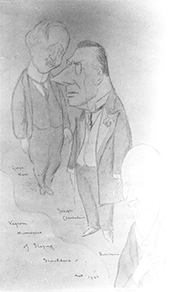
1946
8.25 x 12.6 in; 20.96 x 32 cm
Ink and/or graphite with watercolor on paper
Captioned Vagrom Memories of Sloping Shoulders. George Moore full-length, upper-left side of the picture, slightly turned to his left; Joseph Chamberlain in the center and A.C. Swinburne in lower right.
Provenance, exhibition and publication history in Rupert Hart-Davis, A Catalogue of the Caricatures of Max Beerbohm (1972), number 281. Owned by David Tree Parsons of Broxbourne, Herts, England in 1972. Present whereabouts unknown.
Max’s Last Drawing
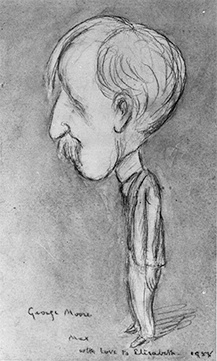
1955
Ink and/or graphite with watercolor on paper
Captioned George Moore. Signed: Max with love to Elizabeth [Jungmann] 1955. George Moore full-length in profile turned to his right.
Provenance, exhibition and publication history in Rupert Hart-Davis, A Catalogue of the Caricatures of Max Beerbohm (1972), number 1057. Owned by Mrs. Eva Reichmann in 1972. Present whereabouts unknown.
In a Picture Gallery

Undated
11.6 x 7.5 in; 29.46 x 19.05 cm
Ink, graphite and watercolor on paper
Signed Max. George Moore full-length looking down and to his right, his left hand raised as though expounding. Two framed pictures hang on the wall behind him.
Provenance, exhibition and publication history in Rupert Hart-Davis, A Catalogue of the Caricatures of Max Beerbohm (1972), number 1058. Owned by the Ashmolean Museum, Oxford University, England
With a Lady
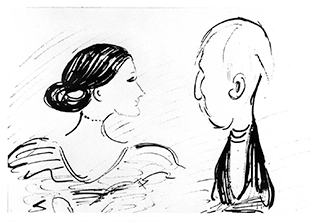
Undated
12.75 x 8 in; 32.39 x 20.32 cm
Black chalk and ink on paper
George Moore half-length on the right side of the picture, head in profile turned to his right, looking at a smiling lady, half-length, returning his gaze. Both in formal attire.
Provenance, exhibition and publication history in Rupert Hart-Davis, A Catalogue of the Caricatures of Max Beerbohm (1972), number 1060. Owned by John Brett-Smith in 1972. Present whereabouts unknown.
Astrakhan and Bowler
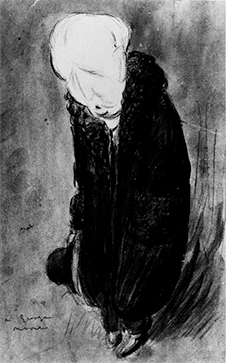
Undated
11.6 x 7.4 in; 29.46 x 18.8 cm
Pencil on paper
Captioned Mr George Moore. Full-length half-turned to his right, wearing astrakhan coat and carrying bowler hat in his right hand.
Provenance, exhibition and publication history in Rupert Hart-Davis, A Catalogue of the Caricatures of Max Beerbohm (1972), number 1062. Owned by the Harry Ransom Center, University of Texas at Austin, USA.
In a Sculpture Gallery
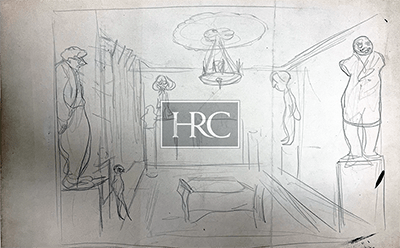
Undated
10.25 x 14 in; 26.04 x 35.56 cm
Pencil on paper
(Photo watermarked by the owner.)
Max Beerbohm standing in a sculpture gallery with four figures on pedestals, one of whom is George Moore in the back right corner of the room.
Owned by the Harry Ransom Center, University of Texas at Austin, USA.

Leave a comment