
←Menu of Pictures of George Moore
The makers of these pictures are currently unknown. They are listed chronologically. Their titles are mostly my invention.
- Father of the Man
- Artist as a Young Man
- The Pagan
- New Dad
- A Sportsman’s Sketch
- To the Queen of the Fairies
- Conversation in Heinemann’s Garden
- At Hill Hall
- With Nancy at Sanary-sur-Mer
- Les lauriers sont coupés I
- Les lauriers sont coupés II
- Les lauriers sont coupés III
- Les lauriers sont coupés IV
- In the Garden of Le Val Changis
- Modernist Montage
- An Apostle
Father of the Man

1861, aet. 9
Tinted and printed daguerreotype
George Moore three-quarter length, looking to his left; right arm resting on a chair back, left hand grasping the belt of his jacket.
Published in George Moore, Memoirs of My Dead Life (1921) as the frontispiece; and in Joseph Hone, The Life of George Moore (1936). Present whereabouts unknown.
Artist as a Young Man
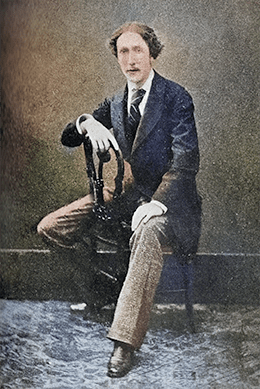
1873-1875, aet. 21-23
Printed photograph, colorized
George Moore full-length, straddling a chair half-turned to his right; right arm resting on the chair back, left hand on his knee.
At the time, he was an art student learning how to paint in London and Paris. Between the time of this picture and The Pagan, he grew a full beard.
The monochrome original was published in Joseph Hone, The Life of George Moore (1936). Present whereabouts unknown.
The Pagan

1880-1881, aet. 28
Printed photograph, colorized
George Moore half-length slightly turned to his left.
At this time, he had published a book of poetry and a play, and would soon publish his second book of poetry Pagan Poems (1881). He sometimes used “Pagan” as his nom de plume in newspapers.
The monochrome original was published in Joseph Hone, The Life of George Moore (1936). Present whereabouts unknown.
New Dad
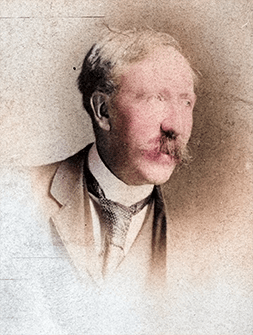
1896, aet. 44
Photograph, colorized
Inscribed George Moore 1896 (cropped from this reproduction). George Moore head and shoulders slightly turned to his left.
Nancy Cunard, who may have been fathered by George Moore, was born on 10 March 1896.
A unique monochrome original was collected by Edwin Gilcher and is now in the Edwin L. Gilcher Papers at Arizona State University Library.
A Sportsman’s Sketch
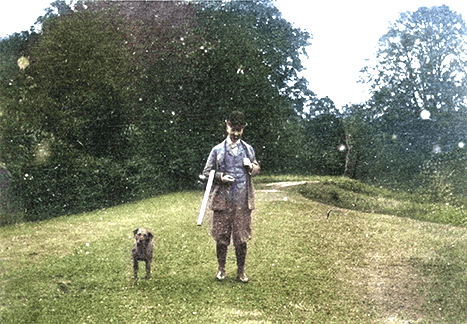
Circa early 1900s, aet. 50
Printed photograph, colorized
George Moore in a driveway bordered by trees at Coole Park, County Galway, Ireland, the home of Lady Augusta Gregory. Full length wearing tall boots and a tall bowler hat; holding an open shotgun over his right arm; his left hand gripping his waistcoat. A hound stands to his right.
Ivan Turgenev, the author of A Sportsman’s Sketches (1852), met George Moore at the bal de l’Assommoir in Paris in 1877. He was one of Moore’s strongest literary influences.
Published in George Moore, Hail and Farewell (1976). The monochrome original was then owned by Colonel R.G. Gregory; now owned by Mr. Colin Smythe.
To the Queen of the Fairies
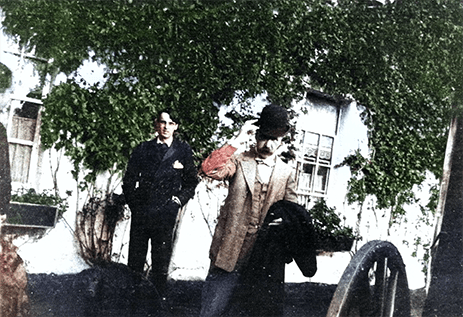
Circa early 1900s, aet. 50
Printed photograph, colorized
In front of the big house at at Coole Park, County Galway, Ireland, the home of Lady Augusta Gregory. George Moore three-quarter length, his right hand raised to his bowler hat, a coat draped over his left arm. William Butler Yeats is full length behind and to Moore’s right. A third figure, maybe Lady Gregory, is barely visible at the left border, looking at Moore. A carriage wheel is at bottom right. Moore wears the same outfit as in A Sportsman’s Sketch.
Max Beerbohm famously caricatured Mr. W.B. Yeats, presenting Mr. George Moore to the Queen of the Fairies (circa 1904).
Published in George Moore, Hail and Farewell (1976). The monochrome original was then owned by Colonel R.G. Gregory; now owned by Mr. Colin Smythe.
Conversation in Heinemann’s Garden
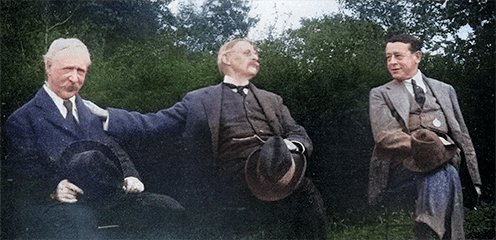
1919, aet. 67
Printed photograph, colorized
Captioned In William Heinemann’s garden at Oakham, 1919. George Moore is seated at left, turned slightly to his left, facing the camera; his close friend the author Edmund Gosse is seated in the center, the right hand on Moore’s left shoulder; the playwright C. Haddon Chambers is seated on the right side of the picture. Each man is jovial and holds a hat in his lap.
The Moore Hall edition of Memoirs of My Dead Life (1921) was dedicated to Gosse. William Heinemann became George Moore’s publisher of record in 1922. An imaginary talk with Gosse was published in the Atlantic Monthly (April 1923) and collected in Conversations in Ebury Street (1924).
The monochrome original was published in Evan Charteris, The Life and Letters of Sir Edmund Gosse (1931). Present whereabouts unknown.
At Hill Hall
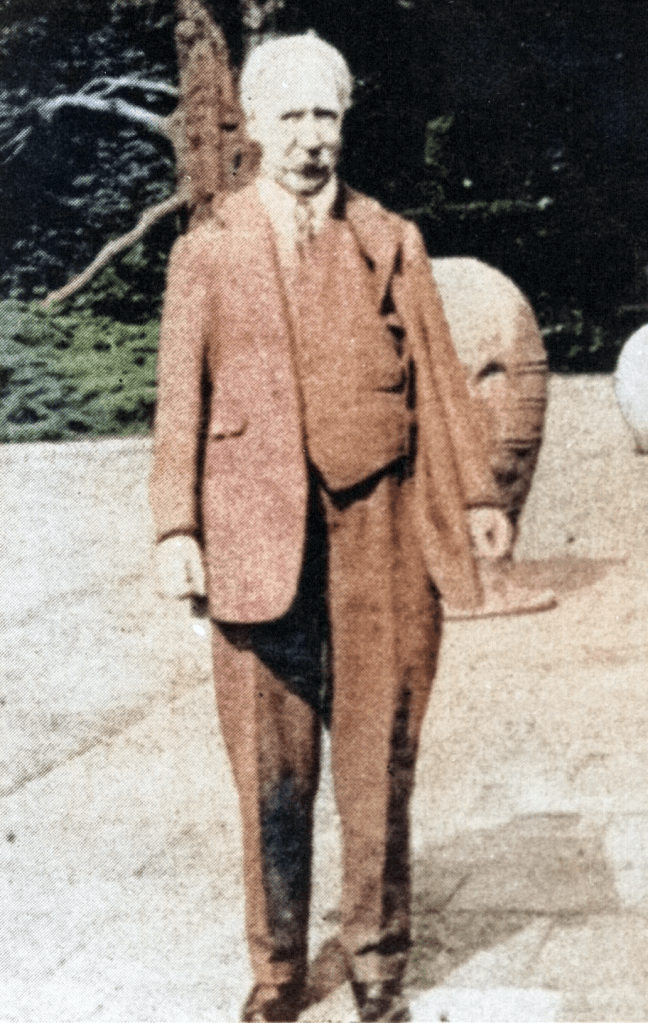
1919, aet. 67
Printed photograph, cropped and colorized
George Moore full-length on a paved terrace at the home of his friends Charles and Mary Hunter.
Published in Nancy Cunard, GM. Memories of George Moore (1956). Owned by the Harry Ransom Center, University of Texas at Austin, USA.
With Nancy at Sanary-sur-Mer
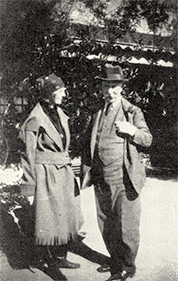
1921, aet. 69
Printed photograph
Captioned G.M and Nancy Cunard at Sanary, winter 1921-22. George Moore full-length standing on a terrace, half-turned to his right and smiling. Nancy Cunard stands on Moore’s right looking at him.
Published in Nancy Cunard, GM. Memories of George Moore (1956). Owned by the Harry Ransom Center, University of Texas at Austin, USA.
Les lauriers sont coupés I
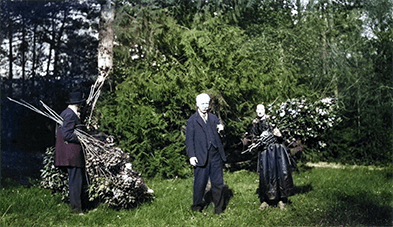
Circa early1920s, aet. 70
Photograph, colorized
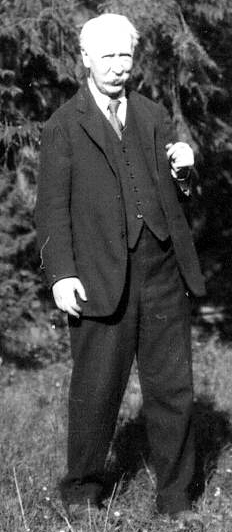
From left to right: Marie Dujardin standing behind her husband Édouard Dujardin, George Moore in the center, and Wanda Landowska; all full length in the garden of Dujardin’s home Le Val Changis, Fontainebleau, France. Moore’s raised left hand holds a sprig. Others hold bunches of cuttings.
Édouard’s experimental novel Les lauriers sont coupés (1887) — “the laurels are cut” — influenced Moore’s aesthetics.
Mme. Marie Dujardin (né Chenou) of Mesnil-le-Roi, France lent me this and similar pictures during a visit to her home in the late 1970s or early 1980s. Present whereabouts unknown.
Les lauriers sont coupés II
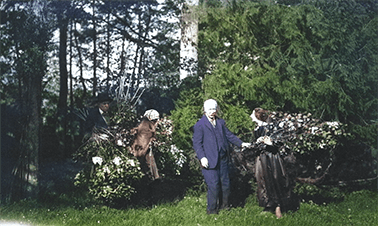
Circa early1920s, aet. 70
Photograph, colorized
From left to right: Édouard Dujardin, Marie Dujardin, George Moore in the center, and Wanda Landowska; all full length in the garden of Dujardin’s home Le Val Changis, Fontainebleau, France. Moore’s left hand rests on Wanda’s cuttings.
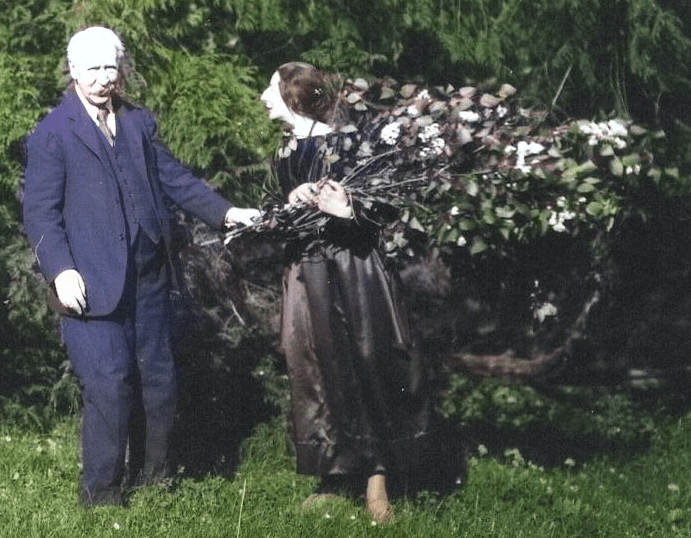
Twenty years after I met Marie, my friend David Goldsmith, professor of chemistry at Emory University, identified Wanda by her nose. Present whereabouts unknown.
Les lauriers sont coupés III

Circa early1920s, aet. 70
Photograph
From left to right: Édouard Dujardin, Marie Dujardin and George Moore in the center facing away, and Wanda Landowska; all full length in the garden of Dujardin’s home Le Val Changis, Fontainebleau, France, mostly prior to cutting the laurels. Present whereabouts unknown.
Les lauriers sont coupés IV
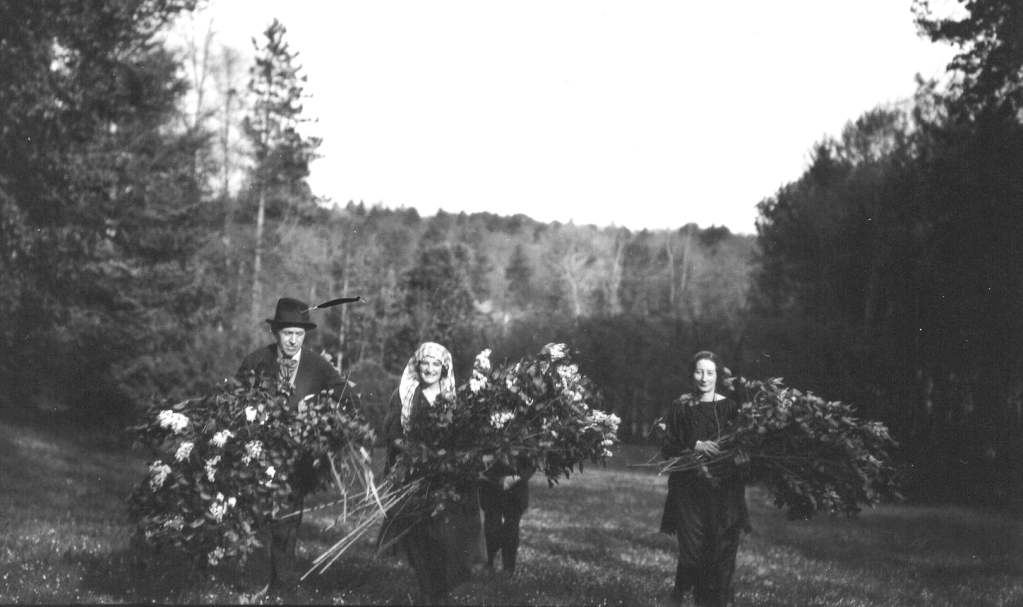
Circa early1920s, aet. 70
Photograph
From left to right: Édouard Dujardin, Marie Dujardin, George Moore hidden behind Marie’s cuttings, and Wanda Landowska; all full length in the garden of Dujardin’s home Le Val Changis, Fontainebleau, France, after cutting the laurels. Present whereabouts unknown.
In the Garden of Le Val Changis

Circa early1920s, aet. 70
Printed photograph, colorized
George Moore and Marie Dujardin in the garden of Édouard Dujardin’s home near Fontainebleau, France. Moore is full-length on the left side of the picture, turned to his left, laughing and talking to Marie seated on the lawn with an open book.
Marie Dujardin (1893-1990) was a novelist and poet. When I asked her what George Moore’s personality was like, she replied “Egoiste.”
The monochrome original was published in Joseph Hone, The Life of George Moore, (1936). Present whereabouts unknown.
Modernist Montage
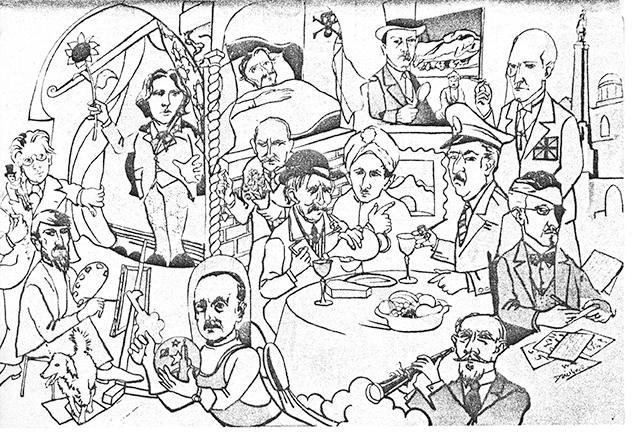
1975
Ink on paper?
Caricature of George Moore and 12 other modernist authors. Moore is seated in the center filling his wine glass. Illegible signature of the artists in lower right corner.
Published inside the back cover of English Literature in Transition 1880-1920, Volume 18, Number 3, 1975. Present whereabouts unknown.
An Apostle
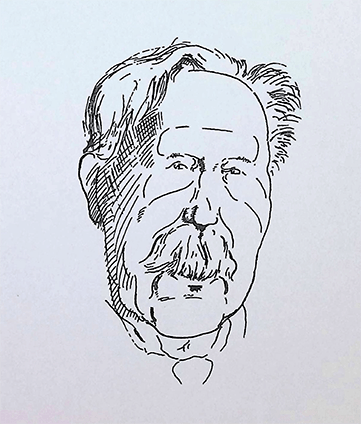
1991
Ink on paper?
Unsigned portrait of George Moore.
Published with Harold Orel, “A Reassessment of George Moore’s Achievement in The Brook Kerith,” English Literature in Transition 1880-1920, Volume 34, Number 1, 1991. Present whereabouts unknown.

Leave a comment