
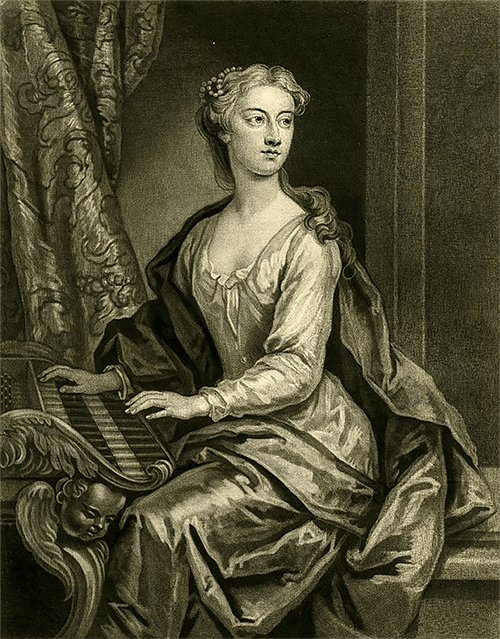
Anastasia Robinson seated at the harpsichord, mezzotint (1727) by John Faber the Younger after an oil painting (1723) by John Vanderbank. From a print in the British Museum (Wikimedia Commons); whereabouts of the painting unknown. The engraving is captioned:
Mrs. Anastatia Robinson
When Robinson awakes the warbling Strings,
And with her heavenly Voice responding Sings;
The winged Graces float upon the Sound,
Bless the sweet Airs, and smiling play around.
The same more or less was said about Miss Evelyn Innes, the heroine of George Moore’s only duology. Moreover both Evelyn and Anastasia were sired by a creative English gentleman; both were Catholic; both attracted early attention to their voices in house concerts; both became celebrated opera stars; both were gifted actors as well as singers. The love of Evelyn’s life was the wealthy baronet Sir Owen Asher, with whom she lived in sin. Though Anastasia secretly married her lover Charles Mordaunt, 3rd Earl of Peterborough, she was believed to be living in sin with him (she eventually claimed the title of Countess; Evelyn withdrew to a convent). More particularly, the lives of both women were complicated by sex. Evelyn’s carnal complications were chronicled by George Moore and Anastasia’s were bandied about by Jonathan Swift.
I chose Anastasia’s portrait for the cover of my two-in-one edition of Evelyn Innes, not because she inspired George (I’m not aware that she did though he bemoaned the rarity of English divas); I chose her because she’s a real world analog for one of George’s most nuanced literary inventions.
Maurice in South Africa
Last month I mentioned my aim to exhume three letters that Maurice Moore wrote to his brother George from the war in South Africa. I’ve made some progress!
George shared the first two letters with William Thomas Stead, an advocacy journalist with whom George had been acquainted for years. Stead at the time was the founding editor of Review of Reviews, but he published the first two anonymous letters from “A British Officer in the Field” in a politically charged broadsheet and pamphlet.
George shared Maurice’s third letter with the Freeman’s Journal in Dublin, where it appeared (anonymously without editorial comment; an excerpt was soon reprinted in The Times of London.
Maurice’s first letter (broadsheet) and third letter (newspaper article) are now published on GMi in readable transcriptions (the vintage print isn’t easy to read). With help from sleuth Michael O’Shea and librarian Máire Ní Chonalláin at the National Library of Ireland, I found Maurice’s second letter (pamphlet) and expect to receive a digital scan in April. I will transcribe and publish it with the other two.
I went to the trouble of collecting Maurice’s three-part anti-war exposé because it helps us appreciate George Moore’s anxious state of mind at the turn of the century. His momentous decision to leave London for a new home in Dublin was nominally an act of performative Irish nationalism, and it actually was that, but not only that. Revulsion over English decadence was also top of mind.
His revulsion was aggravated by Maurice’s letters and subtly woven into the duology of Evelyn Innes and Sister Teresa, which George Moore concluded just before he decamped to Ireland.
Two in One
Last month I also shared my eccentric wish to exhume the third edition of Evelyn Innes, a uniquely important text that has lingered beyond the reach of most scholars for more than a century:
- Unique because the fragile third edition was never reprinted.
- Important because it completed the first full telling of Evelyn’s story.
At the turn of the century, George was having an unexpected problem with Evelyn’s story. The first part, entitled Evelyn Innes, had debuted in 1898; the second part, entitled Sister Teresa, was to be published in 1901. When he finished writing the second part, he was convinced that it didn’t dovetail with his three-year old first part. He believed he had to rewrite the first part in order to overcome its deficiencies and make it flow nicely into the second.
For business reasons, his publisher resisted a proposed rewrite Evelyn Innes but George prevailed, and the revised third edition of Evelyn Innes came to market with the first edition of Sister Teresa. They were perfectly in sync; well, not perfectly.
The third edition of Evelyn Innes was a six-penny paperback closely printed in two columns. It looked like a pocketbook you would pick up in a train station and throw away when you arrived home. It didn’t match the physical appearance of the six-shilling hardcover Sister Teresa and was not built to last.
Most copies didn’t.
I’ve collected books by George Moore for quite a few years and I don’t own the third edition of Evelyn Innes; I never found one for sale! Recently to make a transcription of the text, I tried to borrow one of the few copies I found on WorldCat, but was unsuccessful. To make matters worse, no copy of the fragile printed book had ever been scanned.
Would I find a printed copy in good condition in some rare book library that would scan it for me?
Having recently received a gift from the University of Delaware Library of the first scan of the first edition of A Modern Lover, I did not despair. “Somewhere out there…” a fresh scan of Evelyn Innes must be waiting to be made for me. O where?
I quickly found two such copies. Jason Tomberlin at the Wilson Special Collections Library, University of North Carolina at Chapel Hill, arranged for a scan of his copy; simultaneously Jessica Tubis at the Beinecke Rare Book and Manuscript Library, Yale University, arranged for a scan of hers. The cost of each? My favorite: free!
I have obtained a high-resolution scan of the third edition of Evelyn Innes, perfect for transcription with the help of Abbyy Finereader PDF.
The third edition of Evelyn Innes and first edition of Sister Teresa are the first complete telling of Evelyn’s story. George wanted them to come out in 1901 in one volume under the singular title of Evelyn Innes. That didn’t happen for business reasons, but it’s going to happen now.
I have begun publishing the third edition of Evelyn Innes on GMi. As of today I’m about half way. When I finish, I’ll create a new ebook entitled Evelyn Innes (1901) that contains Evelyn’s story in one volume under its preferred title, the way George wanted it.
I’m not prepared to evaluate the rewrite of Evelyn Innes. My close reading for transcription doesn’t have enough bandwidth for literary criticism; my focus is just to get the historic text right.
I can tell you that the third edition is shorter than the first edition, the pace of storytelling is faster, and maybe the character development is stronger. To make sure visitors to GMi have what they can use, I will (as usual) publish a PDF of George’s text for AI assisted analysis and interpretation.
Rarest of the Rare?
It was challenging to exhume the rare third edition Evelyn Innes. Even rarer is the only edition — make that the only copy — of a privately printed booklet entitled Les Cloches de Corneville (1883), with text by George Moore and his younger brother Augustus.
Two months before the publication of A Modern Lover, the Moores wrote an English libretto for this popular French comic opera. It was evidently printed for rehearsals of a production that opened at the Folies-Dramatiques theater in London on 29 March 1883, for a ten-day engagement.
I transcribed their Cloches de Corneville for GMi from a scan of Edwin Gilcher’s hardcopy, graciously made for me by archivist Seonaid Valiant at the University of Arizona Library.
The libretto has little intrinsic literary value, but it sheds a bit of light on a lost world that George Moore rendered in his earliest fiction. It may also deserve a place in critical reviews of his lifelong devotion to theater and dramatic criticism starting with Martin Luther (1879) and ending with The Passing of the Essenes (1930).
Anybody who wants to ponder George’s Les Cloches de Corneville can now view it on GMi.
A New Discovery System
In addition to curating content in March, I rethought the parameters of interactivity on George Moore Interactive. After some intense, AI-assisted ideation, the GMi website is now on the cusp of a major technical upgrade!
The upgrade is a custom-built GMi Discovery System. The Discovery System will seamlessly plug into the existing website, instantly making it much more searchable, sortable, interpretable, and extendable.
Let me explain.
GMi is hosted by WordPress.com, one of the world’s leading publishing platforms for websites. I built GMi with WordPress development tools in compliance with WordPress technical standards.
There are currently about 2,400 pages of GMi content. I expect to grow the website to more than 10,000 pages before the boundaries of George Moore’s legacy are discernible on the historical horizon.
Most GMi pages are substantial, with each page containing thousands of words of text. That text is published in two flavors:
- HTML markup in WordPress layouts (white characters on black background)
- Google Docs embedded in WordPress layouts (black characters on white background)
The HTML content is largely navigational, explanatory, interpretive, and graphic. You could say that the HTML is Bob talking about George.
The content in Google Docs is largely George’s writing: his fiction, memoirs, essays, plays, poems, and letters: the “primary source materials.” The standard bibliography of George Moore is also published in embedded Google Docs.
My reasons for publishing this way have to do with efficiency, reliability and maintainability behind the curtain, plus usability and coherence on the main stage.
The approach means that GMi pages are not static visual presentations. The pages are actually digital parts assembled in real time as visitors view them, with content flying in from different remote servers and fitting together on the screen like puzzle pieces.
Visitors can’t see that happening, but that’s how it works.
Up to now, conducting research on GMi has been impeded. Visitors have had to know what they’re looking for in order to find it. Exploration has been slow, imprecise, inefficient, and probably frustrating. My bad!
- It has not been possible to search all of the text on all of the pages with one or more search terms at the same time.
- Nor has it been possible to conduct ranked searches in order of relevance.
- Nor has it been possible to conduct chronological searches within user-specified time periods.
- Nor has it been possible to conduct faceted searches that are modulated by scholarly filters.
- Nor has it been possible to conduct modal searches within categories of written materials.
- Nor has it been possible to generate a detailed chronology or timeline of George Moore’s life, work, and legacy.
Up to now, no, for technical rather than design reasons, none of these vital activities has been possible.
But in the near future, yes, all shall be possible.
The forthcoming GMi Discovery System will serve knowledge about George Moore and his worlds the way people like to be served: on a silver platter (so to speak), enabling them to find the bits of information they want, when they want, the way they want, and attain deeper insights.
Those are the immediate benefits of the planned and budgeted Discovery System.
An additional benefit, soon to follow, is that all the content published by GMi (10,000+ pages, 30,000,000+ words) will be machine readable and ingestible by large language models.
A technical foundation will be set for simulating George Moore — his mind, voice, linguistic style and personality — in a conversational chatbot.
Thus the vision I offered in my launch lecture about GMi, in 2023 at the Oak Park Public Library, is on track to fulfillment.
With implementation of the GMi Discovery System, literally unprecedented value will be unlocked for every visitor to the website.
This is what kickstarting a literary legacy looks like in practice. Wait and see!
Up Next
In April 2026 I will finish publishing Evelyn Innes 1901.
I will also add Maurice Moore’s second letter from South Africa, How Not to Make Peace, to the Letters of 1900.
And I will publish George Moore’s letters of 1Q1901, up to his departure for Dublin.
I wanted to do all of this in March, but hey, I’m doing the best I can.
Coming soon but not in April, I will curate and publish two plays and two books of poetry that George wrote before leaving for Dublin. That milestone was a pivot in his life and work, and I would like his corpus on GMi to be complete, or nearly complete, before I move past it.
Besides all this, in April I have some serious fundraising to do for Resurgam that hopefully leads to implementation of the GMi Discovery System. The System has been planned, scoped, and awarded to a talented software developer. When few bucks are found to pay him, the System will be up and running in less than two months.
As it unlocks value for visitors to GMi, the Discovery System may become a tide that raises all boats. After it is installed and successfully tested, Resurgam will freely share the code and implementation plan with any curator who wishes to use it for their digital humanities project. At no charge, or course.
Bob Becker, 30 March 2026
(Subscribe to receive updates.)

