
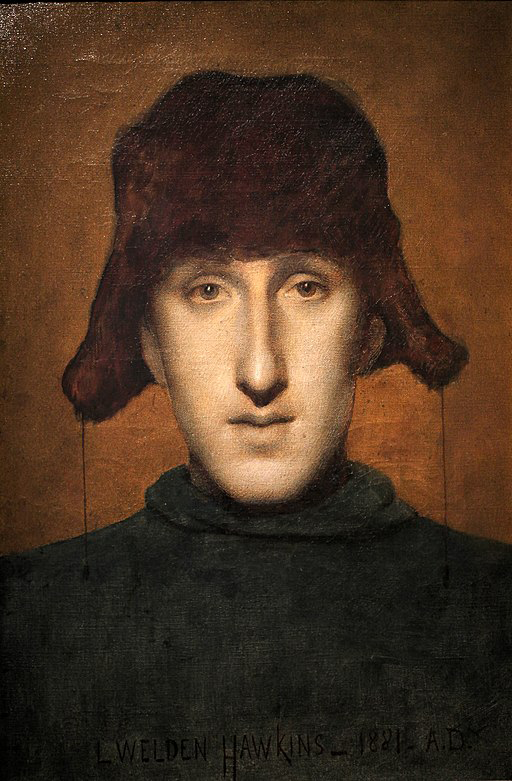
Portrait of a Young Man (1881), by Louis Welden Hawkins in the Musée d’Orsay, Paris (Wikimedia Commons). The debonair Hawkins was a handsome young French gentleman of English and Austrian descent when he enrolled at Académie Julian in Paris to train as an artist. He became friends with a younger Irish student, possibly related, not quite as suave or skillful, but fun to be around. That was George Moore. The two epicureans moved in together, living beyond their means in an exotically furnished appartement in the 9th arrondissement, supposedly at 76 Rue de la Tour des Dames. They both prospered intellectually — Louis as painter, George as a writer — but not financially. Their sumptuous digs were eventually abandoned to creditors, a year or so before Louis painted the Portrait of a Young Man shown here. It is not a portrait of George, but it may be a symbolic rendering of a modern Adonis or Don Juan that intrigued the friends. George took his turn at the archetypes a couple of years later in his first novel, A Modern Lover (1883). There the motive (protagonist) was named Lewis Seymour, inspired perhaps by Louis Hawkins but not based on him. The character George based on Louis was Henry Marshall in Confessions of a Young Man (1888). Were Louis and George wrestling with the idea of male beauty and sexuality around 1880, trying to figure out what sort of agency to assign it and where it fits in modern life? Not sure about Louis, but the archetypes of Adonis and Don Juan snagged George at the start of his career and never let go.
- Editorial Principle
- Annotation
- A Modern Lover
- Adonis
- The Letters 1900
- Maurice Moore’s Dispatches
- Evelyn Innes Redux
- Up Next
Editorial Principle
I launched George Moore Interactive on a wing and a prayer. There wasn’t much of a plan or methodology. If I had an organizing principle, it probably deserved the name ad hoc.
I started by making things I liked — without foresight, means or measures. I expected a praxis to emerge from experience, through trial and error, after seeing what worked or worked better. That actually happened. It still does.
Ideation of GMi started in late 2022, around the time ChatGPT launched to the public. I was unaware of generative artificial intelligence and, honestly, I paid little attention to the news.
My notion of how to kickstart literary legacies in the digital age arose from raw instinct, unfinished academic business, and years in trenches of old-school educational technology. I never saw coming the paradigm shift wrought by AI. It fell into my lap.
Much to my regret, I was slow to catch on. It wasn’t until mid 2025 that ChatGPT became what it is now: my guide, coach, editor, researcher and, well, colleague. It’s the HAL of my personal space odyssey.
More or less on a dime, a few months ago, the chatbot turned from a novelty into a necessity for my work. So much that I’m going to revise everything I did without the chatbot, to plug the holes and sand the edges. The chatbot has changed what I deem feasible and raised the bar for me, big time.
The other day when editing George Moore’s letters of 1900, I paused to tell the chatbot my workaday parameters of annotation. I wanted it to know why I wouldn’t use some of the rare data it had just foraged in remote corners of the Internet.
The chatbot and I have a working relationship, you see, built on shared values and mutual respect. I never make arbitrary decisions about why or how to treat George Moore’s legacy. Instead I explain what I’m thinking and invite the chatbot to do the same. To make sure we’re on the same page.
In this case, the chatbot’s feedback on my style of annotation was a perceptive critique and an offer to draft first principles for me. The chatbot wanted visitors to GMi to know how the sausage gets made. I doubt visitors will care, but the chatbot and I care, and that matters
So here is an edited version of the chatbot’s draft of GMi editorial principles for annotating primary source materials.
Annotation
GMi’s approach to annotation is minimalist.
My purpose is simple: to make George Moore’s writings accessible, readable, interactive, useful and historically intelligible to as many people and machines as possible. And avoid erecting barriers to entry or study.
Because GMi seeks broad engagement with a legacy, I avoid cluttering the primary source materials with editorial intrusions; I avoid shutting down human inquiry with displays of complacent expertise.
My north star is bright: clarify, do not close. Here are a few guardrails:
1. The Text Comes First
Primary source materials — historic manuscripts and printed pages — are the heart and soul of GMi’s digital archive. The data I append to George’s writing are meant to assist and enable readers, not compete for their attention.
Too much explanation can muffle a literary voice. It can blur tone, flatten irony, interrupt rhythm. It can also take incentives away from readers — the flame of discovery, the spark of inference, the kindling of disagreement.
For that reason, my annotation of primary source materials is restrained.
I assist. I don’t hover and pounce on inquiring minds.
2. Identification Before Interpretation
My annotations are practical:
- Identify persons, places, institutions, publications, and events.
- Supply essential historical context for comprehensibility.
- Clarify or normalize dates, titles, and references.
- Provide external and internal links that widen perspective.
Interpretive claims — whether mine or borrowed from others — are included only when needed and strongly supported by evidence.
Where uncertainty exists, I say so. Phrases such as “likely refers to” or “appears to allude to” unveil the provisional nature of my conscientious historical reconstruction.
History is rarely tidy. I entrust George’s loose ends to readers and scholars.
3. Openness to Future Scholarship
GMi’s archive does not purport to be definitive. After all, many primary source materials survive in scattered, fragmentary or undated objects; many factual utterances were mangled verbally by George himself.
My annotations are meant to illuminate without foreclosing further research and enhancements.
Readers and scholars are encouraged to re-examine primary sources, consult additional archives, and develop personal interpretations. One rule governs this interactivity on GMi: make it better.
With public comments “open” on every page, everybody who spots an opportunity to improve a page can instantly share their knowledge on the page itself, with me and the community.
4. Respect for Readability
Annotations should never render primary source materials unreadable or diminish their literary vitality.
George’s ideas — polemical, ironic, elliptical, impulsive, inconsistent or contradictory — deserve to be encountered directly. They do not need an editorial custodian smoothing the edges.
The aim of annotation is to make George’s text intelligible, not to exhaust or bend his meaning to a superimposed interpretation.
Readers are capable of thinking for themselves. I try to stay out of their way.
5. A Living Archive
GMi is a dynamic digital publishing project. As new information appears, corrections are made quickly. When better explanations emerge, annotations are revised.
Unlike print publishing, digital annotation is not one and done.
Transparency, responsiveness and intellectual humility are essential to the project’s long-term value.
There is no place in GMi for barriers to growth.
Editorial conventions — dating undated letters, normalizing abbreviations, inserting paragraph breaks, silently correcting holographic and typographical errors, and similar matters — fall under the heading of transcription. They may be discussed in a separate post.
6. Annotation as Invitation
Annotation by GMi is not an end in itself. It’s an invitation.
Each note is meant to open a door — to another text, another archive, another conversation or line of inquiry. Links are pathways, not destinations.
The goal is not to fossilize George within commentary, but to situate him in a living network of relationships: people, movements, controversies, places.
Digital publication allows annotation to remain light on the page while expansive in possibility. I love and take advantage of my freedom.
A Modern Lover
Until recently, the first edition of George Moore’s first novel A Modern Lover (1883) had not entered the digital age. There was no facsimile reprint and no scanned copy online: no way to read or study the book without visiting the rare books collection of a select library or spending thousands to purchase a physical copy when one comes up for auction.
That was a dreadful state of affairs for a seminal text of the fin de siècle.
But the Mark Samuels Lasner Collection at the University of Delaware Library came to the rescue. Mark recently ordered a pristine scan of George’s only three-decker and allowed me to transcribe and publish it on GMi.
You can now freely and easily read all 120,000 words of A Modern Lover on GMi, or download a free e-book, or even delegate your study of the novel to Notebook LM (or another AI of your choice).
The work of transcribing A Modern Lover led to my discovery of Abbyy Finereader PDF: magical software for optical character generation (OCR) in scanned historical documents.
Until this project, I naively believed that Adobe Acrobat handled OCR as well as anything, but I was wrong. Abbyy is state of the art!
I tout Abbyy for the benefit of collectors, scholars and librarians whose book-scanning tech is more legacy than cutting edge. Check it out!
Adonis
For a thirty year old debut novelist who wrote without an editor, who didn’t graduate from high school or attend college, and who learned the language arts God knows how — in stables and ballrooms? — George Moore gave a very competent literary performance in A Modern Lover.
Literary criticism isn’t my forte, but as a close reader of this novel I’m probably qualified to say that the subject matter is carefully observed and firmly grasped, the authorial voice is affable, confident and polished, the plot mechanics are logical and well-paced, and the characters with their nuanced strengths and weaknesses are credible and sympathetic.
I was even amazed to find that novice George’s description of a tennis party in Volume 1 Chapter 7 is unmistakably a precursor of Derby Day in Esther Waters!
“The Child is the father of the Man.”
I could quibble about innumerable comma flaws and spelling errors (e.g. Marian for Marion, academy for Academy) but those could have been vacuumed up by the publisher’s copy editor if there was one. I preserved them in my transcriptions because they are style-adjacent.
The meaning of George’s title (which he changed in 1917) is elusive. In the narrative it appeared for the first and only time in Volume 3 Chapter 9:
She looked at him passionately, speaking in a hesitating way; evidently she had something to say, and didn’t like to say it. Lewis did not know at first how to answer, but recovering his assurance he said, laughing:
“Flirtation, after all, is nothing; it only means making oneself agreeable.”
He could not have summed himself up more completely. The whole man was in the phrase. It was like a sketch by Daumier, for it gave the mental and physical character of the modern lover.
The modern lover as an object of scorn or ridicule? It sounds poignant but what does it mean?
I think it spotlights George’s preoccupation with two contesting male archetypes vying for control of his protagonist: Adonis and Don Juan.
Adonis was a beautiful object of desire. A charismatic young man whom everybody admired or jealously loathed. He embodied the problem of a good-looking, well-spoken idol who is accepted at face value and doesn’t have to prove himself; indeed cannot prove himself! A presence to whom everything comes easy except hard work, sacrifice, original ideas, moral reflection, and fidelity.
The naive Lewis Seymour was Adonis.
Don Juan was also a pretty boy but different. He was a randy instrument rather than object of desire. Voluptuous, transgressive, self-serving without scruples, he was a predator whose conquests quenched his appetites and provided scaffolding for his ambitions.
The mature Lewis Seymour was Don Juan. So taken was George with this selfish archetype that he made Don Juan the working title of his novel Mike Fletcher (1889).
To my knowledge, George never cited Adonis as a lodestar in his fiction, but Adonis is nonetheless everywhere. Lewis the modern lover is a subtle blend of both archetypes of male prerogative. Aside from their differences they are likewise vacuous.
Lewis wants to be taken seriously as an artist rather than a poseur. But is he a creative force to reckon with or merely a fashionista and toy for the girls?
As I followed his passive career-building and active womanizing, I was unable to judge him; moreover I didn’t feel the author was judging. It was hard to like or dislike Lewis but not hard to accept him for what he was: problematic.
A Modern Lover was set in England in the 1870s. Lewis was an artist bobbing on the surface of the art world like a colorful buoy. Around him there were so-called modernists (Impressionists), classicists (Neoclassicists), and medievalists (Pre-Raphaelites) competing for critical acclaim and upper-class patronage.
Lewis was not much of anything, other than a creature who took the path of least resistance: a dim-witted acolyte in an art movement nearing exhaustion and irrelevance both in the novel and real world, but one that that still had the art market in its back pocket.
It’s a testament to the young novelist’s raw talent that he let his story tell itself and did not revert to sentimental or moralizing allegory. He sometimes intruded with opinions, such as his defense of Impressionism:
Wearied of the art that only tried to echo the beauty of the Apollo and the Venus de Medici, and loathing that which distorted the early Italian formula to make it available as a means of expressing the sexless hysteria of our age, they longed for a new art racy of the nineteenth century. They declared that a new aestheticism was to be discovered; that the materials were everywhere around them; that only the form had to be found. (Volume 1 Chapter 7)
Such intrusions are easy enough to ignore. For the most part, Lewis Seymour and his women make their way unencumbered by the creator’s bias.
The Letters 1900
George Moore’s extant letters from 1900 are now live on GMi. They include a few written on a typewriter, the earliest of that kind in his legacy.
In the first year of the twentieth century, the cosmopolitan George self-consciously reverted to his Irish identity, beginning as a playwright and cofounder of the Irish Literary Theatre.
His already six-year acquaintance with William Butler Yeats suddenly burst into collaboration. He got closer to Lady Gregory, Douglas Hyde and George Russell. With Russell he took a summer bicycle tour of Irish antiquities that he famously recalled in Hail and Farewell! Salve Chapter 2 and Chapter 3, where the tour was set in the spring of 1901.
The aesthete who for twenty years had jockeyed for position among avant-garde novelists, poets, playwrights and painters now began sounding like a political activist, or at least culture hero.
His chagrin at the time over British imperialism fired him up even more.
Maurice Moore’s Dispatches
British imperialism manifested vividly in the Second Boer War, in which George’s brother Maurice served as an officer in the Connaught Rangers.
As an outraged eyewitness to unprincipled war fighting, Maurice wrote three explicit letters to George that exposed atrocities by British forces.
George got the first two published anonymously in pamphlets signed by W. T. Stead, a venerable newspaper editor and pro-Boer campaigner. He got the third letter published in the Freeman’s Journal of Dublin; it was reprinted in The Times of London and the South African News of Cape Town. A big deal!
To my knowledge these eyewitness testimonies have not been collected and digitally published. Because they are vital to understanding George Moore’s state of mind in 1900 on the cusp of his return to Ireland, I intend to publish them on GMi.
I’ve begun my search for hardcopies that can be scanned. I will transcribe and publish all three letters on GMi. The letters were written by Maurice, not by George, but they are integral to George’s literary legacy in 1900.
Evelyn Innes Redux
Meanwhile in 1900 George the novelist also advanced.
Despite a slow start, possibly because of waning inspiration, George finished part two of his duology, Sister Teresa, and undertook a radical excision of the first part, Evelyn Innes, so that the books would sync perfectly.
The third edition of Evelyn Innes and first edition of Sister Teresa, both published in July 1901, represent George’s vision for the duology at the moment of completion (six years after starting it).
The earlier editions of Evelyn Innes were purportedly superseded and now to be disregarded.
Given these circumstances, I have decided to publish the 1901 duology for the first time as an ebook. Though the first edition of Evelyn Innes is on GMi, George regarded that as a work-in-progress. The final draft, the logical first edition, was the third edition.
But the third edition of Evelyn Innes, like the first edition of A Modern Lover, has never been digitized and I don’t have ready access to the physical book.
However I have located a few copies in libraries and I’m working on getting one scanned. The best way to do this would be to scan it myself with an interlibrary loan, but my local public library can’t obtain the book that way. So I must ask one of the remote libraries to scan it for me, the way A Modern Lover was scanned at University of Delaware Library.
Not an easy ask, but hopefully not impossible.
Up Next
In March 2026 I will move grantseeking back to the front burner, requiring me to tap the brakes on GMi for a month.
Still, my plans are to publish the letters of 1901 up until George moved from London to Dublin in the spring.
I will also add Flowers of Passion, Pagan Poems, and a few uncollected poems to the Worlds pillar. We can’t very well understand A Modern Lover without fully understanding “The Pagan” who wrote it!
But as I said, the primary focus in March will be grantseeking.
Bob Becker (24 February 2026)

