
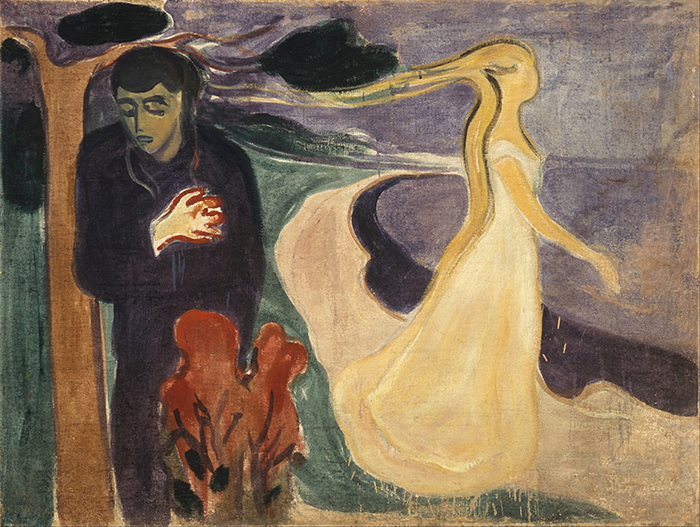
Separation (1896), oil on canvas by Edvard Munch in the Munch Museum, Oslo, Norway (Wikimedia Commons). This unnerving picture was finished the year after George Moore published the bleak stories of Celibates (1895), a book that extended and put some finishing touches on morbid fancies he anatomized in the 1880s. George’s stewing pessimism later resonated with the gloomy dreamscape in Edvard ’s “The Frieze of Life” (of which Separation was part). Both Norwegian artist and Irish novelist embodied tragic themes of love and loss in their work. Is Edvard ’s female figure, as she faced an ominously dark sea, the departing soul of the crazed Kitty Hare? Is she the panicked Agnes Lahens fleeing to a convent shelter after her gross brush with worldliness? Or is she the disconsolate shell of Mildred Lawson, gravitating back to her sterile home in England sans virtue, vocation, and fortune? All three characters and their male counterparts seem to live in Munch‘s picture, though the artist and novelist did not know each other. Still, they observed life from likewise dreary perspectives, wrestled with insoluble problems. and anguished over tensions that fragmented the human condition during the Fin de Siècle.
Convergence
GMi Worlds and Letters have been on two tracks of development, running parallel from month to month but nowise in sync. These tracks are about to intersect, albeit briefly, before resuming their separate ways.
My curation of Celibates this month brings the digital archive of George’s world-building up to 1895. There are still a few gaps to be filled, but after Celibates George Moore kept mostly out of sight as a world-builder until 1898, when he published Evelyn Innes.
Coincidentally this month, with my curation of George’s correspondence of 1897, my digital letters archive is poised to expand into 1898. Our world-builder and letter-writer are going to converge in October!
I’m not promising revelations from the convergence, since the letter-writer rarely aired the creative process and unresolved concerns of the world-builder. His letters tell us where he was, what he was doing, whom he was with on a given day, but they don’t reveal many particulars of his literary inspiration, research and composition.
I infer from this reticence that the man of the world who wrote letters and the author who wrote novels were two different beings in the same body; Jekyll and Hyde, so to speak. That’s somewhat paradoxical, because the novelist mined his real-world experience for character and plot, all the time!
Much as George expropriated his activities, relationships, and domiciles for use in his fiction, he generally didn’t share details about his writing in letters to his social network. For the most part, he let his creative writing speak for itself.
That may be why family and friends were surprised to find themselves turned into literature. At least in his letters, George didn’t tell his models what to expect in his books and evidently preferred to ask forgiveness rather than permission for his treatment of them.
The Kind of Person
What kind of person was George Moore? I’m not asking about his biography, but the man himself.
As far as I’m aware, this question has not been answered convincingly. We have memoirs of George by those who met him, and researched accounts by those who didn’t. All have this in common: latent subjectivity.
Under a mask of objectivity, they reveal as much about the observers as the person observed. They replace a human being who lived once upon a time with an artifact that didn’t.
Take for example the substantial biographies of George Moore by Joseph Hone and Adrian Frazier, published about sixty years apart. What readers found between the covers were two artifacts rather than a singular person: two scorecards that allow readers to check the conventional boxes of narrative portraiture.
But they didn’t find the vital subject, the man himself.
This is not surprising. There is no “definitive” biography of George Moore (or any great writer); and I doubt there ever will or should be. When it comes to literature and art, the word “definitive” is nonsensical in any case.
All we really have in these and similar biographies are portraits of the artist from points of view that were brought to bear, rather than sprung from the subject itself.
This is obvious in the Iconography of George Moore and uncontroversial. The painters and photographers who rendered George actually produced many different and dissimilar images. Each was self-expressive, none was definitive; nor would anybody want or expect them to be. The absence of certainty and uniformity in the visual portraiture is a strong indication of the subject’s complex and elusive humanity.
(By the way, the extreme ambiguity of the portrait that decorates the GMi home page is my reason for its selection!)
With all due respect for “complex and elusive humanity,” to me the question about what kind of person remains crucial. If we somehow get and make use of an answer, it might further activate our understanding and appreciation of George’s phenomenal literary legacy.
It might free his legacy from stodgy and hackneyed opinions that pin him to stultifying intellectual boulders or float him over our heads like a pedagogical piñata.
Because — let’s face this fact together and tediously say it again — George Moore has been underserved by caretakers of his legacy (including me).
His creative achievements are today mostly ignored, his contributions are explained away, his books and articles are generally unread except by curious garbage pickers. The once-vibrant voice of the grand old man is now unheard or marginalized to a fraction of its historic scope and worth.
And that has been true for more than 50 years, at least since the time I started paying attention.
Given George’s seemingly irrevocable obscurity, why did I start GMi (now summing up to nearly 2,000 web pages and rapidly growing)?
As I may have said before, I didn’t do it to shore up the author’s flagging reputation or free him from critical trammels. Those things really don’t matter to me.
I did it, specifically, to empower George to do all of that (and more) for himself!
In his own words and voice (not mine or others), to rejoin conversations that he left many years ago and which continued without him; and to participate in fresh conversations that are just getting started.
Not to ventriloquize George with my picayune theories and discoveries, but to empower him to speak for himself about himself.
That’s a revolutionary agenda with benefits that could spread across the humanities with the aid of advanced technology. Just imagine for any author or artist:
To empower [fill in the blank] to speak for themselves about themselves
Get it? Empowering George Moore is not a destination; its the first leg of an epic curatorial journey.
What Kind of Person?
This brings me back to my initial question, “what kind of person?” The enabling technology of empowerment I mentioned is simulation.
A high-fidelity simulation of George, grounded in GMi, may help to restore his voice and agency. It may wipe the blackboard clean, so to speak, and send Pooh-Bahs packing when the author himself gets his turns to speak.
After all, wouldn’t you rather listen to a fabulous author talking about his life and work than somebody who never even met him? Good, I’m glad we agree about that.
But to simulate George, I’ll need to do more than “check the conventional boxes.” I’ll need to ascertain “the kind of person” he was in real life and will now become in a second life.
That will involve identifying or approximating his personality quirks, body language and facial expressions, the sound of his voice and movement of his hands as he spoke, his eyes when he looked intently into another’s or looked away when his patience famously expired.
Real people pay very close attention to details like these when they’re with somebody and present in the moment. Ironically or necessarily, such quirks and foibles are largely missing from scholarly accounts of historic figures. As if they don’t matter, but they more than matter; they’re crucial.
I have hypothesized that George’s quotidian language and ideas may be reliably inferred from his literature. Why? Because as a writer, he was always self-expressive.
He modulated his prose in a spoken idiom, presumably his own. I speculate that the style of his written language was also the way he talked. I can think of no other explanation for his remarkably fluid prose and penchant for dialogue.
Because George wrote as he spoke, his memoirs seamlessly crossed the line into worldbuilding; his fiction crossed the line into recollection. He was not undisciplined or egotistical, far from it. He was integrative.
I think it will be possible to abstract a high-fidelity simulation of his conversational syntax, cadence, vocabulary and rhetorical finesse from his literary legacy. After the legacy is fully curated, with the help of machine learning and large language models.
His reanimated self in GMi should be able to say pretty much what the living George would have said a hundred years ago, even when discussing subjects that are new to him. And say it in a lifelike manner.
Outlandish? Of course. Technically feasible? You bet. Certain to succeed? Not even close. Worth trying? God yes!
Don’t Touch Me
Writing last month about Celibates: “I vaguely recall that doleful collection of stories as a throwback or piece of unfinished business, a collection of ideas that escaped the wastebasket. But was it?”
Now that I’ve reread the book, I’m sure it is not what I misremembered! You can decide for yourself. The text is live on GMi as an archive of Google Docs, an ebook, and a portfolio of four PDFs that you may upload to AI apps for guided analysis and interpretation.
I have elsewhere written that naming was not a core strength of George Moore, and Celibates was no exception. I won’t speculate how many readers in 1895 would enthusiastically reach for a new book under that title, but probably not many. The implicit subject matter lies somewhere between mundane and repellent!
However that’s not why I object to the title. Instead it’s because the title doesn’t really intimate the subject of the book.
Consider the dictionary definition of a celibate (the noun):
a person who abstains from marriage and sexual relations
Though details were not explicit, Mildred Lawson seems to have had sexual relations with one or two men before accepting the marriage proposal of a third.
Kitty Hare had no objections to sexual relations and accepted the marriage proposal of John Norton. On the other hand, John Norton identified with Peter Abelard (page 451), hardly a paragon of celibacy.
Agnes Lahens was only sixteen years old when she left her parents’s home for a convent, but not to avoid sexual relations or marriage. She was too immature for both.
If Celibates was not really about celibacy per se, then what was its subject?
For Mildred Lawson, the likely answer is this:
For her chastity was her one safeguard, if she were to lose that, she had always felt, and never more strongly than after the Barbizon episode, that there would be no safety for her. She knew that her safety lay in her chastity, others might do without chastity, and come out all right in the end, but she could not: an instinct told her so. (page 247)
Chastity is not a synonym of celibacy. Turning again to the dictionary for help, I find that chastity is:
the state or practice of refraining from extramarital, or especially from all, sexual intercourse
As I understand the word, chastity does not preclude sexual relations and marriage, it merely shelters them in a protective moral shield.
Mildred’s chastity was not a vow of celibacy but a lifestyle choice that ensured her autonomy and agency. She needed independence and freedom; she needed “self-realisation” (page 279); her aversion to sexual relations and marriage was triggered by men who threatened rather than reinforced her legitimate needs.
Kitty Hare was a virgin until her rape, and violence destroyed her, but I don’t think she was crazed by the loss of her virginity per se. Labeling Kitty as a celibate would be a misreading of her character.
Kitty’s fiancée John Norton was the titular celibate in the story, except that egomaniac might be a better description of him. “He was as unfitted to the priesthood as he was for marriage”; neither celibate nor chaste, but a sort of obsessive-compulsive wanker.
As already mentioned, the adolescent Agnes Lahens was not old or self-conscious enough to opt for celibacy. She did not rush back to the convent to preserve her virginity, but to escape the vulgar claptrap of her disgusting parents.
True, she did not like the role of debutante in a first season, but that wasn’t the issue. The issue was her mother trying to pair her with creepy older men with money.
If Not Celibates?
So what was the real subject of Celibates and what might have been a better title?
The subject, I would say, was personhood: the challenges faced by people, especially young women wanting to be themselves in a male-dominated society that has other ideas for them.
I could elaborate, but so can you if you read and ponder the stories from your own perspective. Or ask AI to help.
And a better title? Don’t Touch Me seems more fitting than Celibates. The book is really about why that phrase is spoken by practically every young woman who assumes she will be respected and reinforced as she grows, until she isn’t.
That Question Again
I want to return for a moment to my earlier question: what does Celibates say about the “kind of person” George was?
I think he was one who didn’t think carefully or strategically about the titles of his books. And also one who thought very deeply about their meaning and consequences.
A pretty cool person, to be sure.
Next Up
By now it goes almost without saying that George Moore’s letters of 1898 are going on the workbench in October, along with his novel Evelyn Innes (1898).
George was in middle age, secure in his reputation, at the end of a massive effort to write a novel that seemed beyond his artistic reach and the ability of readers to fathom. We’ll see how that turned out out.
I haven’t forgotten my promise to curate the first edition of A Modern Lover (1883) for GMi, but I don’t own a copy to scan. Every copy that has come up for sale while I was watching was purchased for a relatively insane amount of money, not by me.
However a sympathetic collector is having his copy scanned for GMi, and the results should arrive soon. This will be the first time that the first edition of A Modern Lover has been digitized.
Bob Becker (15 September 2025)

