
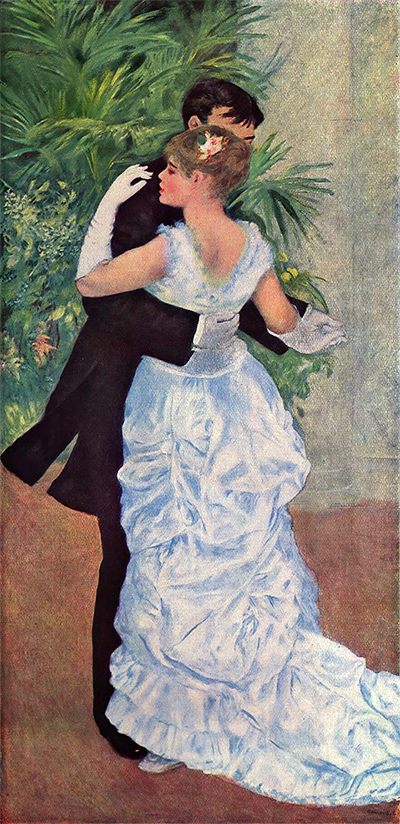
Dance in the City (1883) by Pierre-Auguste Renoir in the Musée d’Orsay, Paris (Wikimedia Commons). Renoir painted this picture in France while his friend George Moore wrote A Drama in Muslin (1886) in Ireland and England. George’s realistic story took place in 1882-1884, so it is easy to imagine Renoir’s model Suzanne Valadon as George’s character Olive Barton dancing through an Irish Social Season. Suzanne and Olive were about the same age; both were wardrobed in fine muslin.
- Why Muslin?
- Timely and Timeless
- Secular Humanism (so to speak)
- Women
- More Letters
- Next Up in Worlds
- High Price of Collecting
Why Muslin?
A Drama in Muslin (1886) was George Moore’s third novel and first on an Irish theme. The title is obscure. Even after it was truncated as Muslin (1915), it connoted next to nothing about bildungsroman, Irish identity, or feminism — three mutually reinforcing pillars of the story that were (and are) its selling points. George didn’t explain what his title meant. I guess he expected readers to figure it out.
By comparison, his rival Thomas Hardy had a gift for catchy titles that practically jump off the cover, as if saying “buy me,” or “read me,” or at least “open me and see what I’m about.” For the most part, George did not have the knack.
The title of his first novel A Modern Lover (1883) helped trigger a ban by censorious booksellers who already deemed him a pornographer; the title was revived nearly thirty years later by D.H. Lawrence, who was also deemed a pornographer.
The title of George’s second novel A Mummer’s Wife (1885) used an archaic synonym for entertainer that implied a snarky attitude towards theatrical folk, but said little about the story. The characters in the novel were not in fact “mummers” but musical comedians.
In my opinion, George’s first grippy title didn’t arrive until Memoirs of My Dead Life (1906), and that book was nonfiction. Its title represented the content and had an inviting, poetic cadence, as most of Hardy’s titles did.
So what was “a drama in muslin”?
First, it was not “drama” per se, but prose narrative. In the title, drama loosely refers to riveting emotional events, not theatrical performance (though the story opens on one). Not being a potboiler, such events were actually few and far between in the prose, so calling the novel a drama seems misleading. The title eclipsed the author’s real literary achievement!
And what about “muslin”? Now we may be getting somewhere. Muslin as George used the term is ultra-fine cotton fabric handcrafted in India, the stuff of ladies gowns for formal occasions. Elegant muslin dresses were worn by Irish debutants at the dinners, drawing-rooms and balls of the Castle season.
Muslin generally signifies fashion; in the novel it signified wardrobe that women wore to the marriage market. The most luxurious, most flattering and attractive way to suit up for battle.
Is A Drama in Muslin explicitly about fashion?
It is not, nor is the metaphor of muslin much explained or referenced in his text. Alice and Olive Barton, Violet Scully and May Gould are called “muslin martyrs” towards the end, but there was so much more going on in their life stories that the label barely stuck.
Timely and Timeless
“How does an artist give timeless values a timely form? … I don’t think anybody who cares about the arts hasn’t asked the same question. It doesn’t matter whether your fundamental concern is the musical, visual, literary, or theatrical arts. A frozen academicism is almost inevitably the result when the timeless overtakes the timely. When the timely overwhelms the timeless, all you’re left with is a fad.” — from Jed Perl, “Echoes of Eternity,” New York Review of Books (27 March 2025).
I recently stumbled upon Jed Perl’s pithy dichotomy while transcribing A Drama in Muslin for GMi. It gave me a particularly apt lens for viewing the novel, in which George Moore arguably composed nearly perfect harmonies between timely and timeless content.
Timely in the early 1880s was decadence and Land War in Ireland raging in the background of A Drama in Muslin. The timeless stratum that imbues the story with beauty and pathos was the naive longing of several young women, each rendered as both a type and a fully realized individual.
The aim of each female character was to succeed under circumstances that were anything but propitious.
Like Russian novelists he adored — especially Ivan Turgenev — George did not allow the timeless to overtake the timely. Political upheaval, economic disparity and bigoted injustice were not mitigated by sentimental anxieties and happy or poetic endings. A Drama in Muslin was brutally honest.
Nor did he allow the timely to overwhelm the timeless. Not one of the novel’s 131,000 words obscured, minimized or justified acute personal grievances of his characters in favor of grand ideals or historic events.
Instead, touching sentiments of his young women and momentous events of Irish history coexist in the novel like staffs of elegiac melody: sentiments on the treble clef, history on the bass clef. Like a grand opera or symphony?
George’s novel as a whole is imaginative and realistic. It is a faithful and lofty rendering of life — comparable to Renoir’s painting — that is both timely and timeless, neither frozen academicism nor pulp fiction.
When I read A Drama in Muslin and look at Dance in the City I am mindful of the time and place of their origins; yet I experience them as testaments of truth and beauty in my life. Not either/or but both at the same time.
Secular Humanism (so to speak)
George Moore began writing A Drama in Muslin while still writing his first great novel, A Mummer’s Wife (1885). The new project was a self-conscious pivot away from his mentor Émile Zola and French literary naturalism. But what was he pivoting towards?
Being an artist rather than a polemicist, George did not explicitly state the aim of his pivot. He even tried to obscure it by masking his evolution as role-playing. But a clue to what was really going on surfaced in the course of his storytelling:
“…the ideal life should, it seems to me, lie in the reconciliation — no, reconciliation is not the word I want; I scarcely know how to express myself — well, in making the two ends meet — in making the ends of nature the ends also of what we call our conscience.” — A Drama in Muslin (1886, page 228).
Another dichotomy rendered and resolved. This one involved, not timely and timeless content, but transcendent morality: the knowing or figuring out what is the right thing to do, and doing that without expectations of reward or even appreciation. The arc of George Moore’s moral universe, starting in the early 1880s, was bending toward justice.
It’s ironic that a young man, all of whose books were banned for indecency, was, on the record, in point of fact, one of the more righteous creative writers of his era. I may be overstating that, but it’s worth pondering.
In A Drama in Muslin, he made the ends of nature synchronous with the ends of conscience, albeit unhappily. The story concluded with a melancholy, open-ended reunion of the Barton sisters. Their values and aspirations were preserved and protected in exile, but still unfulfilled.
George’s pivot continued in memoirs he published later in the 1880s. It reached a zenith in his novel Esther Waters (1894).
When I encountered Esther Waters as a student of fin-de-siècle “aesthetes and decadents,” I was immediately convinced that George Moore, more than any of his late Victorian contemporaries, had plucked the brass ring of modernism.
Now I see that moral inklings glimmering in A Drama in Muslin burst into flame in Esther Waters and eventually expanded, during the Great War, into cosmic starlight in The Brook Kerith (1916).
I give the “ideal life” that George envisioned in his fiction the name “secular humanism.” He got there about fifty years ahead of that movement, but the pieces seem to fit. I’m likewise proposing that Alice Barton may be seen as its incipient, feminist standard-bearer.
Women
The first English edition of A Drama in Muslin is now published, chapter by chapter, on GMi. In a few days, a free Apple ebook will also be available in the GMi Shop.
All of which begs the question: So what? Who cares? What difference does it make?
Claims that A Drama in Muslin is worth reading because it’s a good or great late Victorian or early modernist novel, deeply enriched though generally overlooked, is not a compelling answer. Many people no longer read books, and those who do already have enough good ones on the nightstand without adding another classic tome to the pile.
Reminders that A Drama in Muslin is a pivotal text in George Moore’s legacy and the Western canon generally likewise don’t cut it. Let’s be honest friends, the works of George Moore are like old trees growing in a forest that very few people walk through nowadays; and whether this tree is taller or prettier or more consequential to the environment doesn’t much matter beyond our leaning and crumbling ivory towers.
What matters, maybe, right now, is the contribution A Drama in Muslin makes to our fragile understanding of women, or rather the way our male-dominated society objectifies women for profit and pleasure.
The novel makes a unique, nuanced, engaging and yes, even timeless case for women thriving beyond the male gaze; for girls as innocent victims and also as intelligent, industrious individuals whose lives are trivialized rather than liberated by sexual politics.
Arguments won’t suffice here, there’s no room for that. I’ll try to answer my so-what question with something better than argument: a fantasy.
Imagine, if you will, Suzanne Valadon stepping out of Renoir’s painting, not as a model but a real young woman having fun at a dance. Imagine being introduced to her, learning about her family and background, her talent and hard work, her artistic accomplishments and professional constraints. Imagine being charmed by her pretty face and figure, dazzled by her fearless and candid personality, confused by the possibility that she is not only sweeter, but also smarter and more capable than you are.
Then imagine Suzanne stepping back into Renoir’s painting and resuming the dance with that tuxedoed nonentity whose role in a picture is little more than her drop shadow.
Would you ever be able to look at Dance in the City again in the same simpleminded way you usually look at art? I believe the answer is no, you would not.
Instead you would perceive that Suzanne was a girl like Alice, Olive, Violet and May, likewise dressed in a white cloud of muslin; and I think you would enjoy Renoir’s painting not less, but far, far more than before, knowing who the model was. Her dance would suddenly be full of meaning.
That may be what George Moore accomplishes in A Drama in Muslin today, in 2025, 140 years after he wrote and Renoir painted. That is why the novel still makes a difference IMHO.
The book and painting may enhance our appreciation of art, history, culture, humanity… and yadayadayada. More important than any of that, they entertain and edify in timely and timeless ways. When we let them.
More Letters
Last month I raised the curtain on George Moore’s letters of the 1880s. They are all prim and proper on GMi for human and machine learners.
Now his letters of 1890, 1891 and 1892 are also live on GMi, as always free to read and use.
In the early 1890s George reached his fortieth year; he worked hard and made very little money; he watched helplessly as his private Irish income evaporated in murder and mayhem; he conducted literary and theatrical experiments without much success; and be began work on a masterpiece like no other.
The letters track his moves. Those of 1893 are now on the workbench.
A reminder: the letters of George Moore and other texts on GMi are interactive. They invite commentary. The kinds of comments I am keen to read are corrections and enhancements. If you notice a detail that may be a mistake, call it out. I will be grateful and make amends.
Next Up in Worlds
After publishing 13 ebook titles that are theoretically worthy of fresh attention, my next “windmill” will be one that probably isn’t. It is a novel that George Moore thought was brilliant while writing it, and after publication felt was the worst novel ever written. Not just by him, by anyone.
A Mere Accident (1887) came out after A Drama in Muslin (1886). Can it be as awful as the author (and critics) insisted that it was? Let’s find out.
High Price of Collecting
Just two first editions of George Moore have eluded me over the years: Martin Luther (1879) and A Modern Lover (1883). It’s not that they haven’t been offered, but the asking prices were too high (for me).
Quite recently both books in good condition were auctioned on the same day: one in Ireland, the other in England. As usual, I placed my “reasonable” bids and was promptly crushed. Sale prices were higher than ever!
A Modern Lover sold for £5,500 and Martin Luther sold for €1,300. The take-home costs were about 50% higher, since buyers had to pay commission and tax on each transaction.
I can’t imagine what made these books worth the gargantuan prices paid. They are rare, to be sure, but not unique; moreover they are juvenile works of a disregarded author. I feel pretty sure that when they were taken home from the auctions, they were put on shelves, never to be looked at again (until the next auction).
I would have scanned and transcribed them, and published the texts for all the world to see and use. Oh well, until the next auction….

