

The Drawing Lesson (1879), by Henri Fantin-Latour (Wikimedia Commons) appears on the cover of Modern Art by Joris-Karl Huysmans. Huysmans reviewed this picture in the Salon of 1879: “M. Fantin-Latour is not a ‘couturier’ or a painter of accessories, he’s a great painter who grasps and renders life. His painting is neither pedantic, nor strained: it is strong and simple. M. Fantin-Latour is one of the best artists we have in France.” In 1879, George Moore finished an artistic expatriation in Paris and returned to London as a budding man of letters. He had much in common and a few differences with the avant-gardist Huysmans.
- More Books for George
- New Motto
- Future Shock
- Resurgam
- French Correction
- OMG
- Confession, Memoir, Autobiography
- Me and Social Networking
More Books for George
My excitement about modernist art history surged in September with Paris 1874: The Impressionist Moment; in October I touted Anka Muhlstein’s The Pen and the Brush (2017), about the dovetail of nineteenth century French art and literature.
In November I’m back on a soapbox to extol two other splendid books: Anka Muhlstein’s Camille Pissarro. The Audacity of Impressionism, translated by Adriana Hunter (2024) and Joris-Karl Huysmans’ Modern Art, translated by Brendan King (2019). King’s is the first English translation of that French masterpiece from 1883.
George Moore is not mentioned in either book. Nonetheless, Camille the painter and Joris-Karl the art critic epitomized much of George’s passion for painting and literature, and he knew both of them.
Both books can supply rich context for visitors to the Impressionist Moment in Washington D.C. before it closes in January; likewise for visitors to a special exhibition at the Art Institute of Chicago opening in June 2025.
You won’t want to miss Gustave Caillebotte in Chicago, so go ahead and start the background reading. Prepare to walk thoughtfully through the galleries, pausing between pictures to catch your breath. I’ll meet you in the Member’s Lounge where we can mutually effervesce.
New Motto
George Moore’s love of antique printing and bookbinding is no secret to collectors. Starting in his fortieth year and increasingly as he got older, he lavished TLC on the design and construction of handmade books.
For that reason, it seemed fitting for me to borrow a motto from the 17th century Dutch publisher Elzevir. Their woodcut insignia was contemporary with Dutch masters that George cherished. I have nailed it to the front door of GMi, replacing a vignette of purportedly similar vintage.

Known as le Solitaire (the Hermit), the woodcut is a Dutch elm tree entwined by a fruited vine; beside the tree a man stands alone, reaching for fruit with his right hand. Opposite him, an ironic motto in Latin: non solus (not alone).
What does that mean? Unable to work it out, I asked ChatGPT and in two seconds received an eloquent answer that is too long to repeat here. But it left intact my belief about all fine art: that it means what you want.
What I want for GMi goes something like this. The tree is life. The fruited vine is the arts. The man alone is a writer or reader, probably both.
In grasping the fruit of life (art), the solitary man is no longer alone; he joins something greater than himself; and greatness is now within him.
Accordingly, makers and patrons of GMi truly are non solus.
Future Shock
A novel way of grasping the fruit was recently reported by Andrew Higgins in “An ‘Interview’ With a Dead Luminary Exposes the Pitfalls of A.I.” (New York Times, 3 November 2024).
If you read that intriguing article you may be tempted to join a chorus of protesters that Andrew quoted. However, that would be a mistake.
Yes, of course, a “technology-enabled resurrection” of Wisława Szymborska on Polish radio seems a lot like technology-enabled re-animation of George Moore that’s been promised hereabouts.
And to be sure, there are similarities. Both projects are experiments to engage readers with consequential authors who are no longer with us in the flesh. To engage readers with the authors themselves, not just their writing.
Was the Polish experiment successful? By the numbers, yes it was. It roused popular desires to experience a dead poet as a living individual, even though poetry is perhaps the least popular of the literary arts.
To me, the “protestable” problem in Krakow (if there was one) was not the resurrection of Wisława, but the use of a computer model to interview her.
Such technical symmetry turned her interview into a closed system, and made humans superfluous to the dialogue: mere auditors, like students in a lecture hall.
A closed system is one that GMi won’t make. The re-animated George may occasionally converse with other models, but far more importantly he will converse freely with real humans like you and me.
We will not be his auditors, but his interviewers; and George will talk not for us, but with us, about whatever we have on our minds at the moment.
Resurgam
Speaking of resurrection and re-animation, “resurgam” is a Latin word that means “I shall rise again”; it’s the title of the last chapter in George Moore’s Memoirs of My Dead Life (1906).
In 2024, it is also the name of a new not-for-profit, 501(c)(3) corporation in Illinois.
I am forming Resurgam NFP for the express purpose of winning institutional grants to fund research and development of George Moore’s literary legacy.
This bold move follows the timid inception of my first Gofundme Campaign. Remember that?
If it got past you the first couple of times I mentioned it, have a listen to my pitch, Why George? It is performed by James, my Irish AI alter ego, who was cast and vetted by Michael O’Shea.
My Gofundme Campaign wants to finance travel to the UK for vital research at the British Library. Several noble and generous people stepped up with a donation. I am very grateful to them, but more are needed.
Resurgam NFP is key to unlocking that more. I expect it to start cranking out grant applications by mid-2025. And to win.
So stand clear, my friends, GMi is going to the next level!
French Correction
George Moore was sort-of bilingual. Though lacking formal education in any language, he managed to read and write passably in English and French.
His letters were mostly written in English, but quite a few are in French to French correspondents. Those French letters are problematic for me.
Now that I’m filling the Letters pillar of GMi, slowly but surely, with fresh transcriptions, I have to face that problem head on.
I started transcribing in the year 1863. Week later I have reached 1887. The process is horribly slow for two reasons.
First, I am slow because I exclude footnotes from George’s text. Instead of those distracting superscript numbers that interrupt, often unnecessarily, I place minimal explanatory notes in a headstone for each letter. That little bit of editorial assistance takes time.
Second, I am slow because I render each letter as “sensible text,” stripping out the dross left by George’s careless penmanship. My fresh transcriptions are corrected for paragraph breaks, capitalization, spelling and punctuation; now more readable and learnable than ever.
This process is not a problem for me with letters in English, but I am not competent to perform cleanup with letters in French. I am easily flustered by accents grave and aigu.
Now however, thanks to my Dublin colleague Michael O’Shea, a true heroine has arrived at GMi to get me over this hurdle.
Her name is Claudette Walsh. She is a native of Lyon who moved to Ireland to teach French, and stayed. Eventually James Joyce cast his spell over her, as he has over Michael, and she joined the Joyce community in Ireland as an acolyte.
I don’t know what Joyce is doing for Claudette, but I know very well what she is doing for Moore. She is making his French letters presentable to the world. I am very grateful indeed for her gracious support.
By removing pedantic footnotes and correcting slovenly penmanship, GMi is ensuring that the letters of George Moore are eminently readable, accessible, and useful to human readers and machine learners.
With thousands of letters flowing into this kickstart, everybody will be well served.
OMG
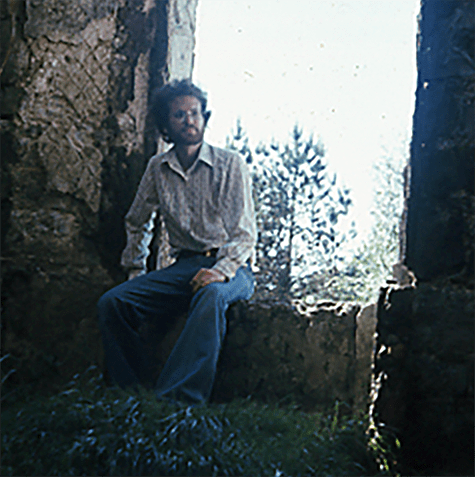
While searching microfilm reels to answer Claudette’s questions about particular words that make no sense in any language, I came across an image that likewise makes little sense, unless you were there.
It’s a photograph of me aet. 26, during my first visit to Moore Hall. I am sitting inside a window of the ruin, posing for my camera perched a few feet away.
You couldn’t have been there because I was alone. I took a train from Dublin to Claremorris; from there I hitchhiked to Muckloon. I was stunned that the local workmen who gave me a lift knew so much about the racehorses of the Moores a hundred years previous, but nothing at all about the writer.
After climbing into the house and taking this picture, I spent the night in my tent on the grass below the gated and locked front door. It was as black and silent as outer space! Unable to sleep, I got so agitated that I drank the wine and smoked the cigar that I planned to leave at George’s grave.
Just as well that I did, because the next morning was wet and overcast, and I couldn’t find Mr. Macdonald who, I was told, rented boats for rowing to the remote island grave in Lough Carra.
I walked and hitchhiked away from Moore Hall, promising George that I would be back. I have kept my promise.
Confession, Memoir, Autobiography
When I recently posted Vale in the GMi Shop, I finished making available all of George Moore’s published writing about himself, all in one place, all free.
These are the only editions whose readers can communicate with the editor and each other about what George wrote; and the only editions whose text is open for computerized textual analysis.
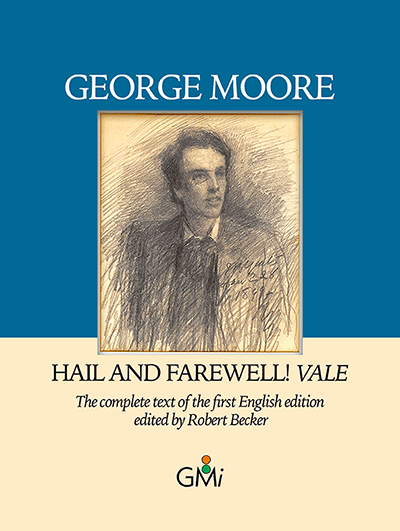
The cover of Vale has a portrait sketch by John Butler Yeats of his son William, drawn around the time that George Moore was (temporarily) enchanted by the great poet.
I chose this artwork partly because W.B. Yeats catalyzed George’s return to his native land for the Irish Literary Revival, but mostly because I previously chose similar drawings by JBY for Ave and Salve. They make a nice set.
That said, there’s a caveat. Edward Martyn earned his spot on the cover of Ave because George centered that book on their relationship. You cannot appreciate and enjoy Ave without taking Edward into your heart the way George did.
George Russell (Æ) earned his spot on the cover of Salve for the same reason. Each of the first two volumes of Hail and Farewell turns on a friendship of surpassing, intrinsic value to the author.
The person who actually earned a spot on the cover of Vale is not Yeats, but George’s brother Maurice Moore, “the Colonel.” Vale turns on their fraught fraternal relationship. The book is a candid testament to it.
By the time George published Vale in 1914, he was over the magic of Yeats. Nonetheless appreciative of Yeats’s poetry, but somewhat dismissive of the man and his performative charisma.
Though William Butler Yeats is not a pivotal foil in Vale, the way Maurice Moore is, he is nevertheless George’s persistent foil across all three volumes of Hail and Farewell.
Since John Butler Yeats did not draw a portrait of Maurice Moore, I felt sure that William Butler Years was the next best choice for the cover of Vale. I got to make a “set” though perhaps not perfectly.
And by the way, as an aside to Michael and Claudette, Chapter 7 of Vale opens with a discussion about Yeats and the modernist quest for literary opacity.
Speaking of Stéphane Mallarmé (and incidentally of Yeats), George wrote: “His phrases will never grow old, for they tell us nothing; the secret meaning is so deeply embedded that generations will try to puzzle through them….”
The proverbial search for immortality! Excuse me for yawning.
Me and Social Networking
Months ago while pondering the low visibility of GMi on the web, I posted that I would overcome my resistance, hold my nose, and join social networks in order to “get GMi out there.”
I thought I would, but I didn’t. I couldn’t. The Musk-Zuckerberg axis of evil has a stench that seeps into my pores even when my nostrils are blocked.
However, just the other day, I created an account on Bluesky Social, the reincarnation of Twitter that has no stench (so far); it comes off smelling like a rose.
I am trying it, hoping to connect with others whose interests I share. And maybe learn something nice about a world that is otherwise falling apart.
If you are, or choose to become, a subscriber on Bluesky Social, please connect with @beckermultimedia.bsky.social. That’s me! As of today I follow nobody and nobody follows me. Help me change that.

