
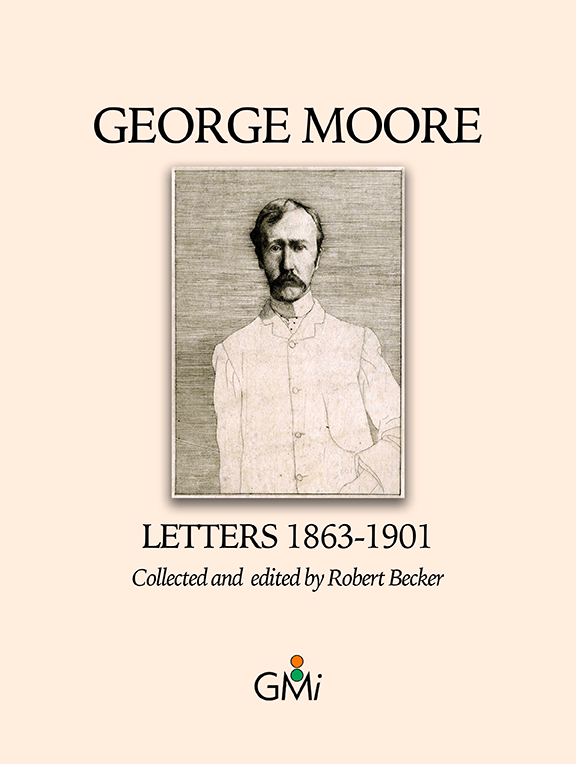
The cover of an ebook — 40 years in the oven and still not ready to come out — with a portrait of George Moore aet. 36 by William Strang (see Iconography). This etching was the frontispiece in an edition of Confessions of a Young Man where George admitted “Two dominant notes in my character — an original hatred of my native country, and a brutal loathing of the religion I was brought up in” (Chapter 7). Why do I find that endearing? It’s a puzzlement.
- I Crowdsource
- % Complete
- GMi Ebooks
- GMi Audiobooks
- Letters Launch
- Breakthrough Scanning
- By George he’s got it!
I Crowdsource
I believe in crowdsourcing; in particular the crowdsourcing of quality.
We know that quality can mean almost anything. Here it refers to the high fidelity of transcribed text to sources.
My sources are pages printed more than a century ago, that have aged ever since on the shelves of librarians and collectors. Sources are also handwritten sheets that were never printed, but likewise ossified in archives and attics.
The purported fidelity of my transcriptions is a promise of accuracy. A promise that the language I found on yesterday’s paper is accurately reflected in today’s digital media.
But transcription ain’t replication. The higher calling is to represent both evident and latent intentions in sources, not just copy them like a Xerox machine.
In more than 1,000 web pages on George Moore Interactive, I’ve gone a long way to assuring quality by adhering to Deming’s cardinal rules of process control. Every text of George Moore that you read on GMi is the outcome of systematic steps that should have prevented defects from creeping in.
Should, but not must. There’s no doubt in my mind that errors are present in what I have published.
That’s where crowdsourcing comes in. I admittedly publish imperfect texts that are as high in quality as I can make them, given my rapid pace of development. I am relying on the crowd — people who use the texts — to tell me when they suspect errors.
That’s why every GMi webpage (including this post) has its own comment box. When somebody reads something that doesn’t seem right, they needn’t wonder. They can leave a question or suggestion for me to investigate.
My vision, my design and development of George Moore Interactive are founded on a belief in crowdsourcing. The ultimate success of the mission hinges on it.
% Complete
George Moore’s literary legacy is being reconstructed for the digital age in seven august pillars. They are the main menu items listed on the GMi home page. Here’s a quick recap of where things now stand:
- Aesthetics: 80% complete
- Iconography: 100% complete
- Worlds: 10% complete
- Letters: 0% complete (see below)
- Bibliography: 100% complete
- Chronology: 0% complete
- Collections: 0% complete
By complete I don’t mean finished, dead and buried. Complete means “the best I can do until the crowd steps up to make GMi better.”
GMi Ebooks
My anticipated migration out of the Kindle Store has begun. Loyal fan of Amazon though I am, I have little respect for their ebook business.
Currently in the GMi Shop there are seven ebooks. Five are Apple Books and two are Kindle editions. I’ll soon create Apple Books to replace the Kindles so that all GMi ebooks can be downloaded from the store I prefer.
At the start of this migration, I decided to price GMi’s Apple ebooks as free. Why? It seems that charging even a small fee to download an ebook may create friction for potential readers while being inconsequential to me. It feels better to give the ebooks away.
Apple Books are not for everybody. To ensure digital rights management, they can be downloaded only to Apple devices (as far as I know). Remember though, the text of every GMi ebook is also available for free on the GMi website, in a different format.
The next ebook in the pipeline is A Communication to My Friends. Coming soon.
GMi Audiobooks
I had a dream that one day George Moore’s fine stories and essays would be released as engaging audiobooks. It may no longer be a dream. It seems to be happening.
During migration to Apple Books I stumbled upon technologies for generating audiobooks out of ebooks. Who knew this was possible? The audiobooks purportedly have naturalistic digital voices — not perfect, not famous, not Her — but not bad either. Moreover these generative audiobooks are fast and easy to make when a producer comes on board.
While I wait for Saoirse Ronan and Colin Farrell to get with the GMi program, I will proceed with this crazy AI alternative. GMi audiobooks performed by non-human, humanlike voices will not be free to download, but they will be reasonably priced and perhaps help me land George’s literary legacy more firmly in the digital age.
Letters Launch
Thanks to new and affordable scanning technology (described below), my work on the Letters pillar of GMi has begun. This pillar is designed to hold careful transcriptions of George’s 6,000+ extant letters: handwritten, typed, and printed between 1863 and 1933.
I located most of those letters around 40 years ago. The Letters of George Moore 1863-1901 was my unpublished doctoral dissertation at the University of Reading, England. I transcribed many more letters as an independent scholar at the Berg Collection of the New York Public Library, a postdoc at the University of Pittsburgh, and a naive professor at Emory University before deciding that I’d had quite enough of the ivory tower.
I suddenly stopped work, stored everything in the unlikely event that I would ever want to see it again, and went looking for a real life. (I found one.)
Before that extinction event of scholarly aspiration, all of my independent and academic work had been accomplished without a personal computer, without a printer or scanner, and without the Internet. I owned a portable Smith Corona typewriter, a desk and chair, a file cabinet; and honestly not much else. Bob Becker in those days bore a striking resemblance to Bob Cratchit.
So you may imagine my excitement and trepidation when I unboxed and organized my old files a few months ago, suspecting that the time for reviving the Letters was approaching. I spent many hours resurrecting my dormant analog office — minus the typewriter — so that I could once again see what I have, what I had created, what I needed to make sense of and work on.
I didn’t get far beyond that. I was stymied by a question: how can I digitize so many letters without doing what I generally hate to do: seek funding. George Moore Interactive is self-funded, but there is a limit to my generosity, even to myself. Making stuff and giving it away is deeply satisfying to me, but not rewarding. I didn’t wish to spend thousands more dollars to carry the letters of George Moore across the chasm into the digital age.
Instead I spent hundreds. Overhead scanners that I serendipitously discovered a few weeks ago triggered the first of two eurekas. I read about how they worked, marveled, settled on a make and model that seemed to fit the needs of GMi, and quietly murmured “Eureka?” After much anxious self-doubt of the too-good-to-be-true variety, I plunked down the cash.
Not an obscene amount of cash, because I would live on even if the scanner failed to live up to expectations. But I suffer from anti-early-adapter syndrome, which causes me to avoid purchasing bad shit because I don’t want to feel like a fool afterwards.
Anyway, I cleared space in my office for the scanner and it arrived the following week. It stayed in the box for a week after that, like a UXB, until my courage (fortified with single malt Scotch) returned.
Then in no time at all, the box was open, the tech was configured, the minimal documentation was read, and a test was conducted. “Eureka!” I exclaimed. The scanner does just what it’s supposed to do — that well, that fast, that easily.
What I had foreseen as a slow, expensive, cumbersome Letters project was transformed into fun and elegant. Many details must still be decided, about how to publish the letters in a way that complements the GMi mission, but those are good problems to have and to solve.
Breakthrough Scanning
The maker of my overhead scanner is a Chinese firm named CEZUR (pronounced caesar). They have a very light footprint in the United States, basically a warehouse on the West Coast, and that initially worried me.
Why aren’t they everywhere? Where are the resellers? How will I obtain service? My emailed questions were answered in English by HQ in China. To my satisfaction, though I still had doubts. Fear of the unknown.
The scanner is overhead rather than flatbed. An elevated arm floods the scanning platform (a black mat) with just the right kind and amount of light, from multiple angles.
An image of the targeted object appears on my computer screen. Using software controls I optimize the image and then press to scan it; pressing either a button on my screen, a button on my desk, or a pedal on the floor. That pedal expedites scanning of multi-part objects.
Anyone familiar with flatbed would be amazed, as I was, by the speed of this machine. Each scan takes about one second.

CEZUR ET24 Pro scanner configured by GMi for the Worlds and Letters pillars.
If the object I’m scanning is an open book (often it is), CEZUR software automatically corrects the position of the book and the roll of the pages. These two factors are death stars to optical character recognition, as I know from painful experience. Like magic, software makes a scanned object appear perfectly straight and flat on my computer screen, no matter how awry it is on the mat.
The magic continues with advanced OCR that transforms a two-page spread into separate consecutive pages. I can configure OCR for different languages.
The French language in many of George’s writings has been a minefield for me, because the conventional OCR I was using didn’t recognize uniquely French letterforms. That minefield is now clear. Electric sheep can graze there.
At last I batch export my optimized scans to Adobe PDF and Microsoft Word; the former is for reference images, the latter is to open in Apple Pages for initial editing (I prefer Pages to Word) before importing pristine text into Google Docs for final editing.
To those who have never suffered the technical woes of flatbed scanning or the time and expense of outsourced book scanning, this overview may seem trivial and boring. Everybody else may stand up and shout “Hail CEZUR.”
By George he’s got it!
I have previously mentioned A.O. Scott of the New York Times. He was formerly a movie critic, now he’s a literary critic of exceptional ability. Like Fintan O’Toole in the New York Review of Books, he never fails to write well, no matter what the topic, and he always writes things that I find interesting if not inspiring. Take for example this quote from a book review:
“She belongs in an as-yet-undefined and perhaps undefinable class of prose artists who blend feeling and analysis, speculation and research, wit and instruction as they track down the elusive patterns and inescapable contradictions of modern experience.” 1
I wrote to Mr. Scott after reading his startling review, explaining that George Moore was a member of the distinguished class, perhaps even a founding member. He replied by assuring me that George is now on Anthony’s reading list!
I hope George won’t disappoint. Given Anthony’s exquisite taste, I doubt that he will. Because George wrote about himself, before Anthony or I were born, anticipating that we would someday come along:
“Other men write for money, or for fame, or to kill time, but we are completely disinterested. We are moved by the love of the work itself, and therefore can make sacrifices….” Hail and Farewell! Ave, (London 1911, page 73).
Ave is now a free download in the GMi Shop.
- “An Ode to Gardens That’s Also a Bouquet of Idea,” by A.O. Scott in the New York Times, reviewing The Garden Against Time: In Search of a Common Paradise, by Olivia Laing. ↩︎
