
Hi Reader. This post comes from George Moore Interactive. As usual there are bits and pieces of project news. Please subscribe to receive notifications.
Westport House
The Places gallery of the Iconography of George Moore tells an emerging story about Westport House in County Mayo, Ireland.
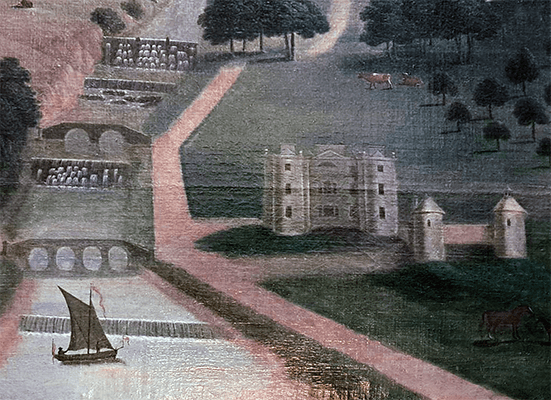
Westport House was the ancestral home of Louisa Browne Moore (d. 1860); Louisa was the author George Moore’s grandmother. Her father-in-law, the author’s great grandfather also named George (1729-1799) seems to have painted Westport House in 1761, while he was living nearby at his family estate of Ashbrook. Decades later, after retiring from business in Spain, he created the new demesne of Moore Hall with his considerable fortune. Moore Hall is where his grandson the author was born in 1852 and buried in 1933.
Was that confusing? Here is a birds-eye view of the Moore family tree reflecting movement from Ashbrook to Moore Hall.
I said the great grandfather seems to have painted Westport House because there are two landscape pictures hanging there that are are signed G Moore and dated 1761. A daughter of the eleventh Marquess of Sligo, the artist Sheelyn Browne who grew up at Westport House, remembers her father identifying the painter as a Moore of Moore Hall (so-called starting in 1795; before that, of Ashbrook).
As told in the Iconography, I haven’t found documentary evidence for my attribution of the paintings, but I think it’s plausible. I know of no other G Moore who was close enough to the Brownes to paint their home and create a family heirloom!
Okay, fine, but is the attribution important? I think it is, because it suggests (however faintly) that a century later the author George Moore’s aberrant ambition to become a painter, and his lifelong passion for the visual arts, was an inherited characteristic — likewise inherited by his father before him.
LitCrit
“The fact that he is something of a storm-centre for criticism lends additional interest to his views.” So said the Freeman’s Journal about George Moore in “The Irish Literary Theatre,” 13 November 1901.
In recent weeks I have transcribed several more essays of George Moore’s literary criticism, including the one just quoted, from horrendously muddy facsimiles provided by Newspapers.com and the British Newspaper Archive. These photo images are readable, often just barely, by a diligent human like me but not by a machine — even a smart machine like Textract; hence without manual transcription the essays cannot enter the digital age.
(Cue the trumpets) Stand back everybody, the essays are coming…!
Of course I am biased, but George Moore’s essays — even when pulled out of the mud and laboriously cleaned — are consistently edifying and enjoyable. For example, many essays describing his passion for theater are profoundly original and consistent over the decades they were written.
As the essays begin to circulate online after years in archival limbo, I hope that folks who are interested in the Abbey Theatre in Dublin, and the National Theatre in London, will learn a little something new about origin stories. George Moore was among the builders! Likewise I want fans of W.B. Yeats — Fintan O’Toole, I’m looking at you — to read Moore’s criticism for a greater appreciation of why Yeats collaborated with him. The tail didn’t wag the dog!
Avowals
In my previous post I wrote that Avowals would be the next book in the Worlds pillar of George Moore Interactive. I messed up. Not remembering Avowals accurately, I assumed it was worldbuilding, but only two of its sixteen chapters are; all the rest are literary criticism.
So for that reason, Chapters 12 and 15 of Avowals are now in the Worlds pillar of GMi; the others are in the Aesthetics pillar as literary criticism of 1919 (the year that Avowals came out). A GMi Kindle edition of Avowals, all 107,000 words, will be published later this month.
Next up in the GMi canon: Conversations in Ebury Street. I expect this book to contain only literary criticism for the Aesthetics pillar and Kindle edition. I may be mistaken. Stay tuned.
By the way, the difference between worldbuilding and criticism was not scrupulously managed by Moore. He tended to mingle genres and not stay in his lane in his writing projects.
So just to be clear: the Worlds pillar of GMi is for George’s imaginative worldbuilding. The Aesthetics pillar is for his philosophy of art, which I have divided into art criticism and literary criticism.
You could say that Worlds is subjective (interior, fictional) writing and Aesthetics is objective (exterior, factual) writing. Not sure that’s always true but it may help GMi readers to perceive the difference though the author himself sometimes ignored it. His memoirs are especially tricky.
One Voice
To me one of the endearing qualities of George Moore is his voice. I find his writing voice to be personal and personable, genuine and candid, coherent and confident, conscientious and consistent, fresh across genres and decades. George the writer was a cool guy.
But what about his speaking voice? How did the living George sound in conversation? I don’t know, and that needs to change.
This project is heading towards George’s re-animation as a life-like character in this website; one who will spontaneously discuss topics with visitors, about his world and theirs.
Sounds like a lot of fun, but how good can it be if the new digital voice doesn’t even try to sound like the actual man?
I will to try to make the written and spoken voices sound alike, and there’s a good chance I’ll succeed. There are two complementary ways forward for re-animating George Moore with one authentic voice.
One way is to use the linguistic resources in George Moore Interactive to fabricate speech that says things the way George did, and would if he were still alive. A voice that gets his idioms, grammar and semantics right.
Another is to sample voices of living human beings whose identity and background have something in common with George’s, and letting a vocal simulation emerge by averaging the samples. Getting his timbre, tone, pace and pronunciation right.
Gathering and averaging samples is necessary because there are no extant recordings of George Moore speaking, at least none that I know of.
However the technologies for synthesizing his voice do exist at companies like Elevenlabs and OpenAI. Here’s what is going to happen with their help:
- GMi will synthesize a voice that simulates the historic George
- That synthetic voice will converse with visitors using generative AI
- The voice will also perform published texts (e.g. Avowals) on command
- And later it will dialogue with other re-animations (Wilde, Joyce etc.)
If you imagine yourself in a three-way conversation (not a chat) with George Moore and William Butler Yeats, you can see the future approach. Fast.
Relevance
I mentioned earlier how Moore’s voice continues to resonate despite the years that have passed since he died. Here’s an example of his rhetoric that snagged my attention in one of those muddy facsimiles:
“People who begin by believing absurdities are soon ready to commit atrocities.” Mr. George Moore on Ireland. The Observer, 29 September 1918.
That aphorism was coined more than a hundred years ago. Here in stop-the-steal USA in 2024, I can totally and anxiously relate. It is so now!
A lot more now is in the pipeline.
Letters to the Editor
I mentioned in an earlier post that letters to the editor would be included in the Letters pillar of George Moore Interactive, and that is true. However I have decided to double-post them in Aesthetics as well, because that is where a large part of their context lives. This process has already begun.
Get Involved
At some point more people like you may become involved with George Moore Interactive. The project is large enough to welcome them, and offer meaningful ways to help.
To that end, here is a Volunteer page where they can step up, if they feel like it. The page lists several ways to donate their time, including “other” if they want to add a new one.
And here is a Donate page for those who have more money than time to spare. Their donations would pay for technical services that are required to build this site (already 900 web pages and growing).
And finally here is a Shop page that announces a commercial initiative. Eventually it will open into a bazaar for themed merchandise and experiential services like education and travel. Buyers and sellers welcome!
See you next time!

2 responses to “One Voice”
Hi Bob,
I was interested to see the painting attributed to G. Moore. As you say, it’s very plausibly by GM’s great grandfather and what makes me think so is the similarity to paintings of Ireland in that period by Gabriel Beranger and Francis Grose. All of them have a hint of architectural draughtsmanship, with a touch of the local and sometimes a little odd or dubious perspective. You can find Beranger pics in various places but perhaps look at Beranger Watercolours – UCD Special Collections https://www.ucd.ie/specialcollections/archives/beranger/ where on the opening page, there is one drawing. The rest of the site only provides a list of the holdings. The style of painting homes, castles, churches at the end of the 18th century in Ireland and Britain, both amateur and more professional, was much less romantic or elaborate than in the following century.
Best wishes,
Mary
LikeLiked by 1 person
Thank you Mary, I only just found your comment from back in June. Thanks for the pictorial references. Not sure if I already mentioned this, but I brought the paintings at Westport House to the attention of the National Gallery of Ireland. A curator there Niamh MacNally (nmacnally@ngi.ie) was intrigued!
LikeLike