
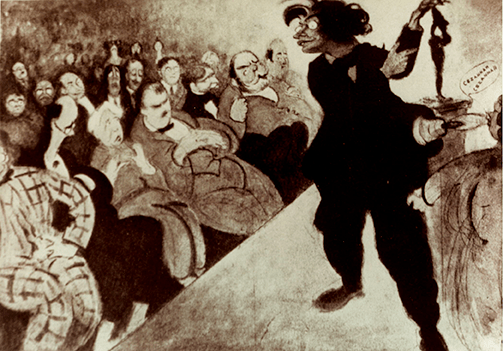
From The Unknown God (1911), by Henry Tonks, caricaturing art critic Roger Fry giving a lecture about post impressionism to an audience including George Moore, St. John Hutchinson, D.S. MacColl, William Sargent, Walter Sickert, and Philip Wilson Steer. Moore’s facial expression and raised hands betray surprise and dismay, probably because Fry is demonstrating his aesthetics with a dead cat. Published online with interesting notes by JSSgallery; also published in Joseph Hone, The Life of Henry Tonks (1939) and Martha Kapos, ed. The Impressionists and Their Legacy (1995). Present whereabouts unknown.
In a newspaper column (The Speaker, London, 20 January 1894, pages 73-74) George Moore defended his admittedly naive appreciation of art against “the imposture of the expert.” He pushed back against authorities who trade in “preposterous theories.” Nitpicking by geeks in aesthetics did not please him! He rejected it wholesale, going so far as to claim that he — an aesthete grounded in direct sensory perception — is right even if/when he may be technically wrong.
I was reminded of this ‘chagrin of the amateur’ when I reviewed documentation about a portrait sketch of George Moore in the Ashmolean Museum. One distinguished expert — Ronald Pickvance — had publicly attributed the sketch to Edgar Degas; another — Theodore Reff — quietly challenged Pickvance for what seemed (to me) like no good reason (in a word: hubris).
In my Iconography of George Moore, I side with Pickvance because I believe his attribution is correct; but the Ashmolean sides with Professor Reff because… well I don’t know why. Perhaps because “preposterous theories” can bend a curve when they come from an expert. Moore believed that kind of thing happens all the time.
Now that I’m well along in salvaging all of Moore’s art criticism (under a banner of Aesthetics), it may be a good time to raise the question: Why bother? is Moore’s vintage art criticism worth the effort? will making it useable in the twenty-first century kickstart his literary legacy? Or should his art criticism be left to rot in the analog mausoleum where it’s hard to find, hard to read, and impossible to analyze — or even use efficiently?
I hesitate to broach this question because it sounds scholarly, and mine is not that kind of project. I am wholly committed to making the writer himself — his life and work — more accessible, integrated and dynamic; to bringing him back to life, so to speak, come what may. I am not promoting a thesis about him, nor do I care much about others’ theories — preposterous or otherwise.
It may be observed that scholarship in the humanities typically shifts attention from authentic engagement with content to intellectual hobbyhorses; and I am very wary of doing that. Moore himself can empower readers to form thoughts about his legacy; he doesn’t want or need exegesis. I certainly don’t wish to come between him and them as an “expert.”
That said, I’m using this post to address the question: is Moore’s art criticism now worth the effort? Spoiler alert: It is. His essays are delightful and meaningful on several levels, from style to ideation. That being my personal opinion, the project is making it easier for others to form their own.
Others in this case cannot include the late Douglas Cooper, an art historian and critic, collector and curator, who vouchsafed his view of Moore’s art criticism in an article named George Moore and Modern Art (Horizon, A Review of Literature and Art, ed. Cyril Connelly, London: Vol X1, No 62, February 1945, pages 113-130).
The tiny community of interest centered on George Moore always laments the passive neglect he suffers. Douglas Cooper was not a member of that community and not one to neglect; he vigorously assaulted Moore’s legacy.
To take Cooper the expert at his word, Moore’s art criticism and, moreover, his eyes and brain and ethics, were irredeemably defective. Cooper’s tone is supercilious and condescending when he explains this, as though he nursed a personal grievance of some sort. However he seems to have trained that attitude on many others during his combative lifetime, so it’s best not to take it as a unique response to Moore.
According to Cooper, George Moore was a twerp: uneducated, uncultivated, inexperienced, insincere and chronically devious; a liar and a plagiarist; a fop and a poseur. Cooper asserted that Moore’s art criticism doesn’t rise to the level of aestheticism, so my calling a pillar of this project Aesthetics makes me as dumb as Moore. I am in effect promoting a fraud.
To Cooper, Moore’s essays betray a “lack of any positive or connecting theme, of any standards or principles consistently applied. They merely skim the surface of art without ever being penetrating or profound, without ever expressing a conception. Indeed it is impossible to extract from them Moore’s artistic philosophy (if he had one!) as their spirit is largely negative, a denying rather than an appraising of art.”
Gosh! If Cooper was right about that, Moore was his kindred spirit! But he was not right; and the explicit claim of Moore’s art criticism — really his only justification for writing it — was to set forth his aesthetics as a consistent, coherent system which he unfolded in public over a period of several years.
A clue to Cooper’s animosity towards Moore is in the title of his article, George Moore and Modern Art. “Modern” here is more or less equivalent to Cooper’s “great artistic renaissance” of French impressionism. He claimed that Moore’s view of impressionist art was shallow and dead wrong; that Moore merely parroted what he heard “experts” say about it, often not understanding what he wrote and haphazardly screwing it up.
Cooper claimed that Salon painters such as “Cabanel, Lefebvre and Bouguereau had all his admiration”; that “Moore proudly allied himself with the philistines”; and that he visited the studios of French impressionists merely to stalk women rather than consort with artists he admired.
It is true that Moore wrote hundreds of articles of art criticism, most of them reviews of exhibitions in London and Paris. As a columnist he wrote to deadline, not only about the great unwashed of impressionism, but also about far more numerous and influential artists of the day who controlled and skewered the art market.
Much of Moore’s criticism of them is “negative” and “denying” because he loathed their pictures and what they stood for. When he wrote about impressionists, on the other hand, he did so thoughtfully, critically, candidly — not as a fanboy or propagandist. His appreciations of them and other modernist artists are very positive and constructive, but never fawning.
Cooper on a rhetorical roll claimed that “despite the reality of [Moore’s] contacts with the Impressionists, his natural cheap taste remained unaffected and his understanding limited.… If Moore ever had enjoyed any pictorial receptivity, it had already withered by the age of 34” — that is, by 1886, a peak year of the purported “renaissance,” before Moore started a position as one of London’s leading art critics.
OMG, “the imposture of the expert”; it’s so obnoxious! Reminds me of peer reviews (just kidding).
I often find Moore’s writing on art witty and amusing. Cooper’s is neither; nor it is truthful. But one quizzical detail in Cooper has stayed with me after flushing all the rest.
It’s that Cooper discussed the fictional artists named Marshall (Confessions of a Young Man) and Lewis (A Modern Lover; later titled Lewis Seymour and Some Women). But he never mentioned the name of the real symbolist painter this character was based on, Moore’s friend Lewis Welden Hawkins. I suppose the reality of Hawkins didn’t sync with the polemic of Cooper.
If this were a conference paper, I would be making a point-by-point refutation of practically everything that Douglas Cooper wrote in George Moore and Modern Art. And what would that have accomplished? One so-called expert fencing with another for the entertainment of other experts with their own bones to pick. Not fun.
Thank goodness this is not a conference paper; it’s merely a too-lengthy blog post, offering my unequivocal answer to the question: is Moore’s art criticism worth the effort? You have my answer; it’s not Cooper’s and not yours.
You’ll have the opportunity to judge for yourself with a complete interactive archive of Moore’s Aesthetics. Wait a little longer and you’ll also be able to ask a generative George Moore about the art he loved and the art he didn’t like, and about the always vital voice of the amateur in criticism.
“There are too few amateurs among us,” lamented George Moore (Saturday Review, 22 December 1894, page 679). When James McNeil Whistler famously ribbed him about posing as an art expert, both knew that was silly. Douglas Cooper did something similar, only he wasn’t kidding. The damage Cooper did to Moore’s reputation was thankfully limited to fellow “experts.” It won’t last much longer.
