
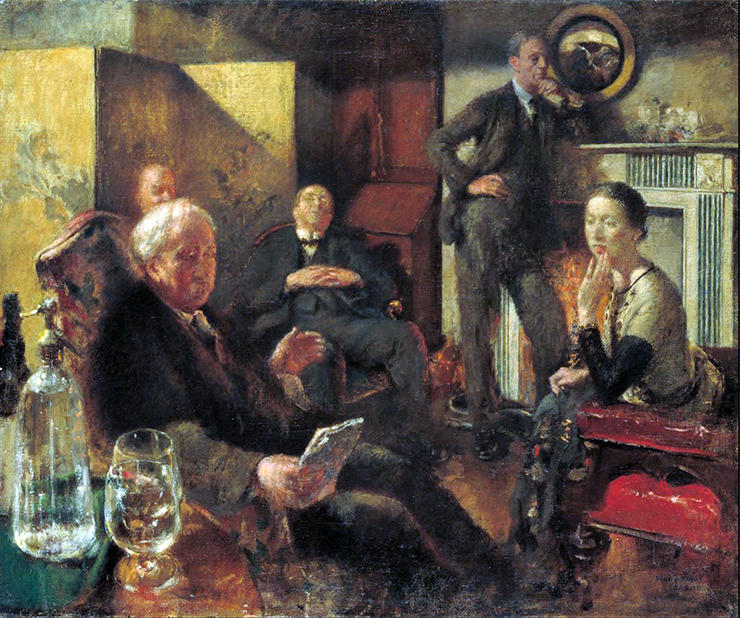
Saturday Night in the Vale (1929), by Henry Tonks. Commissioned by Irish painter William Orpen and bequeathed by him to the Tate Gallery (London). Also see Orpen’s Homage to Manet (1909) in the Manchester Art Gallery. George Moore is in the foreground on the left side of the picture, reading aloud from the manuscript of his novel Aphrodite in Aulis to friends (from left to right) St. John Hutchinson, Philip Wilson Steer, Henry Tonks and Mary Hutchinson. It was customary for Moore to “think out loud” and share his aesthetics for feedback (the target of an epigram by Oscar Wilde). He would revise right up to and beyond the launch of his books! He was also known for giving candid feedback (not always welcome). For example, he said that Henry Tonks, who spent a year painting this picture, made the distinguished author look like a “flabby old cook.” Moore’s raised hand is a typical gesture, often caricatured by Max Beerbohm.
Hi Reader! In the past few months I laid digital foundations for two pillars of George Moore Interactive: Iconography and Bibliography. That means I have optimized imagery and text for eventual integration with a relational database. Scrubbing the data will continue indefinitely of course, but that work is developmental rather than foundational.
As Joan Webster would say on the Isle of Mull, now I really know where I’m going!
It’s time to move the foundational focus to Aesthetics. That’s a pillar of George Moore’s candid, deeply felt, much discussed, sometimes ridiculed, often misunderstood and overlooked philosophy of art.
For now, this pillar concerns just the visual arts, not the other arts in which he was also heavily invested: namely the dramatic, musical, and literary. They will come to the fore a bit later in this project.
Aesthetics consists of 224 articles Moore wrote for many periodical publications in England, Ireland, France and the United States, including a handful that he afterwards collected in books.
I have already obtained “rough” digital scans of the articles. These are photo images of pages, processed with optical character recognition, saved in PDF format. They are somewhat readable by humans, not so much by machines because of peculiar typography and page layout, and dirty physical source media. “Dirty” means showing the wear and tear of age.
Still, I’m happy to have the rough scans (and actually amazed that they even exist thanks to Google Books and similar enterprises).
I have just benchmarked one of Moore’s articles in order to estimate my scope of work in building a complete foundation for the pillar. The article is named Art for the Villa; it’s in the Magazine of Art (London) for July 1889 on pages 296-300. Moore later chose it as a chapter in his book Impressions and Opinions in March 1891.
There are 4,066 words in the first publication of Art for the Villa. This is a relatively long article by George Moore; his typical weekly columns were around 1,700 words.
I spent 3.6 hours transforming the rough scan of Art for the Villa into a Google Doc, a format that nicely supports textual analysis and development. (I converted the bibliography of George Moore into Google Docs for the same reason, though in that case the scan was “clean” because I commissioned it.)
Thanks to aforementioned peculiarities and dirt in Art for the Villa and other articles, I had to invent a process for crossing the chasm from lousy analog to pristine digital text, one that doesn’t necessitate outrageous amounts of manual labor.
In my first draft of this post, I outlined a process. It worked and then it didn’t. Turned out that my initial benchmarking was flawed; it assumed that all rough scans are similar and comparable. In fact, each of the scans is so different from the others that it has to be handled as a unique challenge.
Using Art for the Villa and several other scans as a measuring stick, I estimated it will take less than 600 hours to convert all of Moore’s articles on Aesthetics into pristine Google Docs; that’s about 150 work days at my leisurely pace.
(Actually the pace isn’t leisurely, but it takes a while to build a foundation of this kind because I can spend only part of a day doing it. This is a marathon rather than sprint! Much better for maintaining a sharp focus.)
The yield of these 600 hours will be a Google Doc that faithfully represents the text of a rough scan of each Aesthetics article minus its problems and dirt. Each Google Doc will be formatted for pleasant human viewing on screen, for textual analysis, for machine learning, and for integration with a database.
As I cross the chasm for Aesthetics in the coming months, I will retain the original British spelling and formatting of words, retain the punctuation of the original publication; replace paragraph indents with skipped lines; and eliminate line breaks that were forced by printed page layout. All of this for readability and usability. Moreover I will introduce a consistent style sheet that I inaugurated in Art for the Villa.
This foundational work on Aesthetics doesn’t include developmental tasks such as illustrating the articles with pictures Moore critiqued, inserting internal and external links, and appending explanatory notes. Those will be performed later, when the foundation is hard and strong, and it will continue indefinitely because the canon of George Moore will never again be constrained by the paper it is printed on or an app it is conjured with. The canon will continue to absorb developer and user enhancements in the cloud, more or less forever.

2 responses to “Aesthetics”
Most interesting Bob. I have now persuaded all my virus protectors to let me read ALL of a blog rather than wh
LikeLike
Thank you for reading the posts Mary. It means a lot to me.
LikeLike