
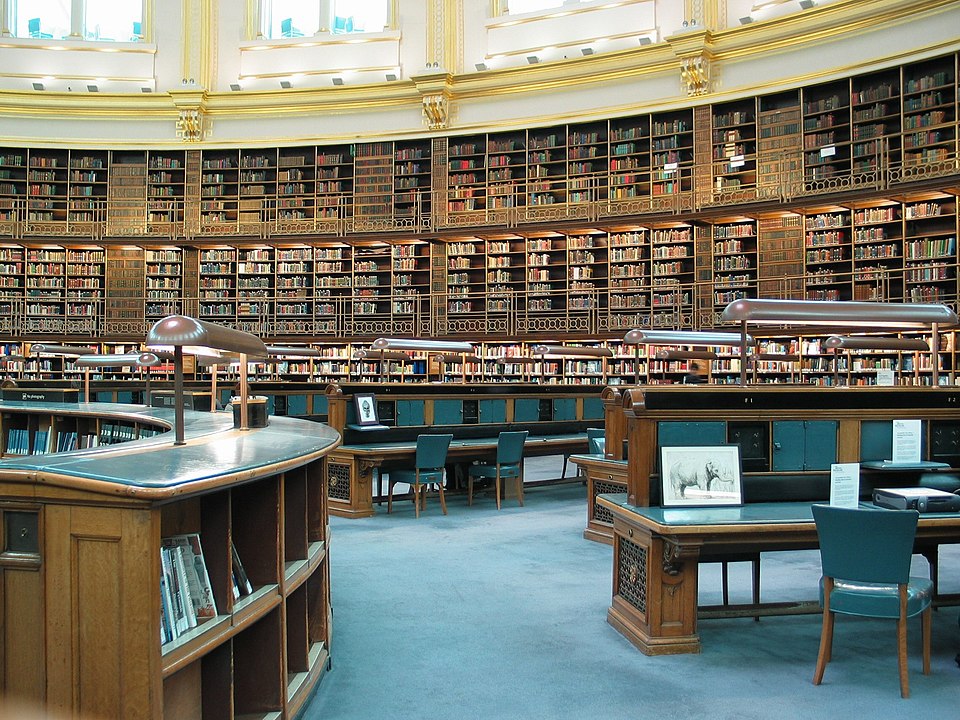
Many other days with the canon were spent at the British Library’s Newspaper Section in Colindale, west of London. The Newspaper Section was relocated about ten years ago; its massive archives are being digitized for easier access. The building where I hunted for quotidian scraps of the canon was demolished in 2015.
Hi Reader! Not many people choose to read or collect or study books by George Moore. That was true 50 years ago when I read one for the first time. It’s still true today.
I’m contrarian dyed-in-the-wool, so I’m always intrigued rather than repelled by neglect and obscurity of the Moore canon. The books of more popular authors may be seen as carefully landscaped public gardens with paved signposted paths and name tags in the beds. Moore’s works by contrast are terra incognita: quiet, dark and mysterious highland that invites me to explore on my own.
I started exploring the Moore canon not because it was quiet or dark or mysterious. The first novel of his that I read, Esther Waters, triggered a kind of ebullient epiphany. After years of studying nineteenth century British and American literature, I was suddenly enchanted by the young, self-actualizing man of wax. His novel seemed (and still seems) incontestably brilliant. I got that impression again and again, year after year, as I read and researched more of his canon.
I didn’t explore the canon to untangle its obscurity or pry open its literary conceits, as scholars do with some modernist legacies. I reveled in its overlooked truth and beauty! By the time I entered it, this terra incognita had been mapped in A Bibliography of George Moore (1970) by an eminent “cartographer” Edwin Gilcher (1909-2002). (You can read a biographical sketch of this improbable, wonderful man online.)
Edwin mapped the Moore canon without a computer or the Internet. That seems incredible to me now, given the technical and economic obstacles he had to overcome. He was not a professor or a trained bibliophile; he created his masterpiece over several decades without institutional funding or the freedom of sabbaticals. He was the ultimate Energizer bunny.
Recently I converted his “map” of the Moore canon into Google Docs, a step towards publishing an updated, interactive edition of his bibliography. That process of conversion has increased my appreciation of both map and maker. It helped me grasp Moore’s canon by the numbers.
The canon is pleasantly diverse and balanced, casting Moore the novelist more broadly as a distinguished man of letters. The books — the yield of a writing career that spanned more than 50 years — manifest in seven genres:
- Long fiction — 19 volumes
- Essay — 12 volumes
- Play — 10 volumes
- Short fiction — 9 volumes
- Autobiography — 7 volumes
- Letters — 7 volumes
- Poetry — 6 volumes
That’s a total of 70 books and pamphlets, more than the 68 that Edwin counted because he treated the trilogy Hail and Farewell as one book, whereas I see it as three books published separately at different times and with different titles.
Boundaries between the genres are permeable, since Moore invented (or re-invented) autobiography as a literary form: aesthetic rather than historical enterprise. That said, his autobiographical writing is neither fiction nor nonfiction; it is worldbuilding.
There are 329 editions of the 70 books and pamphlets by George Moore, including primary texts of unique writing and secondary texts of reprinted writing. Counting only first editions that contain only unique writing, there are 15,031 pages in the Moore canon.
I have not yet summed the revised pages in editions that superseded the first editions (Edwin counted them). Assuming that Moore messed with 20% of his original pages (a reasonable conjecture given his penchant for fussing), the total number of unique pages in the canon may be circa 18,000.
To this total I should add 697 pages of George Moore’s writing in the books of other authors. Edwin called this Contributions. They are spread across 60 volumes and pull the total closer to 19,000 pages.
Aside from books and pamphlets, the canon of George Moore includes at least 693 articles in newspapers and magazines. I haven’t tried to count their words or pages, but once the canon as been fully digitized and databased, machines will perform those calculations in seconds. The sums will be large.
I should also mention translations since they are technically part of the canon. There are 62 published translations of Moore’s writing into 13 languages. That I know of.
I confess that what I know now isn’t nearly enough. It reflects my assessment of a bibliography that was published in two volumes: a Bibliography in 1970 and a Supplement in 1988. Ergo all that I’ve written here about the canon is what Edwin knew 35 years ago!
My next steps in this pillar of George Moore Interactive will bring matters up the present. In particular:
- I must gather bibliographical entries that Edwin wrote in 1988 but didn’t publish. He said in his Supplement that this data should be included in a new edition of the Bibliography. Now’s the time.
- I must gather bibliographical entries that Edwin wrote from 1988 until 2002. According to his family, he continued his research, with the same passion, after his last publication until the end of his life.
- I must identify publications between 2002 and 2023, a period of 20 years that may yield more editions. I am not a bibliographer by training or inclination, but I shall act like one to get this done.
The notes referenced in tasks 1-2 are almost certainly among the Gilcher papers at Arizona State University Library. Locating them may require a bit of effort, but at least I know where to start.
Publications after 2002 must be identified the same way that Edwin would have done it, by sniffing them out, but with the help of technology that he mostly didn’t have.
Terra Incognita
Having called the canon of George Moore terra incognita, I want to reward any reader who has come this far with a poem of that title by D.H. Lawrence, a modernist peer of George Moore. It’s one of my favorites.
Terra Incognita, by D.H. Lawrence (1885-1930)
There are vast realms of consciousness still undreamed of
vast ranges of experience, like the humming of unseen harps,
we know nothing of, within us.
Oh when man has escaped from the barbed-wire entanglement
of his own ideas and his own mechanical devices
there is a marvellous rich world of contact and sheer fluid beauty
and fearless face-to-face awareness of now-naked life
and me, and you, and other men and women
and grapes, and ghouls, and ghosts and green moonlight
and ruddy-orange limbs stirring the limbo
of the unknown air, and eyes so soft
softer than the space between the stars,
and all things, and nothing, and being and not-being
alternately palpitant,
when at last we escape the barbed-wire enclosure
of Know Thyself, knowing we can never know,
we can but touch, and wonder, and ponder, and make our effort
and dangle in a last fastidious fine delight
as the fuchsia does, dangling her reckless drop
of purple after so much putting forth
and slow mounting marvel of a little tree.
From the posthumous More Pansies (1932)
